Why Your Carpet Still Feels Damp (And How To Tell If It’s Actually Dry)
TL;DR: Your carpet can feel bone dry while the underlay underneath is still soaked, which is the perfect environment for mould. Your hand cannot tell the difference between cool and damp, so a moisture reading is the only test that counts. In Brisbane’s humidity, fans alone won’t work: you need extraction and dehumidification to get the room below 60 per cent relative humidity. Clean water gives you 24 to 48 hours before it turns grey, while sewage or floodwater means the carpet and underlay come out immediately. This page covers the layer everyone misses, how to verify what is actually dry, and why so many DIY jobs fail a week later.
In This Article
- Why Your Carpet Feels Dry When It Isn’t
- The Five Things That Decide Whether Your Carpet Dries
- The Mistake Most People Make
- Signs the Drying Has Failed
- How To Tell Whether Your Carpet Is Actually Dry
- The Drying Sequence That Works, And Where DIY Breaks Down
- What A Normal Drying Curve Looks Like
- When DIY Is No Longer Viable
- How We Can Help
- Frequently Asked Questions
Your carpet feels dry. You’ve had the fans running for two days, the room smells fine, and you’ve already pushed the lounge back into place.
Then a week later, it hits you. That musty smell in the corner. A dark tideline along the skirting. You lift a corner of the carpet and the underlay underneath is cold, black and damp.
The carpet wasn’t dry. The surface was.
This is the single most common thing we see on the job. People dry the top of the carpet, feel it with a hand or a bare foot, and call it done. But carpet is a layered system, and the layer holding the water is the one you can’t see or touch. That’s the layer that grows mould.
Here’s what’s actually happening under your carpet, how to tell whether it’s genuinely dry, and what to do when it isn’t.
Why Your Carpet Feels Dry When It Isn’t
Carpet is not one material. From the top down, you have:
- The pile (the fibres you walk on)
- The primary backing (what the fibres are tufted into)
- The secondary backing (the layer glued underneath)
- The underlay (foam, crumb rubber or felt)
- The subfloor (timber, particleboard or concrete)
Water moves down through that stack. The pile is thin and open, so it gives up moisture fast. Airflow across the surface dries it within hours, sometimes less.
The underlay is the problem. Foam and crumb rubber underlay are built to hold air and cushion weight, which means they’re also built to hold water. A saturated underlay can hold moisture for days after the pile above it feels completely dry.
And here’s the part that catches people out: your hand is a terrible moisture meter. Skin reads temperature as much as wetness, and a cool, dry carpet feels identical to a cool, damp one. The only reliable test is a reading, or a corner lifted up to look at the underlay directly.
The Five Things That Decide Whether Your Carpet Dries
Drying isn’t a fixed number of days. It’s the product of five variables, and if any one of them is wrong, the job stalls no matter how long you run the fans.
1. Where the water came from
This decides everything else, including whether the carpet should be dried at all.
The restoration industry classifies water into three categories under the ANSI/IICRC S500 standard:
| Category |
What it is |
Examples |
| Category 1 |
Clean, sanitary water |
Burst supply pipe, bath overflow, hot water system failure |
| Category 2 |
Grey water, significantly contaminated |
Washing machine discharge, dishwasher leak, aquarium break |
| Category 3 |
Grossly contaminated |
Sewage backflow, toilet overflow with waste, ground floodwater |
Two things follow from this that matter to you as a property owner.
First, category 1 water doesn’t stay category 1. Once it sits in carpet and underlay, picking up organic material, it degrades to category 2 within 24 to 48 hours. That’s the clock you’re racing.
Second, porous materials soaked by category 3 water aren’t dried. They’re removed. Under the S500 standard, carpet and underlay that contact grossly contaminated water come out, because no amount of drying makes them safe.
That’s why the water source is the very first question we ask. It changes the entire job.
2. Your carpet type and construction
Not all carpet behaves the same way when it gets wet.
Wool absorbs a lot of water and holds it. It’s also prone to shrinkage and to losing its shape if it dries unevenly. Wool takes longer and needs more careful control.
Synthetic fibres (nylon, polyester, polypropylene) take on far less water in the fibre itself. The pile dries faster. The water still sits in the backing and underlay though, so synthetic carpet doesn’t get you out of the underlay problem.
Loop pile holds water differently to cut pile. Loops trap moisture at their base, and a soaked loop pile can stay damp at the root while the tips feel dry.
Rubber-backed carpet is the tricky one. The rubber layer is a vapour barrier, so water that gets beneath it has almost no way to escape upwards. Trapped moisture under rubber-backed carpet is a classic cause of a persistent musty smell that nobody can trace.
3. The underlay
Underlay is where the real fight is, and different types behave differently.
- Foam and urethane underlay soaks up water and, once wet for long enough, starts to break down and crumble. Dried out, it can be left powdery and flat, which means it’s lost its cushioning job even if it looks fine.
- Crumb rubber doesn’t absorb much into the material itself, but the water sits in the gaps between the crumbs. It’s slow to release.
- Felt and fibre underlay absorbs heavily and dries slowly.
Underlay wet from clean water and caught early can be dried in place. Underlay soaked by grey water, sewage or floodwater, or left wet for days, gets replaced. It’s cheap compared to carpet, and replacing it is the difference between a clean room and a room that smells damp every time it rains.
4. What’s underneath the carpet
The subfloor decides how the last part of the job goes.
Timber floors, including the raised floors under a Queenslander, are common across Brisbane. Wet timber needs to dry slowly and evenly, because drying it too fast causes cupping and gaps.
Particleboard is the one to worry about. It swells when it gets wet and doesn’t go back. If water has reached particleboard, you’re looking at replacement, not drying.
Concrete slabs don’t absorb water, but they give it up very slowly. A slab holds moisture against the underside of your carpet for weeks. This is the single biggest reason a carpet on slab reads dry on the surface and still moulds.
5. Airflow and humidity, the Brisbane factor
Here’s where local conditions matter enormously.
Bureau of Meteorology records for Brisbane show mean relative humidity of 69 per cent at 9am and 60 per cent at 3pm in February, with February rainfall averaging 158.3mm and March averaging 140.7mm.
Mould needs relative humidity above roughly 60 per cent to get going, sustained over time. On a wet surface, growth can start within 24 to 48 hours.
Read those two facts together and the problem becomes obvious. In a Brisbane summer, the outdoor air is already sitting at or above the humidity level mould needs. Opening the windows and letting the breeze through doesn’t dry your carpet. It brings more moisture in and holds it there.
This is why fans alone fail in South East Queensland. Air movers do the first half of the job: they lift moisture off the carpet and into the air. But that moisture has to go somewhere. If the air is already loaded, evaporation slows to a crawl and the room just gets muggy.
The second half of the job is removing water from the air. That’s what a dehumidifier is for, and it’s not optional in a Brisbane wet season.
The Mistake Most People Make
The usual DIY sequence goes something like this: towel, wet vacuum, a couple of pedestal fans, maybe a heater in the corner, and a window cracked open. The carpet feels dry by day two, the furniture goes back, and the job is declared finished.
It fails for four reasons.
They dry the surface and stop. The pile dries. The underlay doesn’t.
They use heat instead of dehumidification. A heater raises the air’s capacity to hold moisture, which helps a little, but it also lifts the temperature in the room. Warm and damp is exactly what mould wants. Direct heat on carpet and backing can also damage the latex that holds the layers together.
They underestimate the volume of water. A wet vacuum pulls water out of the pile. It doesn’t touch the water sitting in the underlay. Extraction and drying are two separate jobs, and the second one takes far longer.
They check with their hand. Cool and damp feels the same as cool and dry. The judgment call is made on the wrong sense.
Signs the Drying Has Failed
If any of these show up in the days after you’ve dried your own carpet, the job isn’t finished. Reach out for a moisture assessment.
- A musty smell that comes back, especially when the room is closed up or the weather turns humid. Smell is usually the first sign, before anything is visible.
- Dark patches or a tideline along the edges of the room, under furniture, at doorways, or near skirting boards. Mould establishes where airflow is worst.
- Patches that feel cool or slightly damp underfoot compared to the rest of the room.
- Visible growth on the underside of the carpet or on the underlay after lifting a corner. Look for black, grey or green spotting and a white powdery bloom.
- Rippling, bubbling or loose carpet. This is delamination, where the backing layers separate from the pile. Once that’s happened, it doesn’t come back.
- Paint or skirting lifting, or a white bloom on the skirting board. Water is still in the wall base.
- A damp, earthy smell returning within a week of cleaning. Surface cleaning doesn’t remove mould from porous materials, so it regrows from the roots that were left behind.
- High readings in one room while the rest of the house sits normal. That’s a local moisture source, and it’s still there.
How To Tell Whether Your Carpet Is Actually Dry
There are four tests you can run yourself, and one of them is worth trusting. The rest are useful for narrowing down where the water went.
Test 1: Lift a corner and look at the underlay
This is the fastest check and the one most people never do. Pull the carpet back at a corner or along a doorway, then look at the underlay underneath. Discolouration, damp patches, a cold feel or an earthy smell all mean the job is not done.
Look at the backing too. The secondary backing is where water sits between the pile and the underlay, and it can hold moisture long after both surfaces feel dry.
Test 2: The paper towel test
Fold a paper towel into a thick square and press it firmly into the carpet with your palm or your heel. Hold it for sixty seconds, then look at it. Any darkening or transfer of moisture means there is still water there.
Then do the same thing on a section of the same carpet in an unaffected room. You need the comparison. A paper towel that comes away slightly cool but dry in both spots tells you the room is fine. One that comes away damp on one and dry on the other tells you exactly where the problem is.
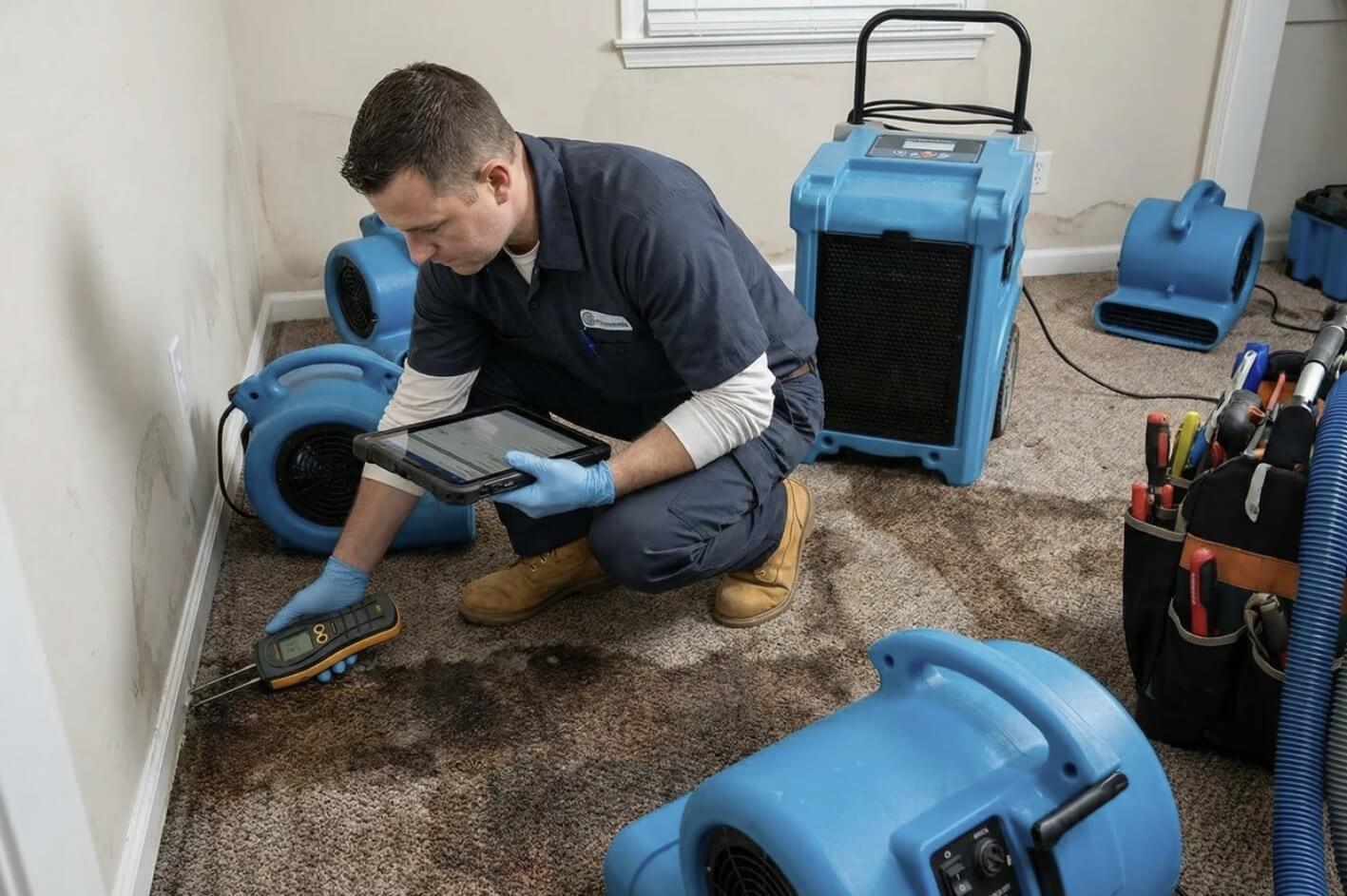
Test 3: A moisture meter (the only test that counts)
A moisture meter gives you a number, and a number can be compared. That’s what makes it the only reliable verdict.
A pin-type meter pushes two probes into the material and reads electrical resistance. It’s the right tool for carpet, backing and underlay because it measures inside the material rather than at the surface. A pinless or non-invasive meter reads capacitance through the surface and is better suited to subfloors, skirting and walls, because it leaves no holes.
Either way, the method is the same. Take a reading in the affected area, then take readings in a known-dry section of the same material in the same room. Drying is finished when the two match. Not when the carpet feels dry. Not when a set number of days has passed. When the numbers match.
On a timber subfloor, a restorer will compare against a dry baseline taken in the same home on the same day, because moisture content readings vary with species, age and the weather. Anyone quoting you a generic number without a baseline is guessing.
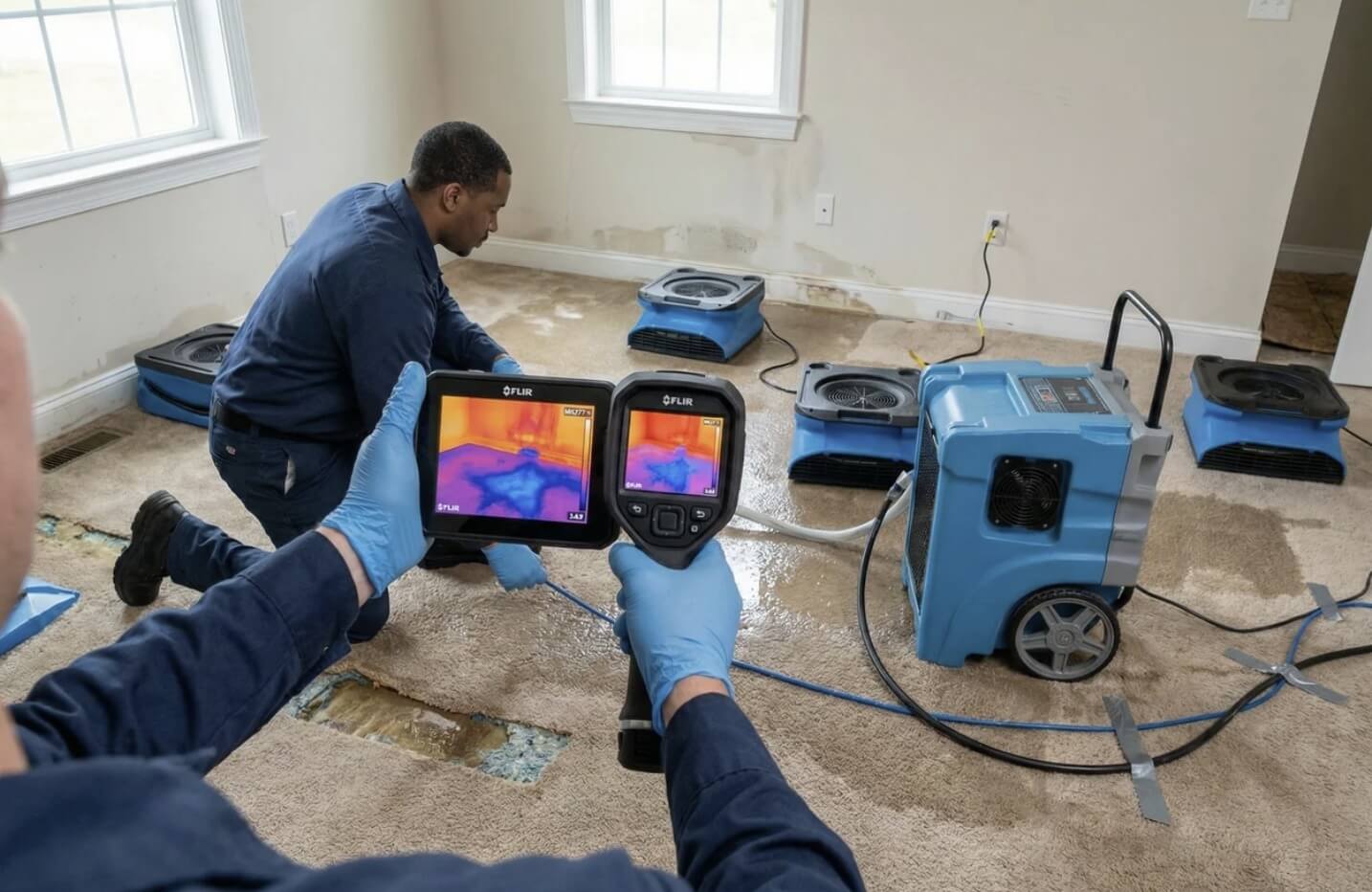
Test 4: Thermal imaging for the water you can’t see
Thermal imaging doesn’t measure moisture, it measures temperature. Evaporating water cools a surface, so a damp patch on a thermal camera usually shows up as a cooler, darker area.
It’s a locating tool, not a verdict. It tells you where to put the meter. That’s how we find water that has tracked sideways under skirting and into wall bases without showing anything on the carpet at all.
What to check beyond the carpet
Carpet being dry doesn’t mean the room is dry. Water wicks sideways and downward, so the last places to check are usually the ones holding the most:
- Under the skirtings and into the bottom plate of the wall
- Inside cabinetry and the kickboard of the kitchen or laundry
- The subfloor, if you can access it from underneath
- The wall behind the carpet edge, particularly if the carpet butts up against plasterboard
A room with wet skirting and dry carpet still needs structural drying. Carpet drying on its own leaves that water exactly where it was.
The Drying Sequence That Works, And Where DIY Breaks Down
We’ve written the full step-by-step walkthrough separately in our guide to how to dry wet carpet quickly, including the exact order of work for an emergency. What follows is the sequence itself, the parts that actually decide the outcome, and where a DIY attempt usually falls over.
Step 1: Stop the water and make the area safe
Turn off the source. If water has reached power points, cabling or appliances, kill the circuit at the switchboard before you touch anything, and get a licensed electrician to check it before the power goes back on.
Keep children and pets out of the room. If the water is sewage or has come in from outside, stop here and call us. That’s not a DIY job, and running a fan in it spreads contamination through the house.
Step 2: Remove the standing water and extract
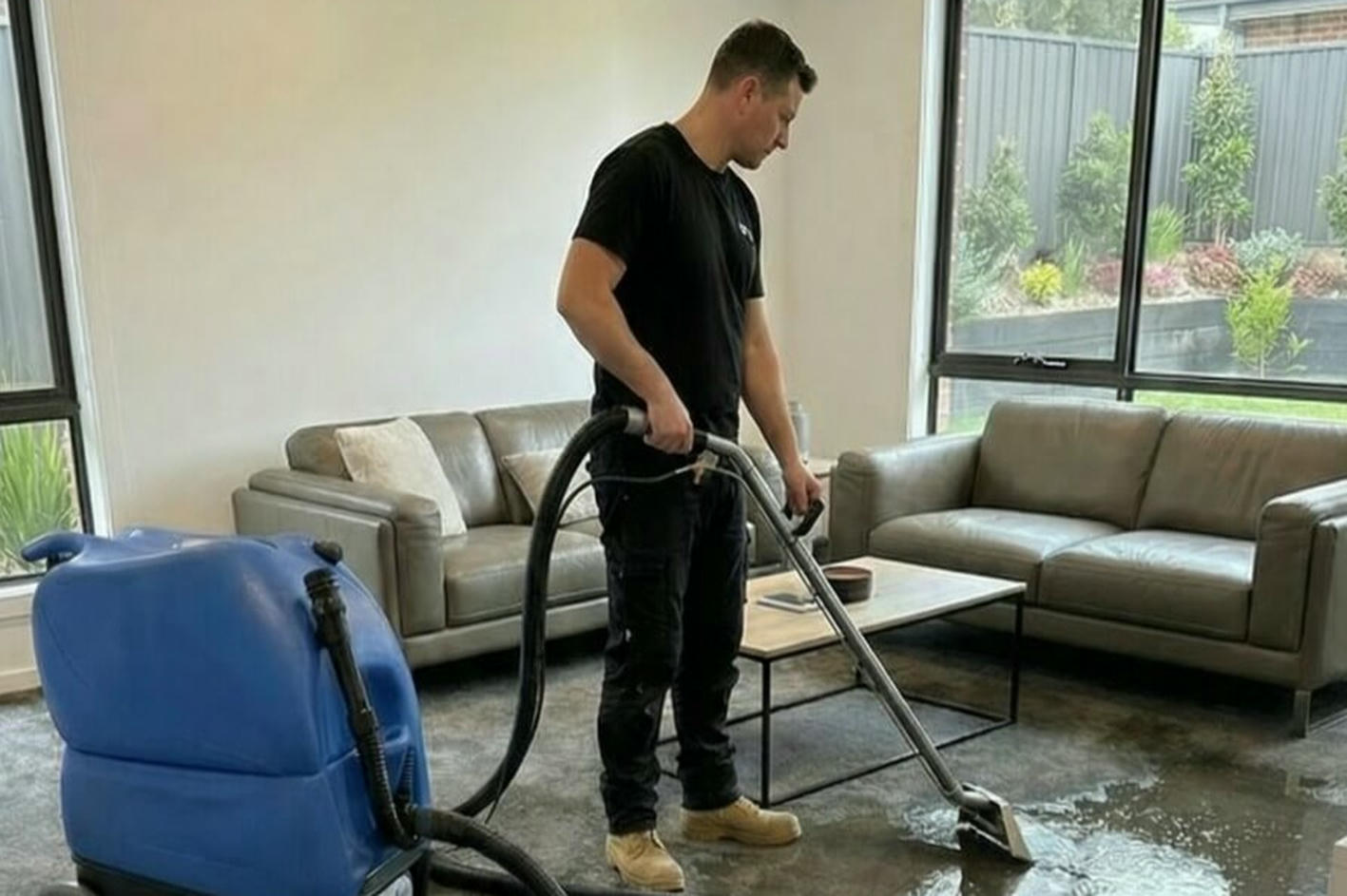
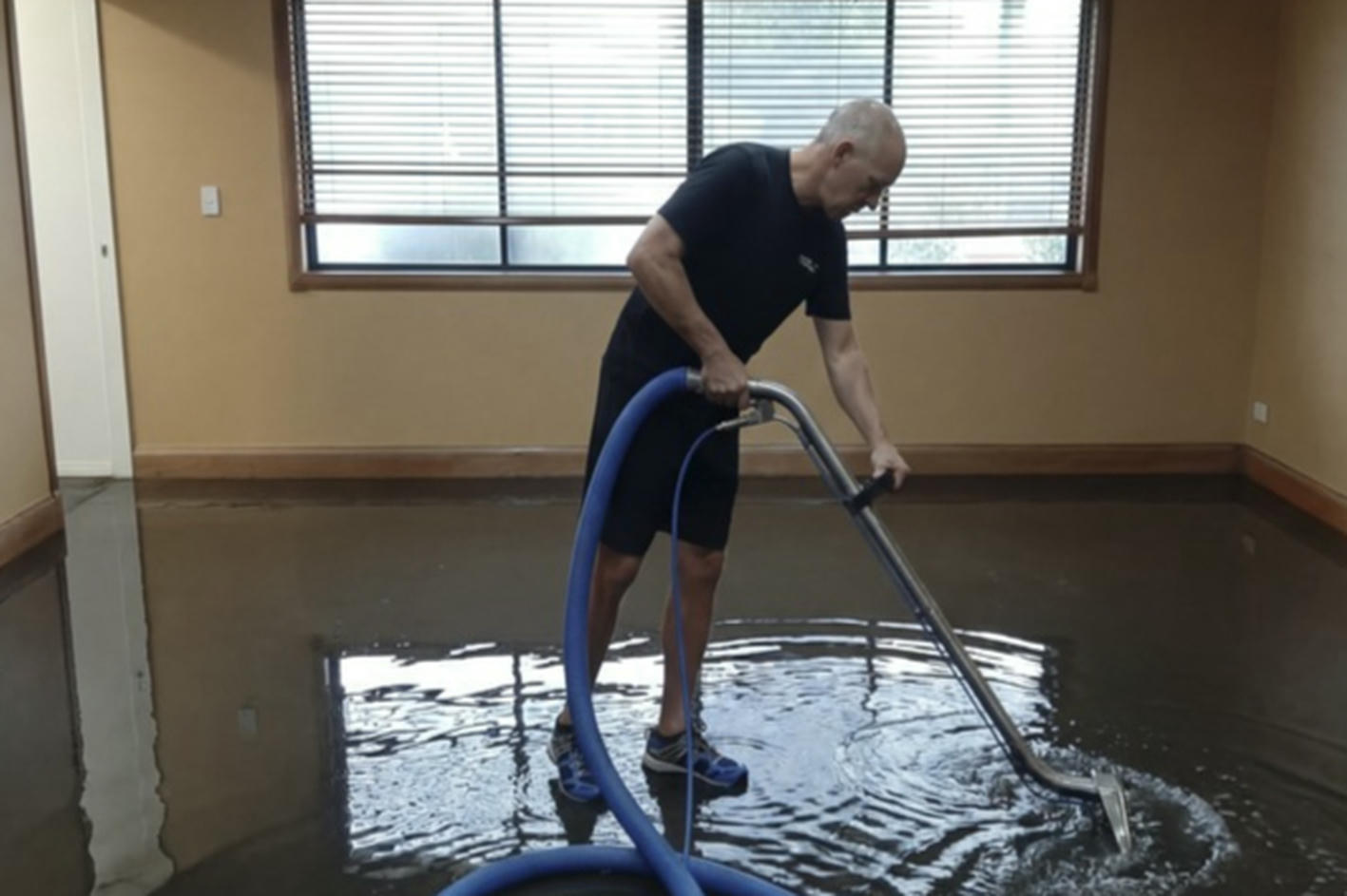
Get the water out before you try to dry anything. A wet vacuum or submersible pump for standing water, then pass over the carpet slowly in overlapping strokes.
Extraction is minutes to an hour of work for a normal room. It’s the cheapest part of the whole process and it removes the most water per minute of effort. Where DIY jobs go wrong is treating this as the whole job rather than the first quarter of it.
Step 3: Get air moving across and under the carpet
Airflow in one direction only dries the top. You need the air to get under the carpet too.
Lift a corner of the carpet, prop it up on a block of timber or a stack of books, and aim a fan underneath. This targets the underlay and backing directly, which is where the moisture sits longest. Even a single pedestal fan wedged into position makes a measurable difference.
Open interior doors, move furniture off the wet area, and get the air circulating around the edges of the room. Edges and corners are where mould starts.
Step 4: Pull the moisture out of the air
This is the step almost everyone skips, and it’s the one that decides whether the job works in Brisbane.
Run a dehumidifier in the closed room. Aim to bring the room’s relative humidity below 60 per cent, and ideally into the 40 to 50 per cent range. Keep doors and windows closed so you’re drying the room, not the street.
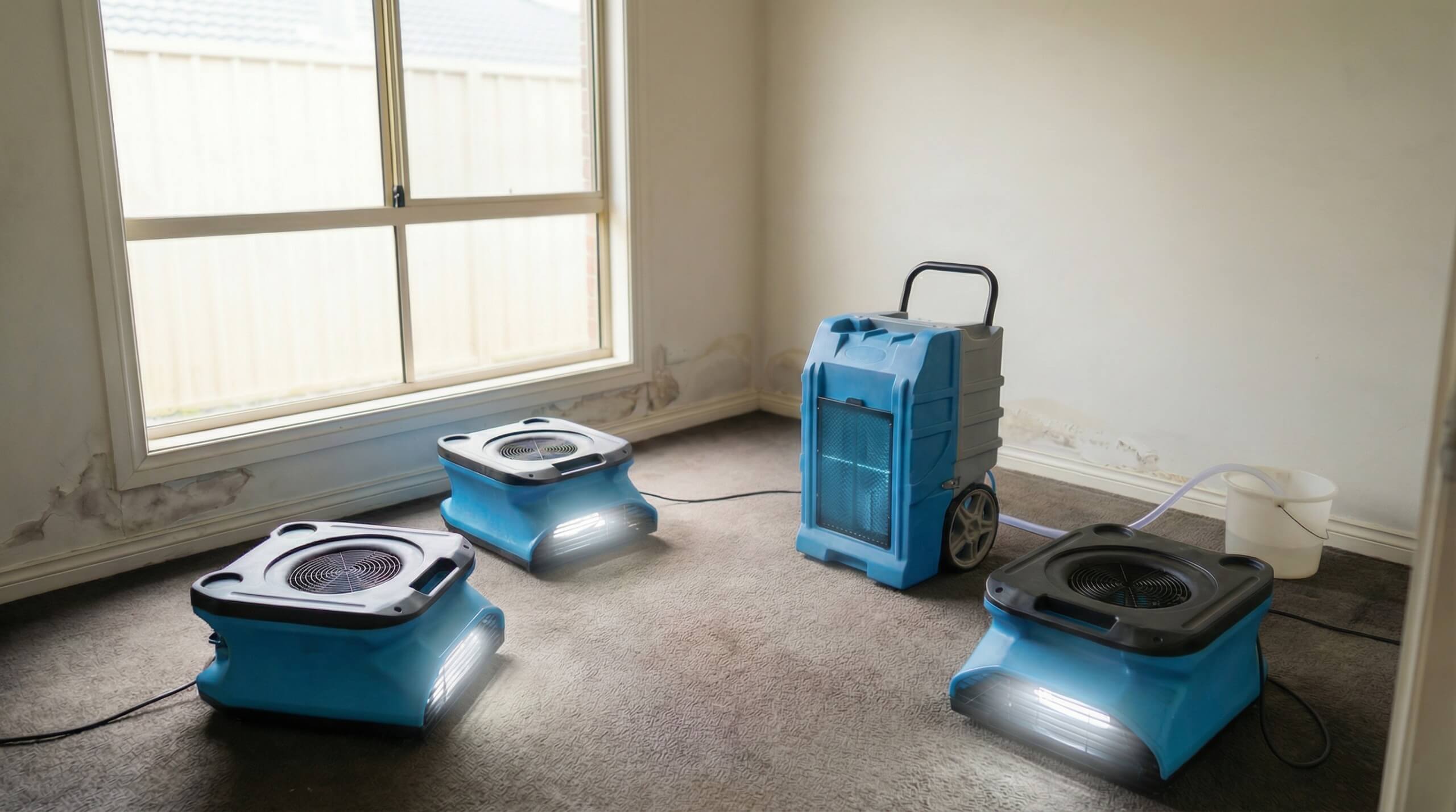
A household unit will handle a small, clean spill. For anything beyond a couple of square metres with wet underlay, a domestic unit can’t remove water fast enough, and you’re better off with commercial equipment. Our dehumidifier hire in Brisbane ranges from a 45L/day unit for a single room through to 120L/day industrial machines, with delivery, setup guidance and pickup included if you’d rather run the drying yourself.
Step 5: Deal with the underlay
If the underlay is saturated, decide early whether it stays or goes. Lift a section and check it. Underlay wet with clean water can be dried in place with air and dehumidification. Underlay that’s black, crumbling, or smells earthy is finished and gets replaced.
Replacing underlay is a fraction of the cost of replacing carpet, and it removes the food source mould needs.
Step 6: Treat the edges and the subfloor as part of the job
The carpet is one surface in a room of surfaces, and water doesn’t respect the boundary. Check under the skirtings, into the bottom plate of the wall, into cabinetry, and into the subfloor if you can access it.
If any of those read wet, you’re running a structural drying job, not a carpet drying job, and the equipment and the timeline both change.
Step 7: Verify with readings before anything goes back
Run the tests in the section above. Compare the affected area against a known-dry reference of the same material, and confirm the underlay as well as the pile.
Only then relay the carpet, replace the underlay and put the furniture back. Furniture blocks airflow and traps moisture, and a lounge sitting on slightly damp carpet is a mould farm with a cushion on top.
What A Normal Drying Curve Looks Like
For a full breakdown of drying times by water category, carpet type and underlay, see our guide to how long wet carpet takes to dry. What matters more here is recognising the shape of a job, so you can tell whether yours is progressing or has stalled.
| Situation |
What normal progress looks like |
| Cup-sized spill, blotted and aired straight away |
A few hours, no equipment needed |
| Clean water across one room, extracted early, air movers and dehumidifier running |
Readings falling steadily over 1 to 3 days |
| Flood-soaked carpet with saturated underlay, commercial drying equipment |
48 to 72 hours of continuous drying before readings match a dry reference |
| Water into walls, subfloor or cabinetry as well as carpet |
3 to 10 days, with the carpet drying long before the structure does |
Two things to take from that table.
The first is that the gap between “a few hours” and “three days” is entirely about whether the underlay got wet. The second is that every range assumes the equipment runs continuously. Switching a dehumidifier off overnight lets the room re-humidify and the clock restarts.
The third thing is the one people miss. When a job stalls, the readings stop falling while the surface still feels dry to the touch. That flat line is your signal that the water is somewhere you haven’t looked yet: under the carpet, in the skirting, or in the subfloor.
When DIY Is No Longer Viable
We’re all for a property owner handling a small, clean spill. But there’s a point where DIY stops saving money and starts costing more.
Call us in if any of the following applies:
- The water is sewage or came in from outside. Category 3 water means removal of affected porous materials, containment and antimicrobial treatment. It’s a health issue, not a drying issue.
- The water has been sitting for more than 24 to 48 hours. Contamination category escalates with time, and the mould window has already opened.
- More than one room, or more than a few square metres, is affected. The equipment required scales quickly beyond what any household has.
- The underlay is saturated. Extraction alone won’t reach it.
- There’s already a musty smell or visible growth. Drying alone won’t fix established mould.
- Water has reached skirting, walls, cabinetry or the subfloor. That’s structural drying, not carpet drying.
- Particleboard is involved. It won’t dry back to a usable state.
- Someone in the home has asthma, allergies or a compromised immune system. The risk profile changes.
- You’re claiming on insurance. Insurers want documented moisture readings and daily records. You can’t produce those with a pedestal fan.
- You can’t seal the room and run equipment continuously. Partial drying is how you end up doing the job twice.
- You’ve already dried it once and the readings won’t settle. A second attempt with the same method produces the same result.
How We Can Help
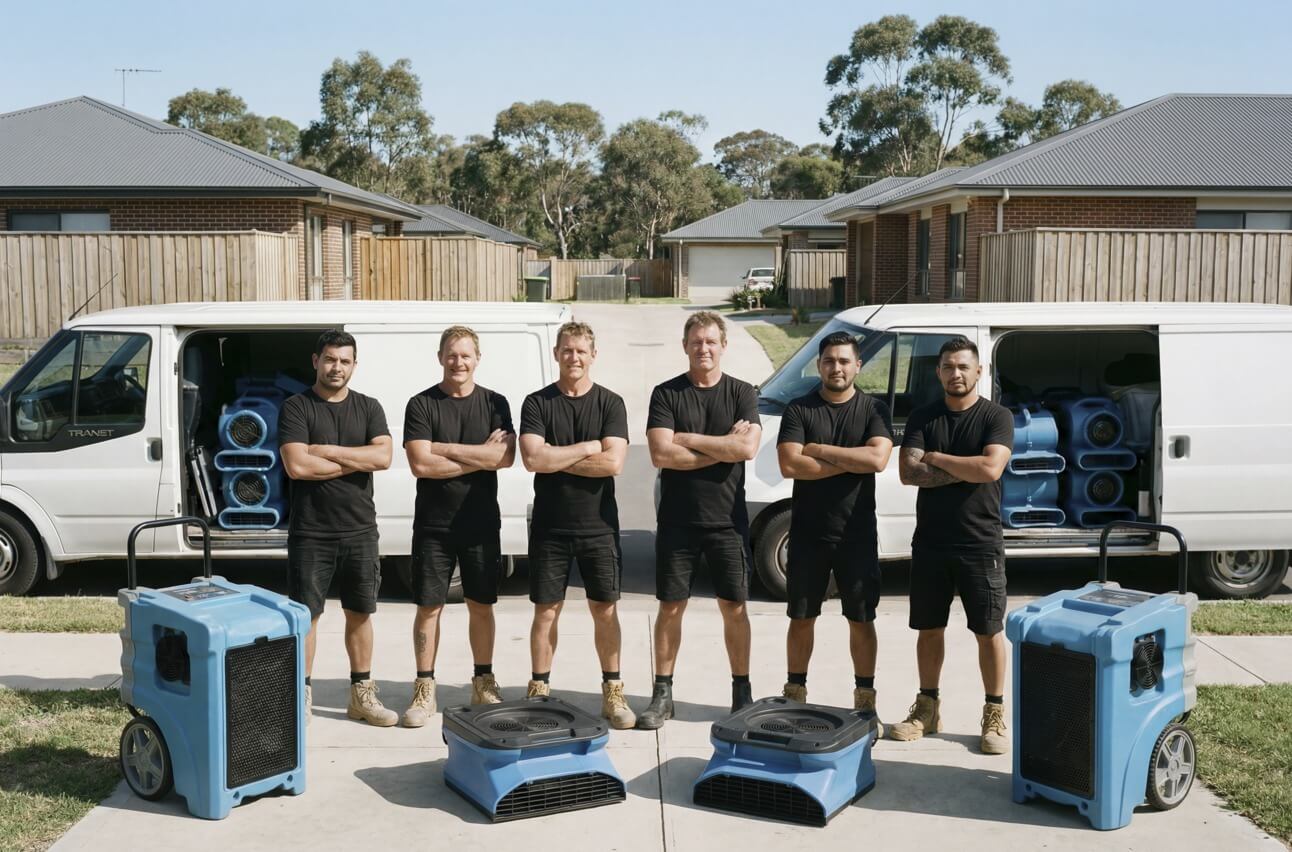
We’re a Brisbane-based flood and water damage restoration team, on call 24 hours a day, and we can be on site within the hour for an urgent job.
What that looks like in practice:
- A free damage assessment. We identify the water source and category, and map where the moisture has actually gone: carpet, underlay, subfloor, skirting, wall base. You get a clear picture before anything starts.
- Extraction with commercial equipment. Industrial pumps and wet vacuums that pull water out of the pile and the backing, not just the surface.
- Controlled airflow and dehumidification. Air movers positioned to drive air under lifted carpet, paired with LGR dehumidifiers that keep working as the air dries out. Standard units stall below about 40 per cent relative humidity. LGR units don’t.
- Correct underlay handling. Dried where it can be saved, replaced where it can’t. We tell you which and why.
- Antimicrobial treatment. Applied during and after drying to stop mould establishing in the backing and underlay.
- Monitoring until the readings say it’s done. We take moisture readings and keep going until they match a dry reference. We don’t stop because the surface feels dry, and we hand over the records.
- Insurance support. Clear moisture reports and documentation, and we work directly with your insurer to keep the claim moving.
If you’d rather handle the drying yourself and just need the gear, we hire commercial dehumidifiers and air movers across Brisbane with same-day delivery in most suburbs. Everything you need for professional carpet drying in Brisbane, whether we’re running the equipment or you are.
We’ve been doing this for over 20 years across Brisbane’s northside, southside, western suburbs, bayside and CBD. We’ve dried carpets after storms, after burst pipes, after washing machine failures and after upstairs bathrooms let go into the room below. The pattern is always the same: the jobs that get started early and get dry properly are the ones where the carpet survives.
The ones left “dry enough” are the ones we come back to a fortnight later with a moisture meter and a bad smell.
If your carpet has been wet for more than a day, or you’ve dried it yourself and something still isn’t right, get it checked. A reading takes minutes. Replacing a room of carpet and underlay doesn’t.
Call us on 07 3185 0987 any time, day or night, or get in touch online and we’ll book an assessment.
Frequently Asked Questions
How can I tell if my carpet is dry underneath?
Lift a corner and look at the underlay, then confirm it with a moisture reading. A pin-type meter pushed into the underlay and compared against a known-dry section of the same carpet is the reliable test. If the affected area reads higher than the dry reference, the job isn’t finished, no matter how dry the surface feels to your hand.
Why does my carpet still smell damp after drying?
Smell is usually the first sign that moisture was left behind, not the last. A musty or earthy smell in a closed room points to damp underlay, backing or skirting, and it returns because the mould root is still inside the material. Surface cleaning and more airflow won’t remove it. It needs a moisture assessment to find where the water still is. If the carpet was recently cleaned rather than flooded, start with our guide to carpet still damp after cleaning, which works through the cleaning-specific causes first.
How long does wet underlay stay wet?
Longer than the carpet above it, and longer than most people expect. Foam and crumb rubber underlay are designed to hold air, which means they also hold water, and saturated underlay can stay damp for days after the pile feels dry. Felt underlay holds more again. On a concrete slab the moisture has nowhere to go, which is why slab homes are the worst offenders and the most likely to fail a fingertip test.
Does wet underlay always need to be replaced?
No. Underlay soaked by clean water and caught within the first day can be dried in place. Underlay soaked by grey water, sewage or floodwater, or left wet for days, gets replaced. So does underlay that’s started to crumble or smell earthy. It costs far less than carpet, so replacing it is rarely worth the risk.
Will a heater help dry my carpet?
Not the way you’d hope. A heater raises the air’s moisture-holding capacity slightly, but it also warms the room, and warm plus damp is the condition mould grows best in. Direct heat on carpet can also damage the latex holding the backing layers together. Airflow plus dehumidification is the combination that works.
How can I tell if mould has already started under my carpet?
Smell is usually first, before anything is visible. If the room smells musty when it’s closed up, or the smell returns after cleaning, lift a corner of the carpet and check the underlay for black, grey or green spotting, a white powdery bloom, or staining. A moisture reading confirms it. Surface cleaning won’t fix mould established in underlay and backing, because the growth is inside the material.
Can I walk on wet carpet?
On a small, clean-water damp patch, yes. On standing water from a flood or a sewage backup, no. That water carries contamination, and walking through it spreads it through the house and onto your skin.
Is drying carpet after flooding different to drying a spill?
Yes, significantly. Floodwater that has come in from outside can carry soil, sewage and chemicals, so the affected carpet and underlay are usually removed rather than dried. A burst supply pipe is clean water, so the carpet can usually be saved if the response is fast. The water source is always the first thing we establish, because a Category 3 job isn’t a harder version of a Category 1 job, it’s a different job entirely.