How Long Does Wet Carpet Take to Dry? What’s Normal and What’s Not
TL;DR: Wet carpet with underlay takes 24 to 48 hours to dry properly with professional equipment, or 48 to 72 hours if water sat overnight. Anything past 72 hours risks mould and permanent carpet damage.
In This Article
- The Short Answer on How Long to Dry Wet Carpet
- What “Dry” Actually Means, and Why Your Carpet Lies to You
- Drying Times by What Is Under Your Carpet
- What Slows Wet Carpet Down in Brisbane
- How to Dry Wet Carpet Brisbane Property Owners Can Do Themselves
- Why Your Carpet Won’t Dry
- The Threshold: When Wet Carpet Stops Being Fixable
- Signs You Should Stop and Call
- How Our Team Can Help
- Frequently Asked Questions About Drying Wet Carpet
Your carpet has been wet for two days. Your bare feet still come away damp, the room smells faintly like a wet dog, and the fans you dragged out of the garage are not making a difference. So you do what anyone would do and search for how long does wet carpet take to dry.
We get this question on the phone most weeks, and the honest answer is that it depends on what is underneath the carpet, not what the carpet is made of. A light spill on a synthetic carpet over a timber floor is a completely different job to a storm soak on foam underlay over a concrete slab. One is finished in half a day. The other is a four day operation with equipment you cannot buy at Bunnings.
This guide gives you the real numbers, the conditions that push those numbers out, and the point where waiting stops being an option.
The Short Answer on How Long to Dry Wet Carpet
Here is the normal range, assuming the water has been stopped and moisture has been extracted properly.
| What got wet |
Realistic drying time with professional equipment |
What to check before you stop |
| Carpet face only, light spill, underlay still dry |
4 to 8 hours |
Underlay reading compared to a dry room |
| Carpet plus foam underlay, clean water, extracted within 24 hours |
24 to 48 hours |
Carpet backing, underlay and the carpet edge at the skirting |
| Carpet plus foam underlay, water sat overnight before extraction |
48 to 72 hours |
Odour, and whether the underlay is still holding water |
| Carpet over a concrete slab |
48 to 72 hours for the carpet, 7 to 14 days for the slab to release its moisture |
Slab moisture reading, not the carpet surface |
| Carpet over timber or particleboard |
48 to 96 hours |
Board edges, swelling and cupping underfoot |
| Nothing but household fans and open windows |
5 days and beyond, with mould risk climbing from 48 hours |
Everything |
Two things to read from that table. First, the drying time doubles the moment the underlay is involved, because foam underlay behaves like a sponge and holds water long after the carpet above feels dry. Second, anything past 48 hours is out of the normal range and needs a reason.
What “Dry” Actually Means, and Why Your Carpet Lies to You
Pressing your hand on the carpet tells you almost nothing. This is the single biggest reason homeowners get caught out.
The dry standard, in plain English
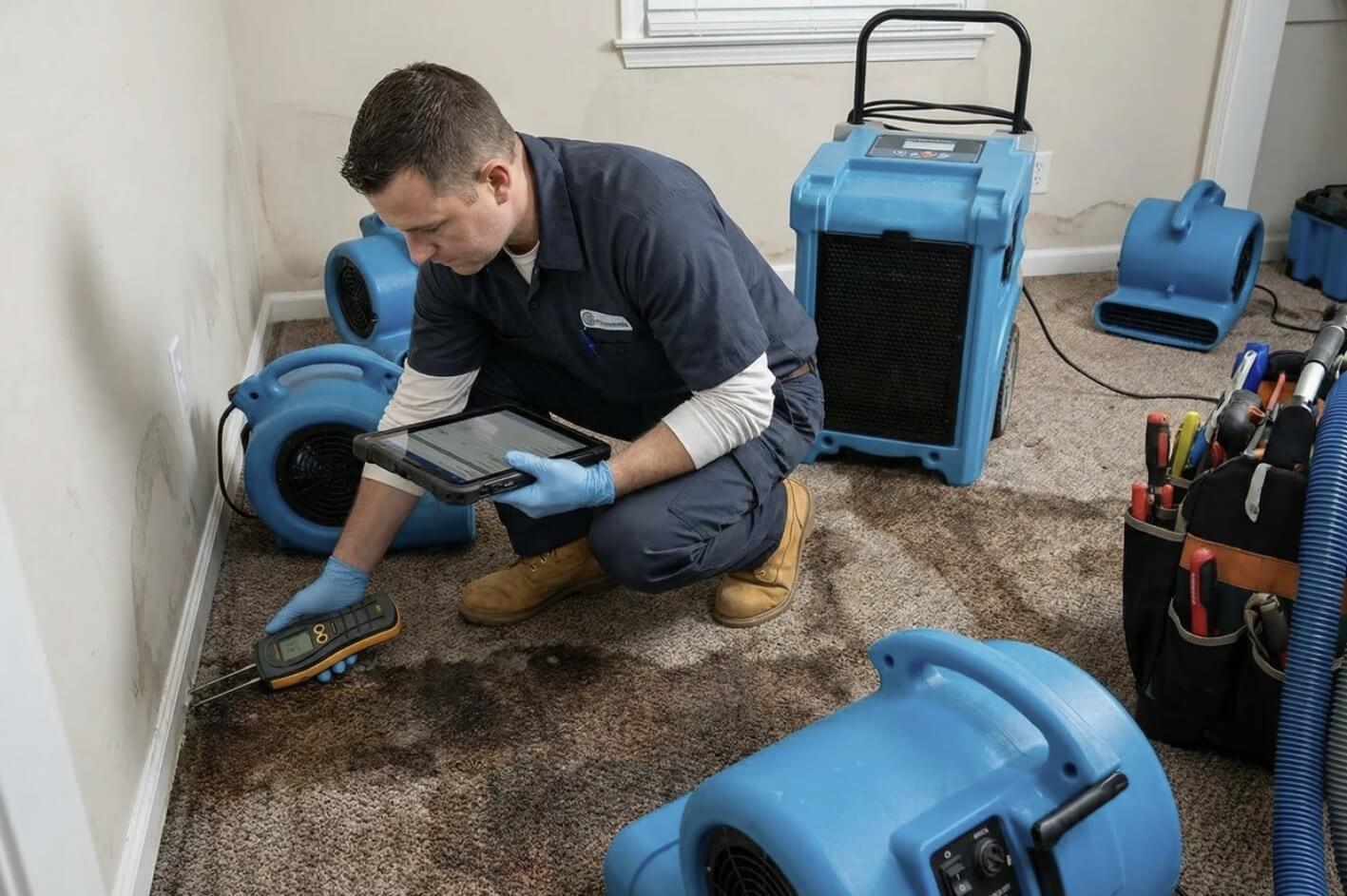
Restorers do not decide a floor is dry by looking at it. We measure the moisture content of the wet materials and compare those numbers to an unaffected reference area in the same building, usually a carpeted room that stayed dry. That reference reading is the target. When the wet carpet, the underlay and the subfloor all match the dry reference, the job is done. It is the method set out in the IICRC S500 standard, which is the framework Australian insurers rely on when they assess a water damage claim.
It also means a job cannot be signed off early on a warm day when the surface feels fine.
Why the surface dries first
Carpet has four layers that matter, and they dry in reverse order of how much water they hold:
- The face fibres. Thin, exposed to air, dry in hours.
- The primary and secondary backing. Denser, slower, and where the latex adhesive sits.
- The underlay. Thick, absorbent, no airflow reaching most of it.
- The subfloor. Concrete or timber, with the longest memory of all.
So the sequence is always the same. The carpet feels dry on day one. The underlay is still wet. The slab underneath is still wet on day four. That gap is where mould gets its start, and it is why a carpet can read dry to the touch and still be a problem.
The three minute self check
Before you assume you are finished, do this:
- Lift a corner of the carpet at a doorway or in a wardrobe. Look at the underside of the carpet and the top of the underlay.
- Press a dry paper towel firmly into the underlay for ten seconds. Any damp patch means the underlay is still holding water.
- Shut yourself in the room for a minute and breathe in. A musty or earthy smell with a dry feeling surface means the moisture is underneath, not gone.
If any of the three fails, the carpet is not dry, regardless of how long it has been.
Drying Times by What Is Under Your Carpet
This is where the real variation lives. The same amount of water on the same carpet behaves differently depending on the floor beneath it.
Carpet only, no underlay saturation
A knocked over glass, a bath overflow caught in a minute, a small leak under the fridge. The water reaches the fibres and stops. Extract it, get air moving, and you are looking at four to eight hours. This is the one scenario where a wet and dry vacuum and a couple of good fans genuinely finish the job.
Carpet plus underlay, the standard leak and flood scenario
Water travelled. It passed through the carpet, through the underlay and is now sitting against the floor. This is what most burst pipes, hot water system failures and washing machine hoses leave behind, and it is the true answer to how long to dry wet carpet in a normal home.
With professional extraction, high velocity air movers and LGR dehumidifiers running continuously, 24 to 48 hours is the target. Foam underlay that has been properly saturated and left overnight pushes that to 48 to 72 hours, and in a fair number of cases the underlay is not worth drying at all.
Carpet on a concrete slab
Most Brisbane homes are built on a slab, which changes the maths. Concrete is porous. Once it takes on water it releases it slowly, upward, into whatever sits on top of it.
That produces the most common frustrating outcome in Brisbane water damage: the carpet dries in two to three days, the slab below is still releasing moisture for a week or more, and the carpet re-wets from underneath. The client thinks the job failed. What actually happened is that the slab was never dried, and carpet alone was never going to dry it.
This is the situation that needs structural drying in Brisbane, where the drying target moves from the carpet to the slab, the skirting and the wall base. Left unmanaged, moisture sitting in concrete reaches the steel reinforcement inside it, the steel rusts and expands, and the slab cracks from the inside out. Once you can see that cracking, the repair bill is in the tens of thousands.
Carpet on timber or particleboard
Timber floors behave differently again. They do not hold water the way concrete does, but they move. Boards swell, edges lift and cupping appears underfoot.
Two to four days is the range for the carpet and the boards, and the floor framing beneath runs longer again. Queenslander homes with a raised timber subfloor need airflow underneath as well as above, which is a job for a subfloor drying setup rather than a fan in the hallway. Particleboard is the weak point here. It swells permanently once soaked and does not return to its original profile.
What Slows Wet Carpet Down in Brisbane
If your carpet is taking longer than the ranges above, one of these is behind it.
One caveat before you read on. Everything above assumes the carpet got wet from water damage. If it was wet because it was cleaned rather than flooded, none of those ranges apply: drying time is set by the cleaning method, not by what sits under the carpet. We cover that separately in why your carpet is still damp after cleaning.
Brisbane’s humidity is working against you
This is the local factor most homeowners do not account for, and it is measurable.
Bureau of Meteorology records for Brisbane show average relative humidity of 66 per cent at 9am and 53 per cent at 3pm across the year. In January, the wettest and most humid month, it averages 66 per cent in the morning and 59 per cent in the afternoon.
The US Environmental Protection Agency recommends keeping indoor relative humidity below 60 per cent to prevent mould growth, and ideally between 30 and 50 per cent.
Read those two sets of numbers together and the problem is obvious. Brisbane’s outdoor air is above the mould prevention ceiling for much of the morning. Opening the windows to dry a wet carpet pumps humid air straight back into the room and slows evaporation to a crawl. On a humid February day, natural drying in an open room can stall almost completely.
This is why dehumidification matters more here than in drier parts of the country. Air movers alone shift moisture from the carpet into the air. If nothing removes it from the air, the air saturates and the carpet stops giving up water.
Fans without a dehumidifier
Moving air around a closed room with the windows shut does very little once that air is saturated. Air movers and dehumidifiers work as a pair or not at all.
A closed room with no airflow at all
The opposite mistake. Shut the door, shut the windows, walk away, and the moisture has nowhere to go. Underlay in a still, dark room under a carpet is close to the ideal conditions for mould.
Saturated foam underlay
Standard foam underlay absorbs many times its own weight in water. Carpet can be sitting on a wet sponge with a dry face. It is the main reason a carpet will not dry.
Heavy pile, wool and loop pile carpet
Wool absorbs more water than synthetic fibre and can felt or shrink if it dries slowly. Thick plush and dense loop pile trap moisture deep in the construction. Nylon and polypropylene give it up faster.
Furniture left standing on the carpet
A sofa leg or a bed base traps a pool of water and blocks airflow in the exact spot nobody checks. Dye transfer from wet timber or fabric furniture is a second problem that shows up later.
Water still getting in
A slow leak behind a wall, a dripping pipe under the sink, a roof tile still passing water. You cannot dry a room that is being re-wet.
Walls wicking water upward
Water travels through the base of plasterboard well above the visible wet line. A carpet dried while the wall base stays wet will pull that moisture back down. Skirting boards and the bottom of the plasterboard are part of the job.
How to Dry Wet Carpet Brisbane Property Owners Can Do Themselves
You can make a real difference in the first hour, and it directly affects how much of your carpet survives. Here is what to do, in order.
In the first hour
- Stop the water. Turn off the water at the meter or the appliance valve. If water is anywhere near power points, switches or appliances, turn the circuit off at the switchboard before you go near it.
- Photograph everything before you touch it. Wide shots of the room, close ups of the water line on walls, and the carpet where it meets the skirting. Your insurer will want these and they are far harder to recreate later.
- Get furniture out or up. Out of the room is best. If it cannot move, put a sheet of plastic or foil under each leg and lift the furniture onto it. Do not leave timber or fabric furniture sitting directly on wet carpet.
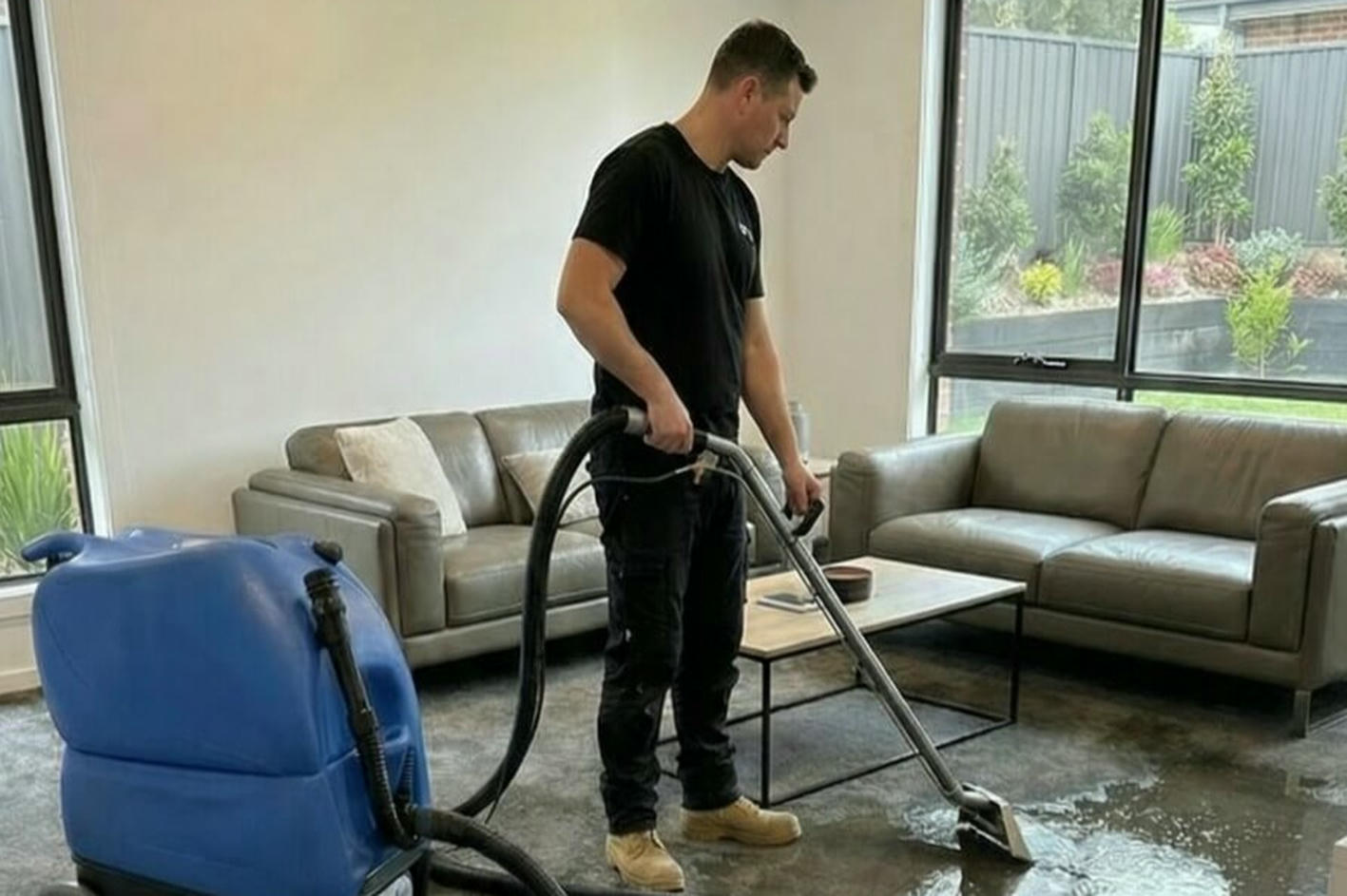
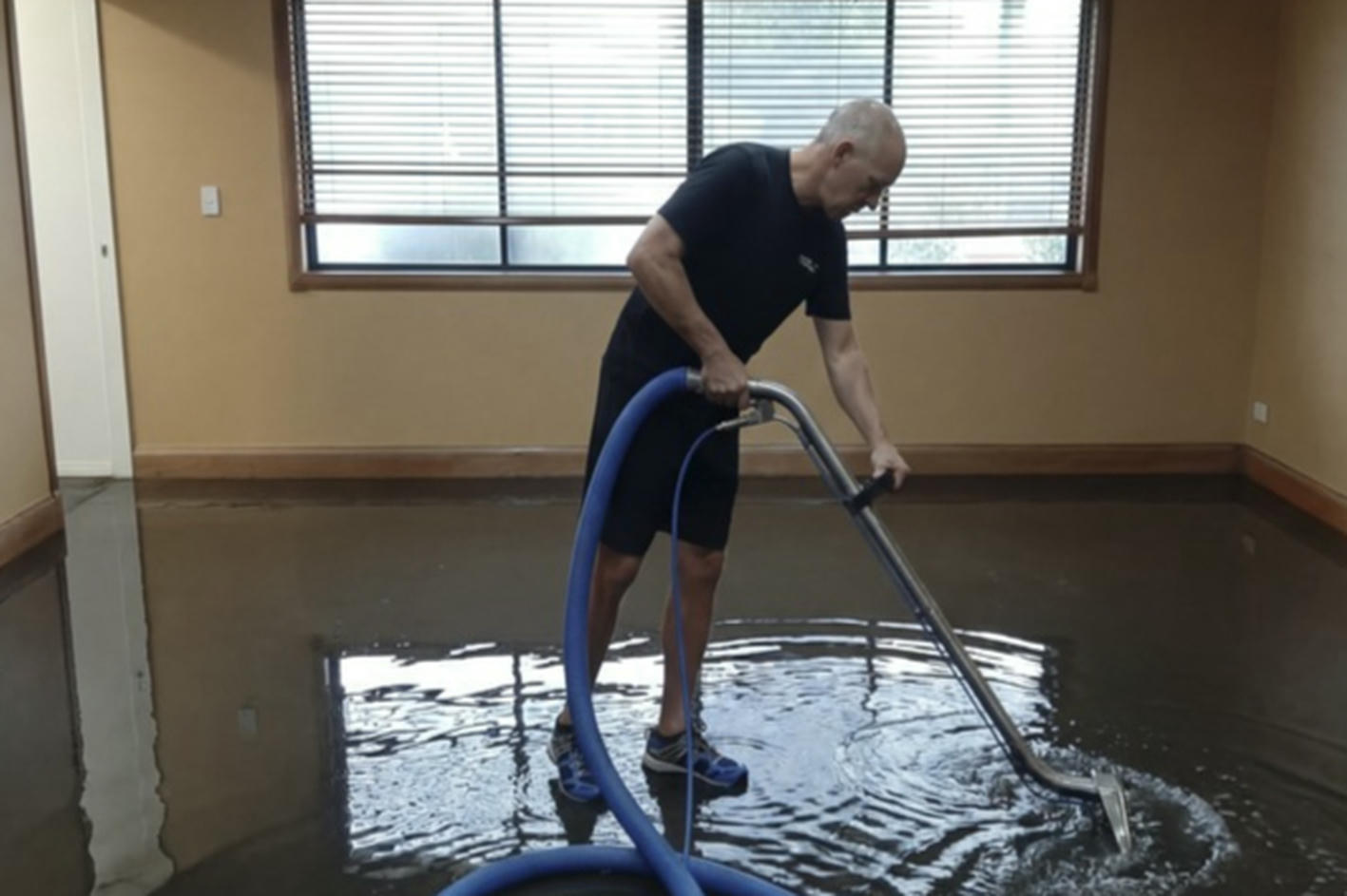
- Extract, do not mop. A wet and dry vacuum pulls water out of the carpet in a way a mop and towels never will. Go over the same area several times, slowly. Never use an ordinary household vacuum on wet carpet.
- Lift the carpet at a corner and look. If the underlay is wet through, the carpet needs to be lifted off the gripper so air can reach the underlay and the floor. This is also how you find out whether you are dealing with a carpet job or a floor job.
Setting up airflow and dehumidification properly
If you are running equipment yourself, placement decides the outcome.
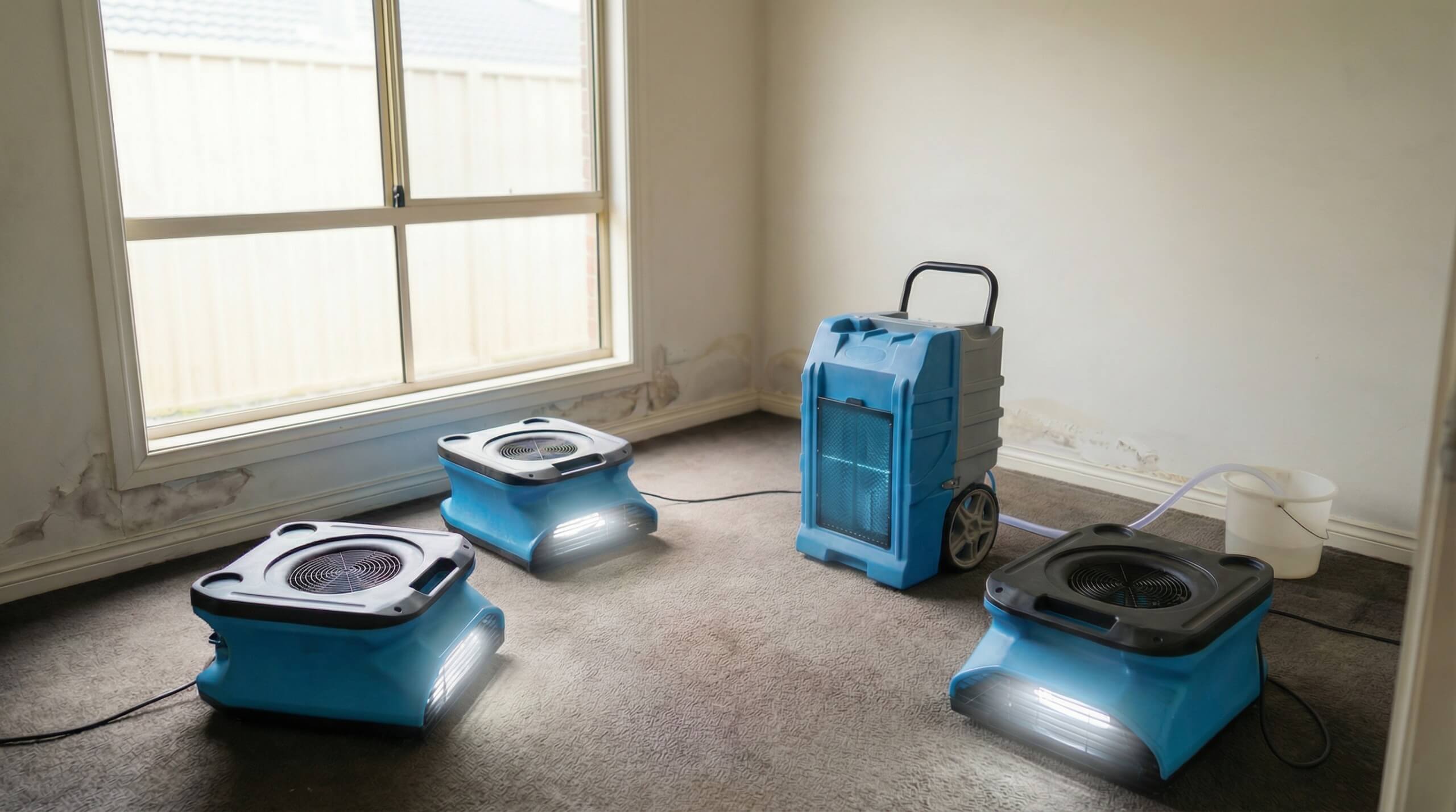
- Put air movers at roughly 45 degrees to the wet surface, not blasting flat along it, and space them every three to five metres.
- Put the dehumidifier in the centre of the drying zone, and empty the tank before it fills and shuts off overnight.
- Close the room up. Windows and doors shut while the dehumidifier runs. It is drying the air inside, and open windows give it an endless supply of Brisbane humidity to fight.
- Run everything continuously, 24 hours a day. Stopping at night resets your progress.
- Run the air conditioning in cool or dry mode if you have it. It dehumidifies the room and helps. Do not use evaporative cooling.
- Keep people and pets off the carpet. Traffic on a wet carpet breaks down the backing.
As a starting point for sizing, our guidance is one LGR dehumidifier per 40 to 50 square metres for moderate water damage, and one per 25 square metres in severe flooding. If you need equipment without a full crew, we hire out air movers, carpet dryers and moisture meters across Brisbane with same day delivery.
What not to do
- Do not use bleach, vinegar or any home remedy and assume the problem is solved. Neither reaches mould growing in the backing or the underlay, and bleach damages carpet fibre.
- Do not point a fan at a wet patch on a concrete slab and call it dry. The slab is still wet underneath.
- Do not clean or treat carpet soaked by sewage, stormwater or river flooding yourself. That is Category 3 water and it carries pathogens. The carpet is a health risk, not a cleaning project.
- Do not stop because the surface feels dry. Check it the way we described above.
Why Your Carpet Won’t Dry
When someone tells us their carpet won’t dry, they have almost always been at it for three or four days. In our experience the cause is one of five things.
- The underlay is still saturated. The most common by far. The carpet above is dry, the sponge below is not, and no amount of surface airflow fixes it.
- There is no dehumidification. Air movers with no moisture removal just cycle damp air around the room.
- The slab or subfloor is feeding moisture back up. The carpet dries, the floor re-wets it, and the cycle repeats.
- The carpet backing has delaminated. The latex adhesive holding the primary and secondary backing together breaks down when it stays wet, and the layers separate. Water gets trapped between them and the carpet feels spongy or ripples underfoot. This one does not dry out to a usable carpet.
- Water is still entering. A slow leak nobody found, a wall base that is still wet, a roof still passing water.
The best way to dry out wet carpet is not a product or a trick. It is finding out which of those five you are dealing with, then treating the actual layer that is wet. Fans on a dry surface over a wet slab is effort with no result.
The Threshold: When Wet Carpet Stops Being Fixable
This is the part worth reading twice, because the difference between a dried carpet and a replaced one is measured in hours.
The US EPA’s guidance is that water damaged buildings and furnishings must be dried within 24 to 48 hours to avoid mould growth. Note the wording: dried within that window, not started within it.
Brisbane shortens that window. Mould spores need moisture, warmth and an organic surface, and carpet, underlay and plasterboard supply the organic part. Our own guide to how long mould takes to grow after water damage sets out the timeline we see locally: germination can begin within 24 hours in Brisbane’s humidity, and visible colonies from 24 to 48 hours.
| Time wet |
What is happening |
What it means for your carpet |
| 0 to 24 hours |
Water is sitting in the fibres, underlay and floor. Nothing irreversible yet. |
Extraction and drying. Highest chance of saving carpet and underlay. |
| 24 to 48 hours |
Spores germinating. Bacteria producing odour. Backing adhesive starting to soften. |
Still recoverable, but the underlay is now a candidate for replacement. |
| 48 to 72 hours |
Visible mould at edges and on the backing. Underlay colonised. Delamination beginning. |
Carpet may survive. Underlay almost certainly will not. Costs climb sharply. |
| Beyond 72 hours |
Mould established through the backing and into the subfloor. Structural moisture. |
Replacement is the honest recommendation for the carpet and underlay. The floor beneath becomes the concern. |
The irreversible damage to watch for is not only mould. It is also:
- Delamination, where the backing layers separate. Once it spreads across a room, the carpet is finished.
- Wool shrinkage and felting, which cannot be reversed.
- Jute and cotton backing shrinkage, which pulls the carpet off the gripper and leaves gaps at the skirting.
- Permanent staining and dye transfer from furniture and from the carpet’s own backing.
- Concrete cancer in the slab below, which is a structural repair rather than a flooring one.
If your carpet has been wet for more than 72 hours, the question changes from how long will it take to dry to what is worth keeping.
Signs You Should Stop and Call
Stop trying to manage it yourself if any of these are true:
- The carpet has been wet for more than 48 hours.
- It smells musty or sour, even faintly.
- The underlay is soaked through when you lift a corner.
- The carpet ripples, bubbles or feels spongy and disconnected underfoot.
- Water came from outside the house, from a toilet, or from sewage.
- The wet area is larger than a single room.
- Anyone in the house has asthma, allergies or a compromised immune system.
- You are planning to claim on insurance and need documented moisture readings.
A moisture reading written down by a certified technician is what an insurer accepts. A homeowner’s opinion that it feels dry is not.
How Our Team Can Help
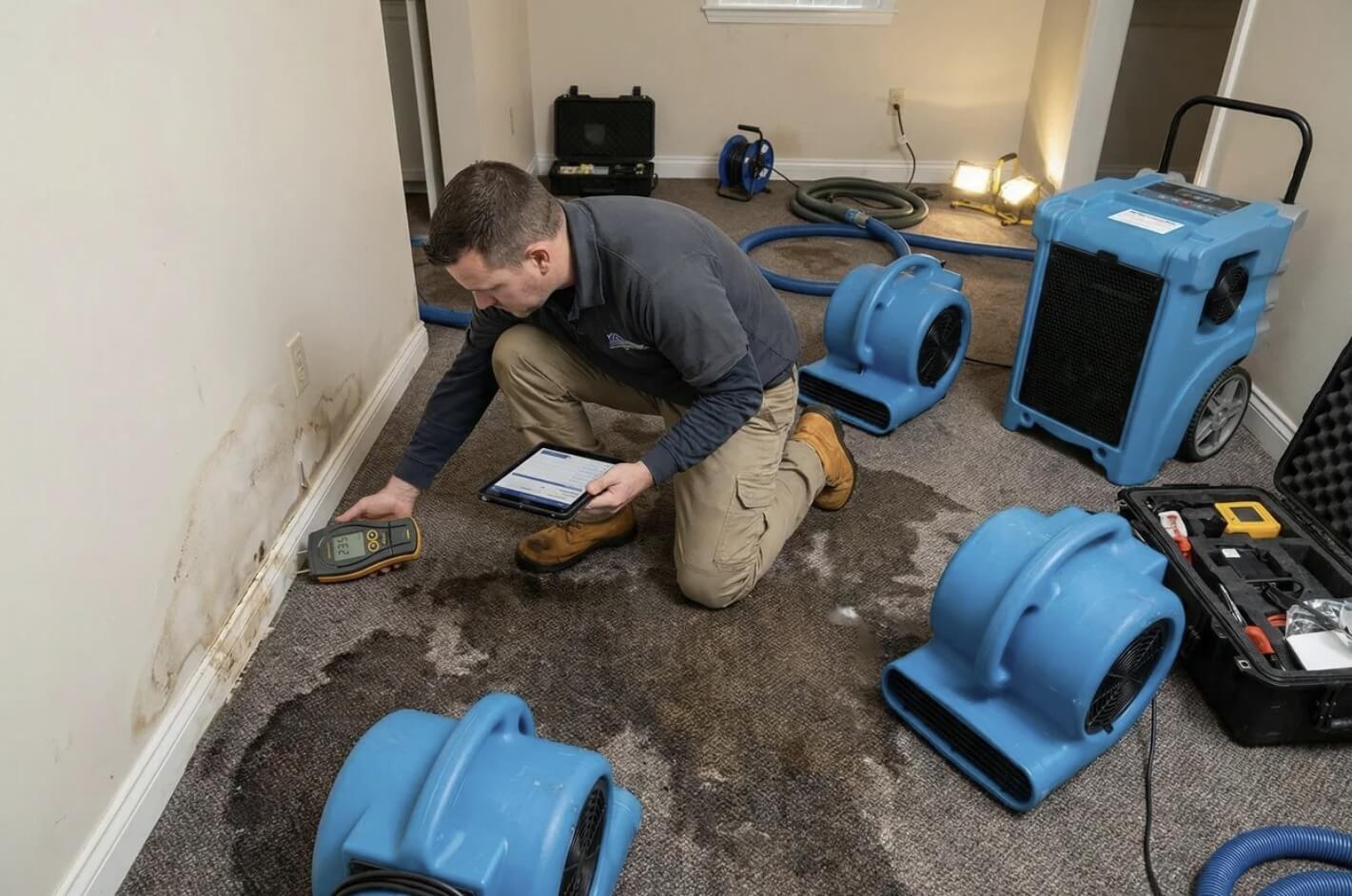
Everything above is the same advice we give on the phone, because most wet carpet problems are genuinely straightforward once you know which layer is wet. The difficulty is that the layer that matters is the one you cannot see, and confirming it needs a calibrated moisture meter, thermal imaging and industrial drying equipment.
Here is what we do when you call Flood Services Brisbane:
- We answer 24 hours a day, every day of the year, and our teams are positioned across Greater Brisbane to be on site within 60 minutes of your call, day or night.
- We start with a free written assessment. Thermal imaging and pin meters map exactly where the moisture is, including inside wall cavities and under the carpet where you cannot see it. You get a straight answer on what can be saved and what cannot, before any work starts.
- We extract properly first. Industrial extraction pulls the standing water out before any drying equipment goes down. Skipping this step is why so many DIY attempts stall.
- We dry to a verified number, not a feeling. High velocity air movers, LGR dehumidifiers, calibrated meters and data loggers, with readings compared to a dry reference area and logged daily. That log is also what your insurer needs.
- We handle the carpet and the floor beneath it. Carpet and underlay drying where the underlay can be saved, and structural drying for the slab, subfloor and wall base where it cannot. Drying one and leaving the other is how a job comes back three weeks later as a mould problem.
- We work with all major Australian insurers and deal with the assessor directly, so you are not translating moisture reports into claim language on your own.
We have been doing this for more than 20 years, and the pattern does not change. The jobs that cost the least and save the most are the ones where someone called on day one rather than day four.
If your carpet is wet right now, put the phone on speaker and start lifting a corner while you talk to us. We will tell you within a few minutes whether it is a fan and a dehumidifier job or something that needs a crew.
Call Flood Services Brisbane on 07 3185 0987, any hour, any day. Free assessment, on site within the hour, and an honest answer about what your carpet needs.
Frequently Asked Questions About Drying Wet Carpet
How long does wet carpet take to dry after a flood or leak?
In most Brisbane homes, carpet with foam underlay takes 24 to 48 hours to dry with professional extraction, air movers and dehumidifiers running continuously. A light spill that never reached the underlay dries in 4 to 8 hours. If water sat overnight or the underlay is fully saturated, allow 48 to 72 hours.
How long does wet carpet take to dry if the underlay is soaked?
48 to 72 hours with professional equipment. Foam underlay holds many times its own weight in water and blocks airflow from reaching the moisture it holds. Saturated underlay is the single most common reason carpet will not dry, and it is a strong candidate for replacement.
Can I dry wet carpet with just fans and open windows?
No, not in Brisbane. Fans move moisture from the carpet into the air but do not remove it from the air. Brisbane averages 66 per cent relative humidity at 9am and 53 per cent at 3pm across the year, and the US EPA recommends indoor humidity below 60 per cent, ideally between 30 and 50 per cent. Open windows push humid outdoor air straight back into the room. You need a dehumidifier and a closed room, or the carpet stops giving up water.
How long before mould grows on wet carpet in Brisbane?
The US EPA’s guidance is that water damaged materials must be dried within 24 to 48 hours to avoid mould growth. In Brisbane’s humidity, spores can germinate within 24 hours and visible colonies appear from 24 to 48 hours. Past 72 hours, mould is established in the backing and the underlay, and replacement becomes the honest recommendation.
Why won’t my carpet dry?
Five causes cover almost every case: the underlay is still saturated, there is no dehumidification so the air stays loaded, the concrete slab or subfloor is feeding moisture back upward, the carpet backing has delaminated and is trapping water between the layers, or water is still entering from a leak, a wet wall base or a roof.
How can I tell if my carpet is actually dry?
Measure it, do not touch it. The wet carpet, the underlay and the subfloor all need to match a moisture reading taken from an unaffected room in the same house, which is the method the IICRC S500 standard uses to define dry. For a quick home check, press a dry paper towel firmly into the underlay for ten seconds. Any damp patch means the underlay is still wet.
Does wet underlay need to be replaced?
If it is standard foam underlay that saturated through and sat wet overnight, yes in most cases. It loses its rebound and keeps holding moisture against the floor beneath. Underlay reached early, within the first 24 hours, can be dried in place with air movers and a dehumidifier and saved.
Will my insurance cover drying wet carpet?
Cover depends on your policy and the cause of the water. Flood Services Brisbane works with all major Australian insurers and provides documented moisture readings, thermal imaging and daily drying logs that assessors accept. Photograph the room and the water line before any work starts, because that evidence is much harder to recreate later.