Residential vs Commercial Water Damage Restoration: What’s Different?
TL;DR
- The real difference isn’t square metres — it’s operational complexity: multiple tenants, separate policies, access restrictions, and compliance obligations.
- Water doesn’t respect lot boundaries. In apartments and strata, one failed hose can affect multiple units and levels before the source is found.
- Owner vs body corporate responsibility depends on where the water originated and whether it’s common property — there’s no blanket rule.
- Commercial claims are more complex. Business interruption cover, multiple policies, and heavier documentation requirements all come into play.
- Timeframes are driven by scope, not property type. A small commercial tenancy can dry as fast as a house. No honest restorer promises fixed timelines before assessment.
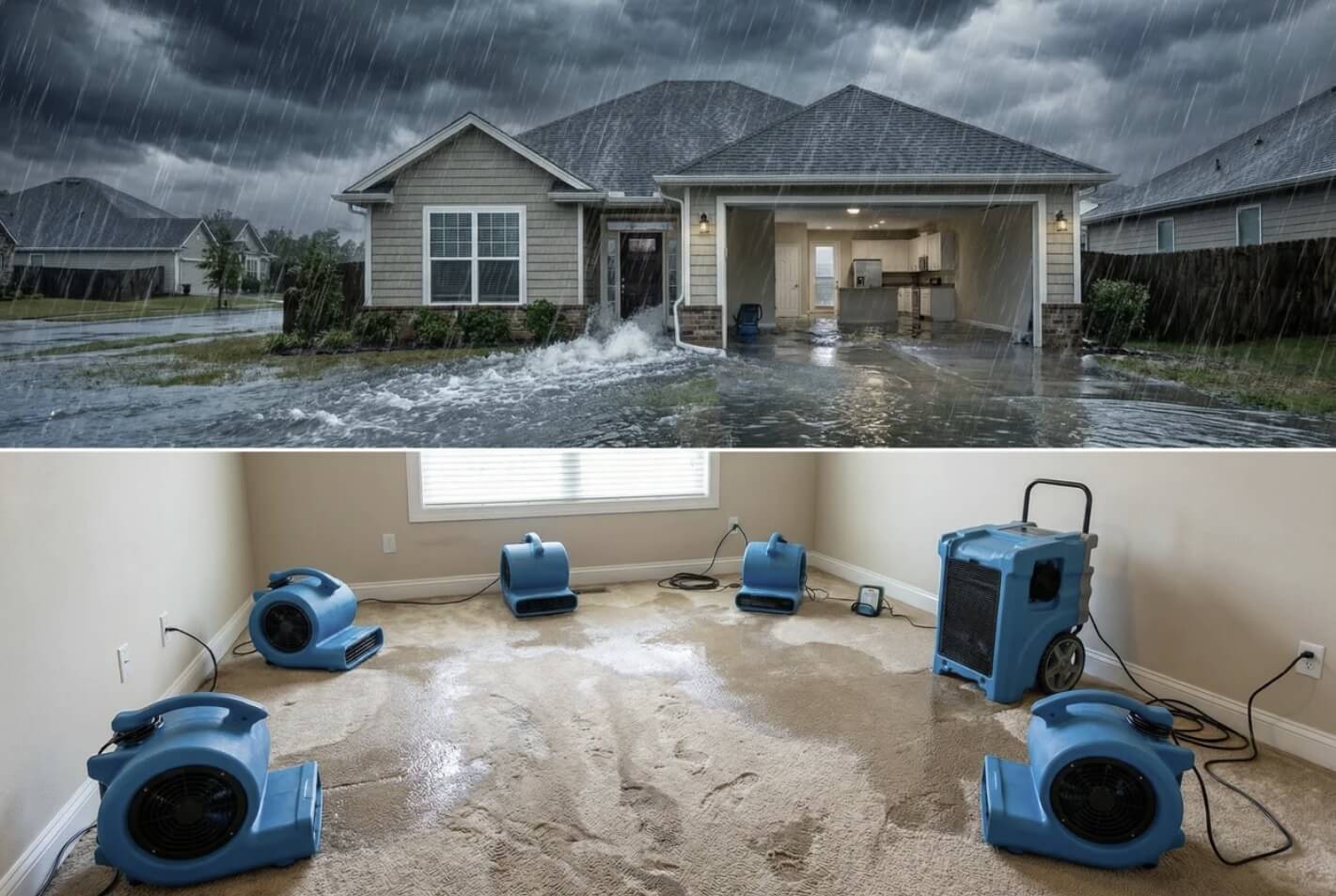
Water damage looks different depending on the property. A burst pipe in a Paddington home is a contained, stressful event for one household. The same failure in a multi-storey commercial building in the CBD can disrupt dozens of tenants, trigger compliance obligations, and run up a claims bill that spans multiple insurance policies.
Understanding what sets residential and commercial restoration apart helps property owners, strata managers, business owners and tenants know what to expect and how to move quickly when it matters.
Scale and Access: The Biggest Differences
The difference between a residential and commercial water damage job is rarely just about square metres. It is about operational complexity.
In a family home, a restoration crew typically works with one household, one insurance policy, and a clearly defined set of affected rooms. Access is straightforward. Decisions are made by the homeowner. The scope is manageable.
Commercial jobs introduce layers that do not exist in residential work. A flooded floor in a Brisbane office building might involve:
- Multiple tenants with separate lease agreements and insurance policies
- Restricted building access after hours or during business operations
- Equipment lifts, loading docks, and movement logistics
- Sensitive assets — server rooms, stock, records, machinery
- WHS obligations for workers and occupants during the restoration process
- Stakeholders ranging from the building owner to facilities managers to individual tenants
Getting the right equipment into a high-rise or large industrial site takes planning that simply does not apply to a three-bedroom house in Carindale.
Commercial restoration also requires detailed documentation from the outset. Insurers, building managers and business owners all have reporting requirements. Restoration teams working on commercial sites are expected to maintain moisture readings, progress reports and evidence trails throughout the job.
That said, not every commercial job is complex. A small flooded office in a single-tenancy building might be restored in a similar timeframe to a residential property. The response should always be proportionate to what is actually there.
Water Damage in Apartments, Townhouses, and Strata
Brisbane’s apartment market has grown significantly over the past decade, and with higher-density living comes a distinct set of water damage challenges.
In a standalone home, water damage is usually self-contained. In an apartment or townhouse, water follows the path of least resistance through shared floors, ceilings, walls and cavities. A washing machine hose that fails on level nine can cause active water ingress through multiple levels before anyone realises there is a problem.
Strata water damage restoration in Brisbane is complicated by several factors:
- Multiple affected lots. Damage may span two, three or more apartments before the source is identified.
- Common property infrastructure. Pipes, drainage and utility infrastructure running through building common areas can be difficult to access without coordinating with the body corporate.
- Building access. Restoring drying equipment in a high-rise typically requires coordination with building management, not just the affected resident.
- Moisture migration. Water that appears in one unit may have originated in another. Identifying the true source is essential before any restoration work begins.
Understanding the difference between surface damp and active water ingress matters particularly in apartments. Condensation, humidity and poor ventilation can create moisture on surfaces that looks like a leak but is not. Active ingress from a plumbing failure or roof penetration requires a different response entirely. Misidentifying the source wastes time and can allow structural damage to worsen.
Thermal imaging and moisture mapping are often essential in multi-level properties to accurately identify where water has travelled, particularly where hidden water damage may have gone undetected for days.
Who Is Responsible: Owner vs Body Corporate?
This is one of the most common questions in strata water damage situations, and there is no single answer that applies to every property.
As a general principle under Queensland law, individual lot owners are responsible for the maintenance and repair of their own lot. Body corporates are responsible for common property, which typically includes common area infrastructure such as shared drainage, roof structures and utility infrastructure running through common areas.
However, responsibility for a specific water damage event depends on several factors:
- Where the water originated
- Whether the source is within a lot or in common property
- The type of infrastructure involved (utility infrastructure may have different rules)
- The specific body corporate arrangements for that scheme
- Whether negligence by another party contributed to the damage
The Queensland Government provides guidance on body corporate maintenance responsibilities and utility infrastructure obligations that is worth reviewing if you are navigating a dispute. Queensland Government guidance on body corporate responsibilities and utility infrastructure outlines the general framework, but individual cases can be more complex.
Do not assume responsibility sits with the body corporate simply because water came from above. Equally, do not assume a lot owner is solely responsible because the leak originated inside their unit. If there is genuine dispute, legal or body corporate advice from a specialist is appropriate.
Regulatory Requirements for Commercial Restoration
Commercial restoration work in Queensland operates within a broader compliance environment than residential work.
Depending on the type and use of the building, restoration teams may need to consider:
- Safe Work practices under Queensland’s WHS framework, particularly where occupants or workers remain in the building during restoration
- Building access requirements, especially in regulated environments such as healthcare, food production or childcare
- Preservation of evidence for insurance investigations before work begins
- Asbestos management plans for older commercial buildings where disturbing building materials may be involved
- Waste and water disposal requirements for contaminated water
Business operators also carry obligations to their staff. If water damage has made a premises unsafe, there are clear obligations around ceasing or restricting operations until the building is safe to occupy again.
Good commercial restoration teams are familiar with these considerations and factor them into how they scope, plan and execute the job.
Insurance Differences: Home vs Business Policy
Residential and commercial water damage claims are governed by fundamentally different policy types, and the differences matter.
Home and contents policies vary significantly between insurers, but they typically cover sudden and accidental damage from events like burst pipes, storm entry and appliance failures. Cover for gradual damage or long-standing leaks is often excluded. If your home insurance covers water damage is a common question — and the honest answer is that it depends on your individual policy and the source of the damage.
Commercial policies introduce additional complexity:
- Business interruption cover may compensate for lost revenue during the period a business cannot trade, but specific conditions and waiting periods apply.
- Multiple policy involvement. A single commercial water damage event can trigger claims across a building owner’s policy, individual tenants’ policies, and public liability cover.
- Documentation requirements. Commercial insurers typically expect more detailed evidence, including moisture readings, photographs and scope reports, before approving works.
- Contents and stock. Commercial contents cover for stock, machinery and equipment is separate from building cover and has its own claim requirements.
Regardless of property type, notify your insurer early, document the damage thoroughly before any work starts, and confirm what the policy requires before restoration works commence.
Equipment and Crew: Commercial Jobs Need More
The scale and layout of a commercial property typically requires more equipment, more personnel and more careful planning than a residential job.
Larger floor areas need more drying units running simultaneously to achieve effective moisture reduction. Commercial jobs may require specialist equipment for high-ceiling spaces, sub-floor cavities, or areas with dense building services infrastructure.
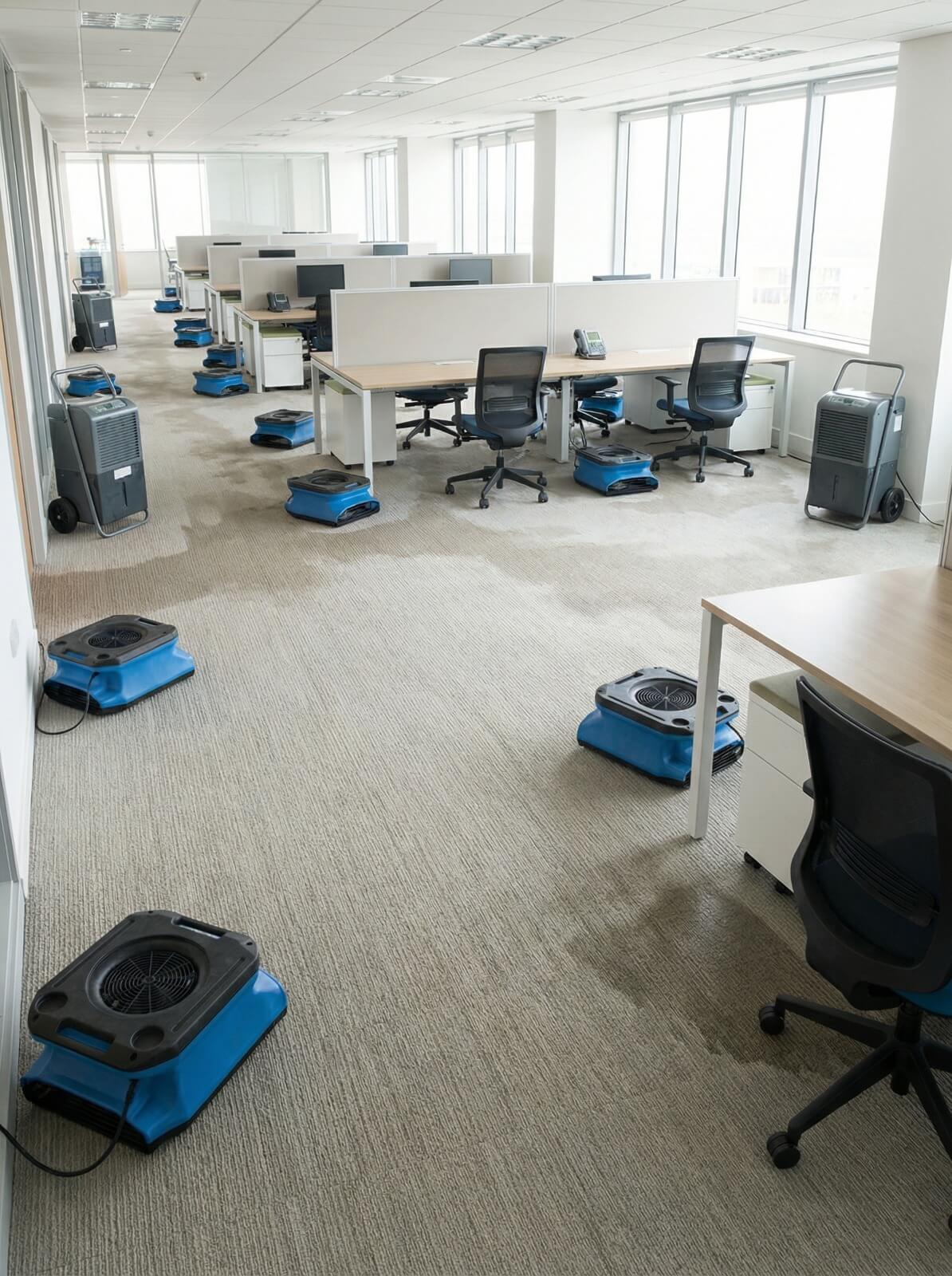
Crew requirements also increase. Documentation, stakeholder communication, safety supervision and equipment management cannot all sit with one person on a large site.
On a residential job, water damage restoration services are typically well-managed by a small team. On a commercial site, particularly a multi-storey or high-traffic property, the team needs to coordinate around building operations while maintaining progress.
Turnaround Time: Residential vs Commercial
Restoration timeframes are driven by the specifics of the job, not the property type alone.
Factors that affect how long restoration takes include:
- The extent and spread of water through the building
- The source of the water and whether it is clean, grey or contaminated
- The materials affected — concrete, timber, plasterboard and carpet all dry at different rates
- Building layout and ventilation
- Current humidity levels and ambient conditions
- Whether the property is occupied during drying
- Insurance approval timelines
- Stakeholder decision-making
Brisbane’s subtropical climate can work against drying in certain seasons. High ambient humidity slows evaporation and can allow mould to establish quickly if drying is not effective. Brisbane residents who lived through the 2011 and 2022 flood events will remember how persistent moisture was in affected buildings, even after floodwaters receded.
A small residential job may be substantially dry within three to five days under the right conditions. A large commercial site may take considerably longer. No honest restorer will promise fixed timeframes without first assessing what is actually there.
Frequently Asked Questions
Can a body corporate make me wait for repairs to my apartment?
Body corporate involvement can add time to a restoration process, particularly where common property is affected. However, urgent repairs to prevent ongoing damage should not be unreasonably delayed. If active water ingress is occurring, document it, notify the body corporate immediately, and seek advice if a response is not forthcoming.
My upstairs neighbour’s washing machine flooded my apartment. Who pays?
This depends on the circumstances. If the neighbour’s negligence caused the failure, they and their insurer may carry liability. If the plumbing that failed is common property infrastructure, the body corporate may be responsible. The source and location of the failure matters. A restoration specialist can help document the event, but responsibility is ultimately a matter for the relevant parties, their insurers and potentially a body corporate dispute process.
Does commercial water damage always take longer than residential?
Not necessarily. A small commercial tenancy with a single affected area may resolve as quickly as a residential job. Larger commercial sites with multiple affected areas, occupied spaces, or complex building infrastructure will take longer. The scope of work determines the timeframe.
What is the difference between surface damp and a water leak?
Surface damp typically refers to moisture accumulating on surfaces due to condensation, high humidity or poor ventilation. It does not involve water entering the building from a source failure. Active water ingress involves water entering through a failure point — a burst pipe, roof penetration, appliance fault or similar. Identifying which problem you are dealing with is the first step in determining the right response.
What should a business owner do first after discovering water damage?
Stop the source of water if it is safe to do so, notify your insurer, and document the damage with photographs before any clean-up begins. Do not allow staff to enter areas that may be structurally compromised or where electrical hazards exist. Engage a qualified restoration team as quickly as possible to contain the spread and begin the assessment process.
Is mould covered by water damage restoration services?
If mould has developed as a direct result of water damage, it is typically addressed as part of the restoration process. Mould that has developed over time due to ongoing condensation or ventilation issues may be treated separately. A thorough moisture assessment will identify the extent and likely cause.