What Is Structural Drying? A Complete Guide for Brisbane Homeowners
Structural Drying 20 August 2026 | Flood Services Brisbane
Structural drying is one of the most critical, and most misunderstood, parts of the water damage restoration process. A floor that looks dry, a wall that feels fine to the touch, can hold moisture levels high enough to grow mould within 48 hours. Structural drying Brisbane services target what you cannot see or feel — the moisture inside the building materials themselves.
Surface Dry vs Structurally Dry: The Difference That Matters
When a flood recedes, the visible water disappears. Carpets may feel damp rather than soaking. Walls may look fine. This creates a dangerous false impression that drying is almost complete.
The reality is different. Porous building materials absorb moisture deeply. Plasterboard holds water in its gypsum core. Timber framing wicks moisture along its grain for metres beyond the water line. Concrete slabs absorb and hold moisture in their pore structure for weeks. Feeling the surface tells you nothing about what is happening inside.
The target moisture content for structural materials after drying is below 16%. Above this level, mould can grow on timber. Above 20%, timber rot bacteria become active. A calibrated moisture meter measures this. Touch cannot.
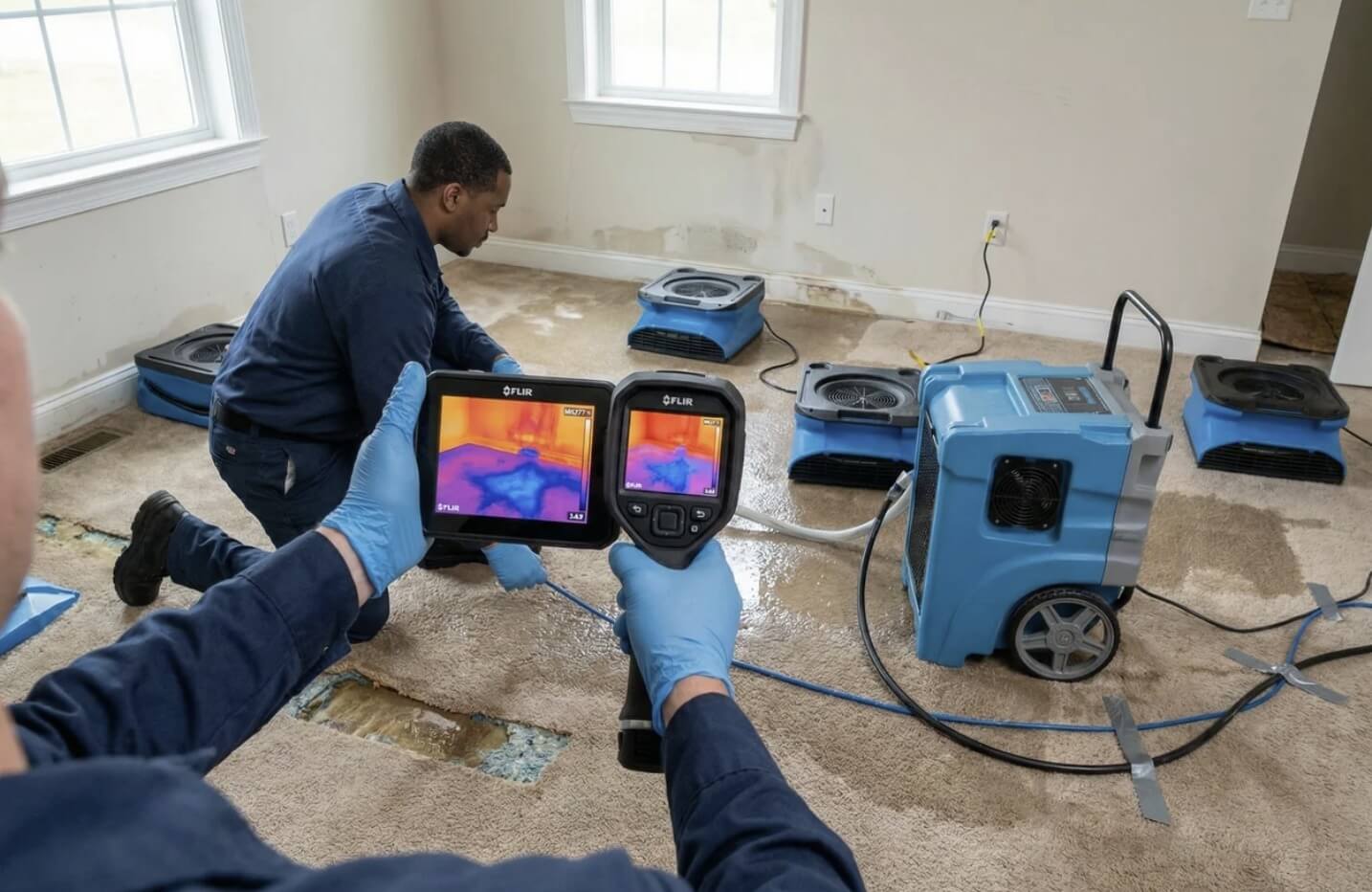
Thermal imaging and calibrated moisture meters confirm actual moisture content inside building materials — not just surface dryness.
Test Method
What It Shows
Is It Reliable?
Touch / Feel
Surface moisture only
No — unreliable
Visual Inspection
Staining, warping, visible mould
Partial — misses hidden moisture
Thermal Imaging Camera
Temperature differentials indicating moisture
Yes — detects hidden moisture
Calibrated Moisture Meter
Actual moisture content (%) inside the material
Yes — the gold standard
What Materials Require Structural Drying?
Timber Framing and Plasterboard
Timber wall framing and plasterboard are the most commonly affected materials after a Brisbane flood event. Both are highly hygroscopic — meaning they actively draw in and hold moisture from the surrounding air. In Brisbane’s humidity, even materials that were not directly flooded can absorb ambient moisture from surrounding wet areas. Structural drying with directed airflow targets these materials from both sides.
Concrete Slabs and Masonry
Concrete is often assumed to be water-resistant. It is not. Concrete is porous and will absorb flood water, retaining it for weeks. Drying a flooded concrete slab on a Brisbane summer requires dehumidification to lower the ambient vapour pressure enough to draw moisture out of the slab. Without this, flooring laid over a damp slab will warp, buckle, or develop adhesion failures within months.
Subfloor and Joists
Subfloor spaces in Brisbane’s raised homes and Queenslanders are some of the most challenging structural drying environments. Damp subfloor timbers in a poorly ventilated crawl space can take two to four weeks to reach safe moisture levels without targeted mechanical drying. Left untreated, wet subfloor joists are a direct cause of structural deterioration, termite attraction, and ongoing mould contamination of the floor above. Our sub-floor, wood and hard floor drying service is specifically designed for these spaces.
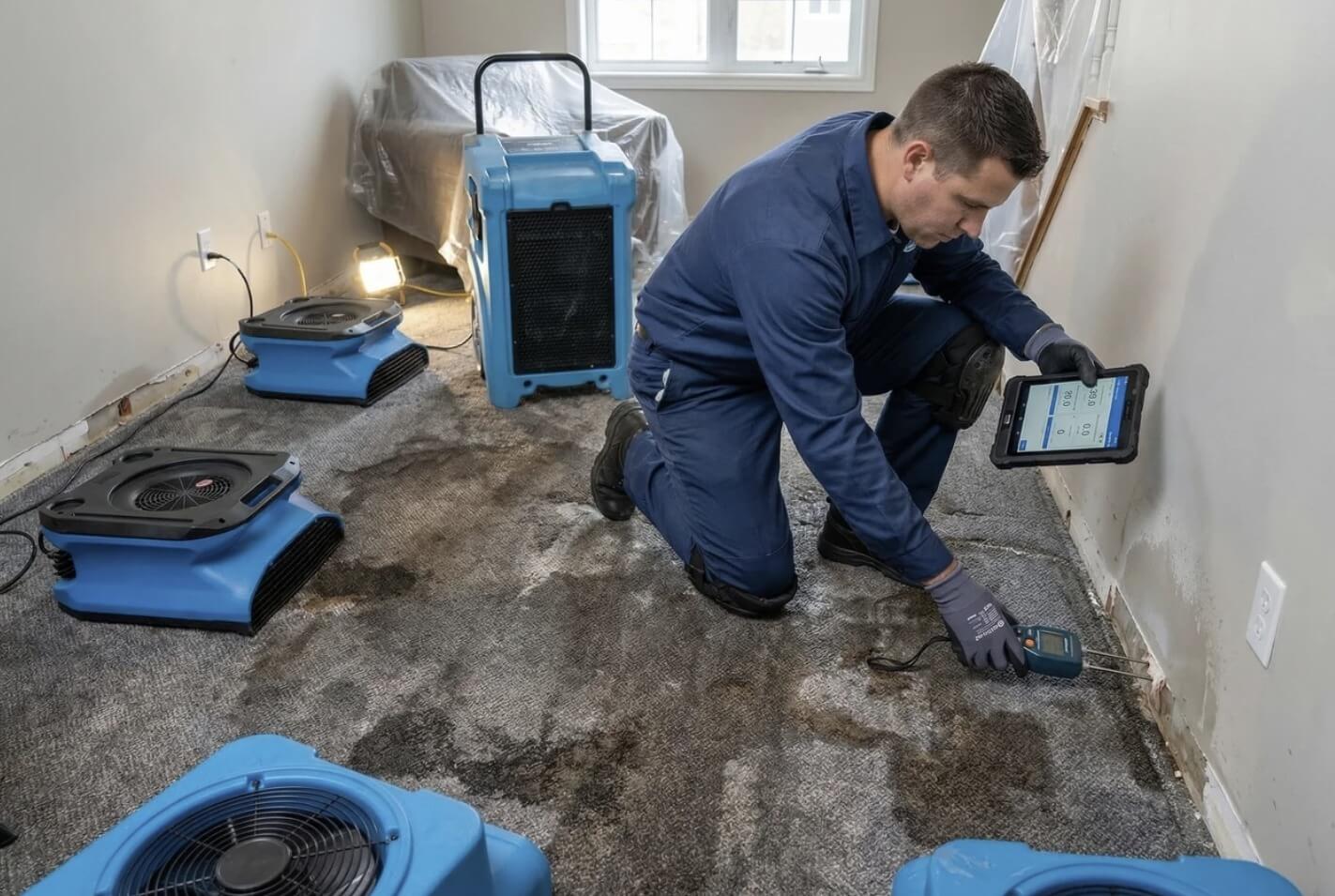
Calibrated moisture meters confirm structural drying is complete before any reinstatement work begins.
Equipment Used in Professional Structural Drying
Not all drying equipment is equal. Industrial-grade tools dry structures in days. Household fans and shop dehumidifiers cannot compete with the moisture volumes involved after a flood.
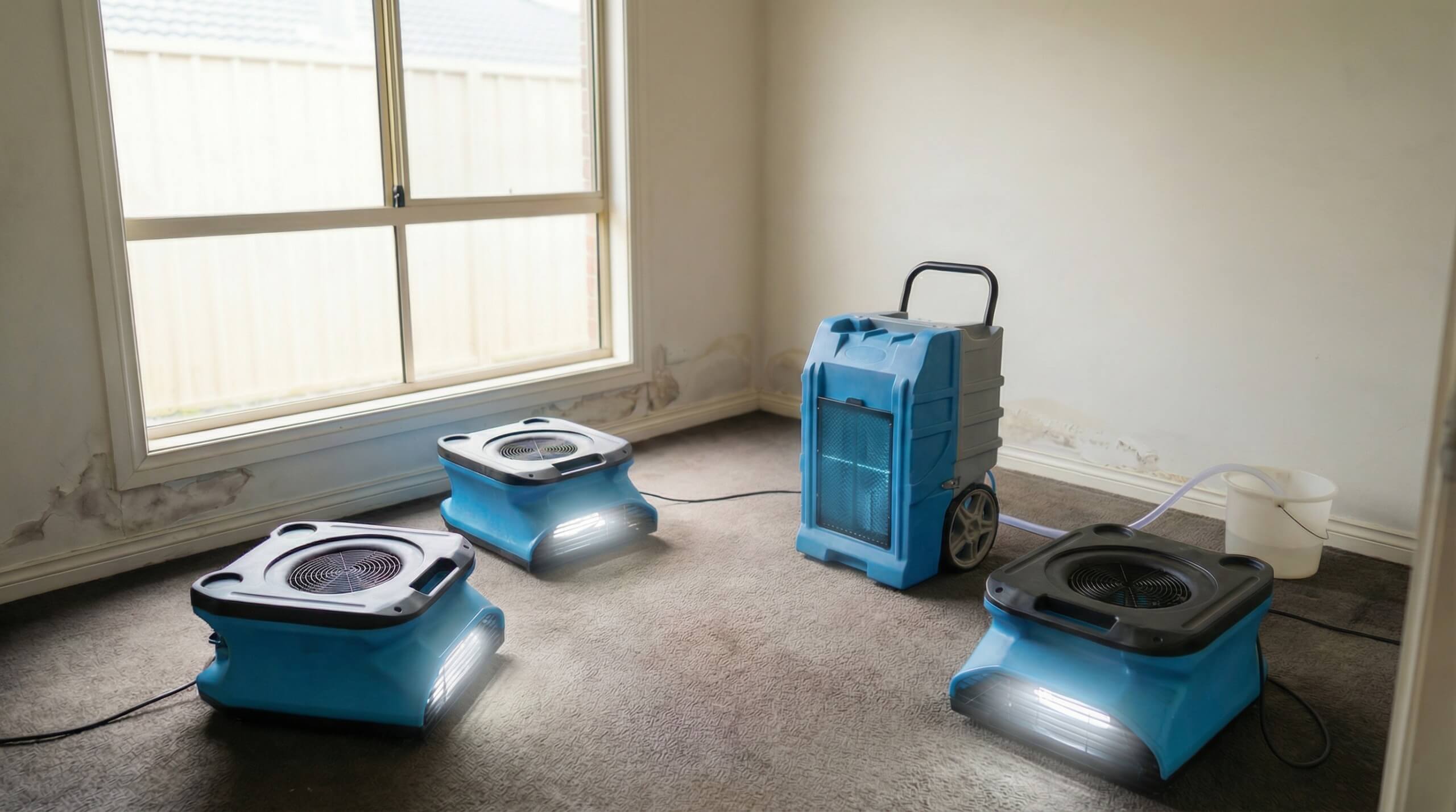
Industrial air movers: high-velocity blowers that direct airflow across and through wet surfaces, accelerating evaporation at the material surface.
Commercial dehumidifiers (LGR): remove moisture from the air as it evaporates from materials, maintaining a low vapour pressure that draws more moisture out.
Thermal imaging cameras: detect temperature differentials that indicate moisture inside walls, ceilings, and floors without invasive access.
Calibrated moisture meters: measure actual moisture content (%) in different material types — pin and non-invasive models for different applications.
Drying mats: applied directly to concrete slabs and subfloor surfaces to direct controlled airflow into the material and extract moisture.
Data loggers: continuously record temperature and relative humidity during the drying period, providing a documented drying curve for insurance purposes.
Need equipment for a smaller job? Flood Services Brisbane also offers professional drying equipment hire — including air movers and dehumidifiers — for Brisbane homeowners who want to manage lower-impact drying themselves.
How Long Does Structural Drying Take in Brisbane?
Structural drying after a flood in Brisbane takes longer than in cooler, drier cities. Brisbane’s ambient humidity — regularly above 70% in summer — competes against the drying process. Dehumidifiers must work harder and longer.
Material
Brisbane Summer
Cooler / Drier Conditions
Carpet and underlay
24–72 hours (if salvageable)
12–48 hours
Plasterboard (light wetting)
2–5 days
1–3 days
Timber framing
5–10 days
3–7 days
Concrete slab (significant saturation)
10–21 days
7–14 days
Subfloor (enclosed, timber)
14–28 days
7–21 days
These are general estimates. Actual drying times depend on the extent of water ingress, the building construction type, how quickly drying equipment was deployed, and the ambient conditions throughout the drying period. Moisture readings confirm completion, not time alone.
The Structural Drying Process: Step by Step
1
Moisture Mapping
Thermal imaging and moisture meters identify all affected materials. A moisture map documents baseline readings throughout the property. This is the starting point for measuring drying progress.
2
Water Extraction
Standing water and surface saturation are removed first with truck-mounted extractors and wet vacuums. Structural drying cannot begin effectively until bulk water is removed. Learn more about our water extraction Brisbane service.
3
Equipment Placement
Air movers are positioned to create a directed airflow pattern across wet surfaces. Dehumidifiers are sized and placed to handle the calculated evaporation load for the affected area.
4
Daily Monitoring
Moisture readings are taken at the same points each day and compared to the baseline map. Equipment is repositioned as drying progresses. Data loggers record conditions continuously.
5
Clearance Report
When all materials reach target moisture content (typically below 16% for timber), a clearance moisture report is issued. This is the document your insurer and builder need before any reinstatement work begins.
Industrial drying equipment runs continuously for days — not hours — to achieve safe structural moisture levels.
Why Brisbane’s Climate Makes Structural Drying Harder
Brisbane’s subtropical climate creates specific challenges for structural drying after flooding that do not apply in Melbourne or Adelaide.
High ambient humidity (typically 65–80% RH in summer) means the air is already close to saturation. Moisture evaporating from wet building materials has less capacity to move into the surrounding air. Dehumidifiers must remove large volumes of moisture from the air before the evaporation gradient between wet materials and the surrounding air is steep enough to draw moisture out efficiently.
Warmer temperatures accelerate mould growth. While warmth can theoretically speed drying, the benefit is outweighed by the mould risk that comes with humid warm conditions. Professionally managed structural drying in Brisbane balances temperature, airflow, and dehumidification to achieve the fastest safe outcome.
Brisbane’s significant proportion of Queenslander and highset homes adds subfloor complexity. Raised timber floors create enclosed subfloor spaces that trap humidity and resist natural drying. These spaces require dedicated subfloor drying equipment and longer drying periods than slab-on-ground homes.
Queensland SES provides emergency guidance for flooding events at qld.gov.au — Queensland Flood Information. Essential reading before and after any significant flooding event.
Why Flood Services Brisbane for Structural Drying
Brisbane-Local Knowledge
We understand Brisbane’s building stock — Queenslanders, highsets, slab homes — and the unique drying challenges each presents.
Industrial Equipment
Truck-mounted extractors, commercial dehumidifiers, thermal cameras, and data loggers — not hire-shop equipment.
Documented Outcomes
Full moisture mapping reports and drying data for insurance claims and builder sign-off.
24/7 Response
Structural drying started within the first 24 hours delivers dramatically better outcomes. We dispatch within 60 minutes.
Need Structural Drying in Brisbane?
Every hour of delay increases damage. Call us now for 24/7 emergency structural drying response. On-site within 60 minutes.
What is structural drying and why is it different from just drying carpet?
Structural drying targets moisture absorbed into the building’s structure — walls, subfloor, timber frames, plasterboard, and concrete — not just surface wetness. Hidden structural moisture causes long-term damage including mould, rot, warping, and concrete cancer if not fully dried by professional equipment. Carpet drying addresses only the surface layer; structural drying addresses the whole building envelope.
How long does structural drying take in Brisbane?
Most structural drying jobs in Brisbane take between 3 and 10 days, depending on the affected materials, the extent of saturation, and Brisbane’s ambient humidity. Concrete slabs and enclosed subfloors can take two to four weeks. We monitor moisture levels daily and only sign off when all materials reach verified safe dryness thresholds — not based on estimated time alone.
How do you know when structural drying is complete?
We use calibrated moisture meters and data loggers to measure moisture content in structural materials. Drying is complete when all readings return to the material’s equilibrium moisture content (EMC) — a scientifically verified standard, not a visual estimate. A clearance report is then issued, documenting all final readings for insurance purposes.
Why does Brisbane’s climate make structural drying harder?
Brisbane’s subtropical humidity (regularly 65–80% RH in summer) means the surrounding air is already close to saturation. This slows the evaporation of moisture from building materials significantly. Dehumidifiers must work harder and longer to create the vapour pressure gradient needed to pull moisture from structural materials. In cooler, drier cities the same job takes considerably less time.
Can I stay in my home during structural drying?
In most cases, yes. Our equipment runs continuously but is manageable to live around. For Category 3 (sewage or floodwater) events, temporary relocation may be recommended for health and safety. We advise you clearly after the initial assessment — we never give a blanket answer without understanding your specific situation.
Is structural drying covered by home insurance?
Yes. Structural drying is typically covered under building insurance for sudden and accidental water damage events. We manage all documentation — moisture logs, drying reports, clearance certificates — and communicate directly with your insurer to make the process straightforward. We work with all major Australian insurers including RACQ, NRMA, Suncorp, Allianz, QBE, and GIO.
Will you need to open my walls to dry the cavities?
Not always. We use injection drying systems that push dry air into wall cavities through small entry points without opening the wall. In cases of severe saturation or high mould risk, controlled removal of plasterboard sections may be recommended — and is covered by most insurers when properly documented.
How much does structural drying cost in Brisbane?
Structural drying costs depend on the affected area, the materials involved, the water category, and how quickly we are called in. The earlier the intervention, the lower the cost.
Job Size
Typical Cost Range
Small (single room)
$1,500 – $3,000
Medium (2–3 rooms)
$3,000 – $6,000
Large (whole floor / subfloor)
$6,000 – $12,000+
We provide a free written assessment before any work begins. Most costs are covered under building insurance for sudden and accidental water events.