How to Use a Dehumidifier for Wet Carpet & Water Damage
Wet carpet is a countdown, not an inconvenience. In Brisbane’s subtropical humidity, that countdown moves faster than most people realise. A dehumidifier is the single most important tool you can deploy, but only if you use it properly. This guide covers exactly how.
Why Use a Dehumidifier for Water Damage?
Carpet holds water in three layers: the pile you can see, the underlay beneath it, and the subfloor below that. A fan alone moves air across the top. It does not pull moisture from deep within the carpet backing or the underlay. That trapped moisture is where mould begins, usually within 24 to 48 hours.
A dehumidifier extracts water vapour from the air. This lowers the relative humidity in the room, which creates a vapour pressure differential between the wet carpet and the surrounding air. Moisture migrates from the carpet fibres into the drier air, and the dehumidifier captures it. Without this process, evaporation stalls and the carpet stays wet for days, even with fans running.
Australia’s AS-IICRC S500:2025 standard, the country’s first nationally recognised water damage restoration framework, defines this as a closed drying system: seal the room, control airflow, and mechanically strip moisture from the air. The science is settled. Open windows work against you.
How a Dehumidifier Helps Dry Wet Carpet
A wet carpet releases moisture into the air through evaporation. If that moisture stays in the room, humidity hits saturation and evaporation stops. The carpet cannot dry any further, no matter how many fans you run.
The dehumidifier breaks this cycle. It pulls humid air across refrigerated coils, condenses the water, drains it away, and returns dry air to the room. That dry air can then absorb more moisture from the carpet. The cycle repeats until the carpet, underlay, and subfloor reach their dry standard, typically 8 to 12 per cent moisture content for timber substrates as specified by Australian building codes.
In practice, a domestic dehumidifier extracts 10 to 20 litres of water per day. A commercial low-grain refrigerant (LGR) unit extracts 30 to 80 litres per day. That is the difference between a damp carpet that smells musty in a week and a fully restored floor.
When a Dehumidifier Is Enough vs. When You Need Professional Help
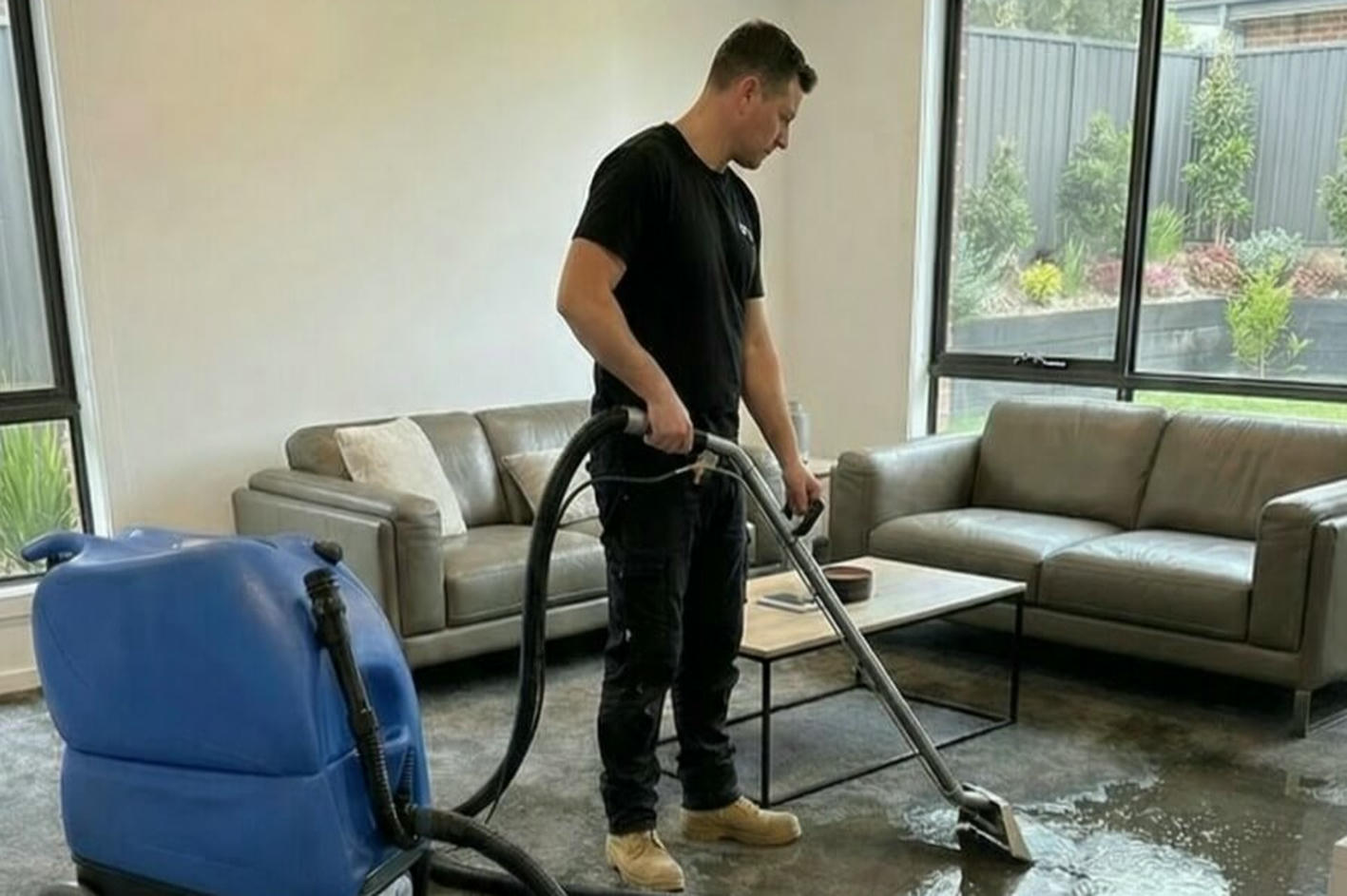
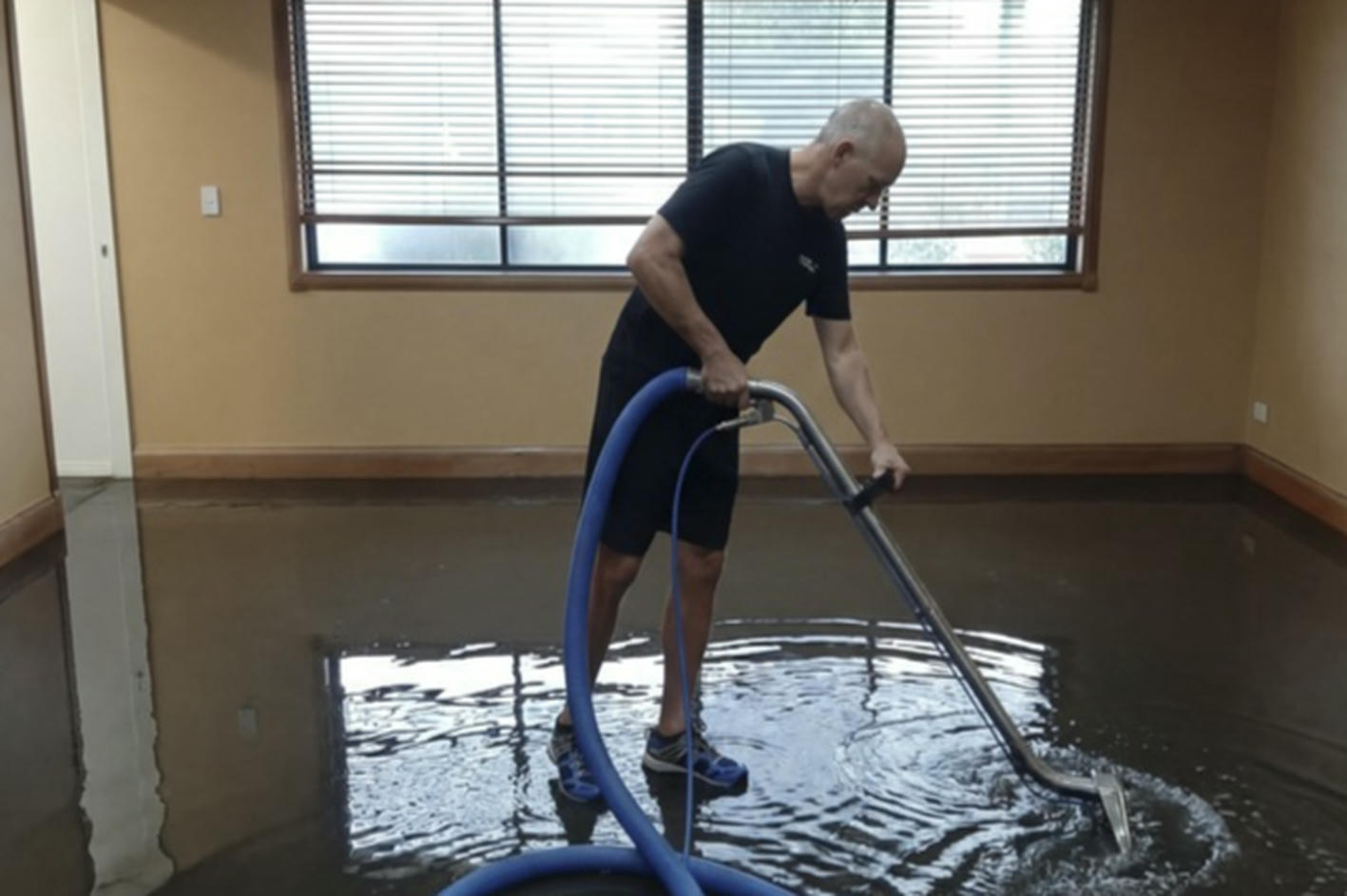
A dehumidifier can handle clean water spills caught early. Burst flexi hose, overflowing sink, a minor leak you caught within hours. Extract standing water first with a wet/dry vacuum, then deploy the dehumidifier in a sealed room.
It stops being enough when:
- Water has saturated the underlay for more than 24 hours
- The water source is grey or black (washing machine overflow, sewage, storm surge)
- Skirting boards, walls, or wall cavities are wet
- You can smell mustiness before you even lift the carpet
- Pressing a paper towel into the underlay shows any moisture transfer after 48 hours of active drying
Under the AS-IICRC S500:2025 standard, Category 1 water (clean) can be managed with extraction and dehumidification within 24 to 48 hours. Category 2 (grey water) requires antimicrobial treatment and PPE. Category 3 (black water) demands full containment, removal of all porous materials, and professional decontamination.
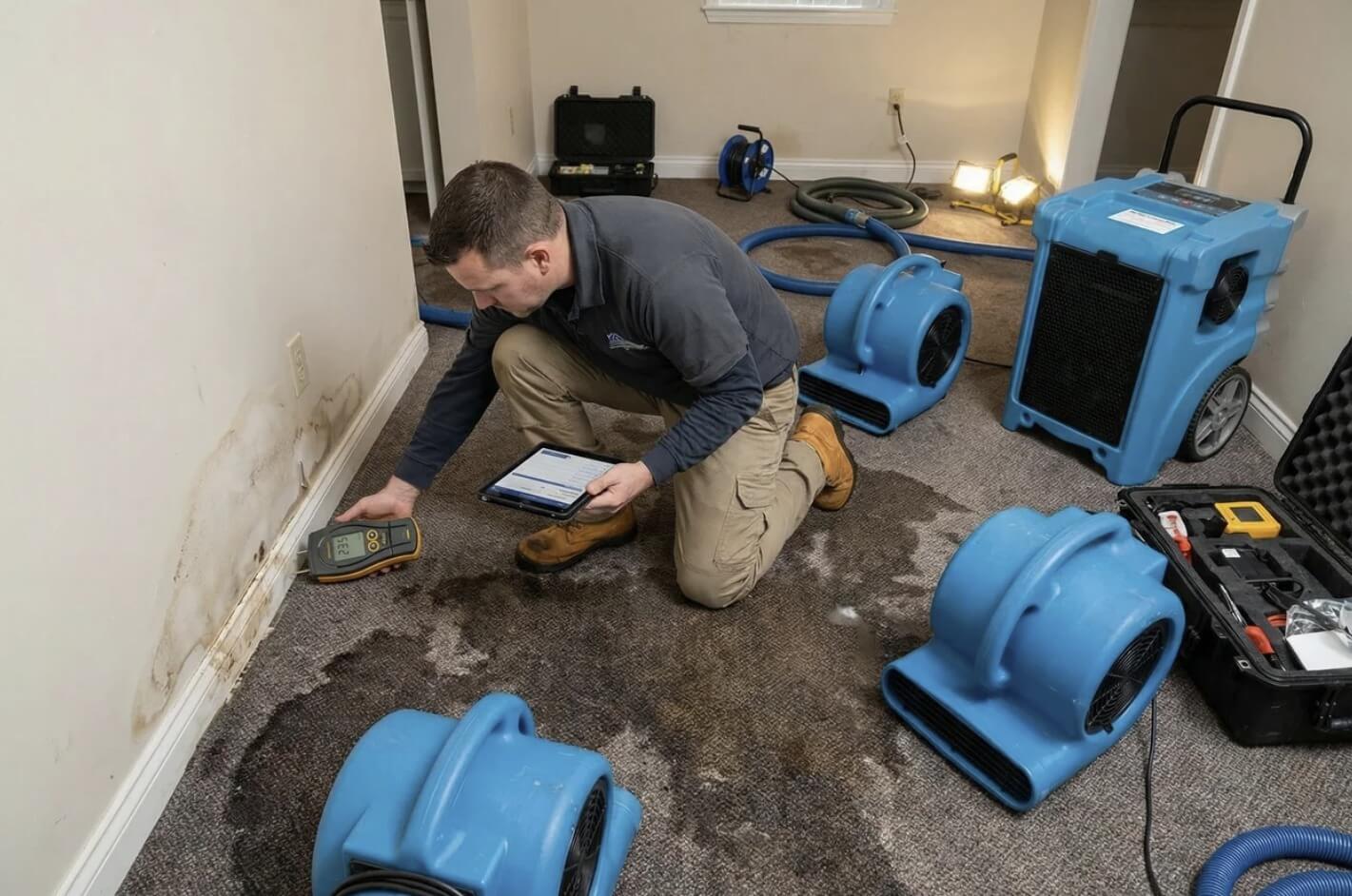
If you are unsure, professional carpet drying services include moisture mapping and thermal imaging to confirm what is actually happening beneath the surface.
How to Use a Dehumidifier to Dry Carpet
Get the sequencing right. Most DIY attempts fail because people skip steps or do them in the wrong order.
How to Use a Dehumidifier for the First Time
Remove the unit from its packaging. Check the filter is clean and seated properly. If it has a continuous drain port and you plan to run it for more than a day, connect a hose now. A full collection tank shuts the unit off, and a stopped dehumidifier does nothing.
Plug it in, switch it on, set the target humidity to 30 to 40 per cent for aggressive drying. Let it run. Do not open the door to check on it every hour. Do not crack a window for fresh air. Every time you let outside air in, Brisbane’s 70 to 80 per cent humidity floods the room and the dehumidifier has to start over.
How to Use a Dehumidifier Correctly: Placement & Setup
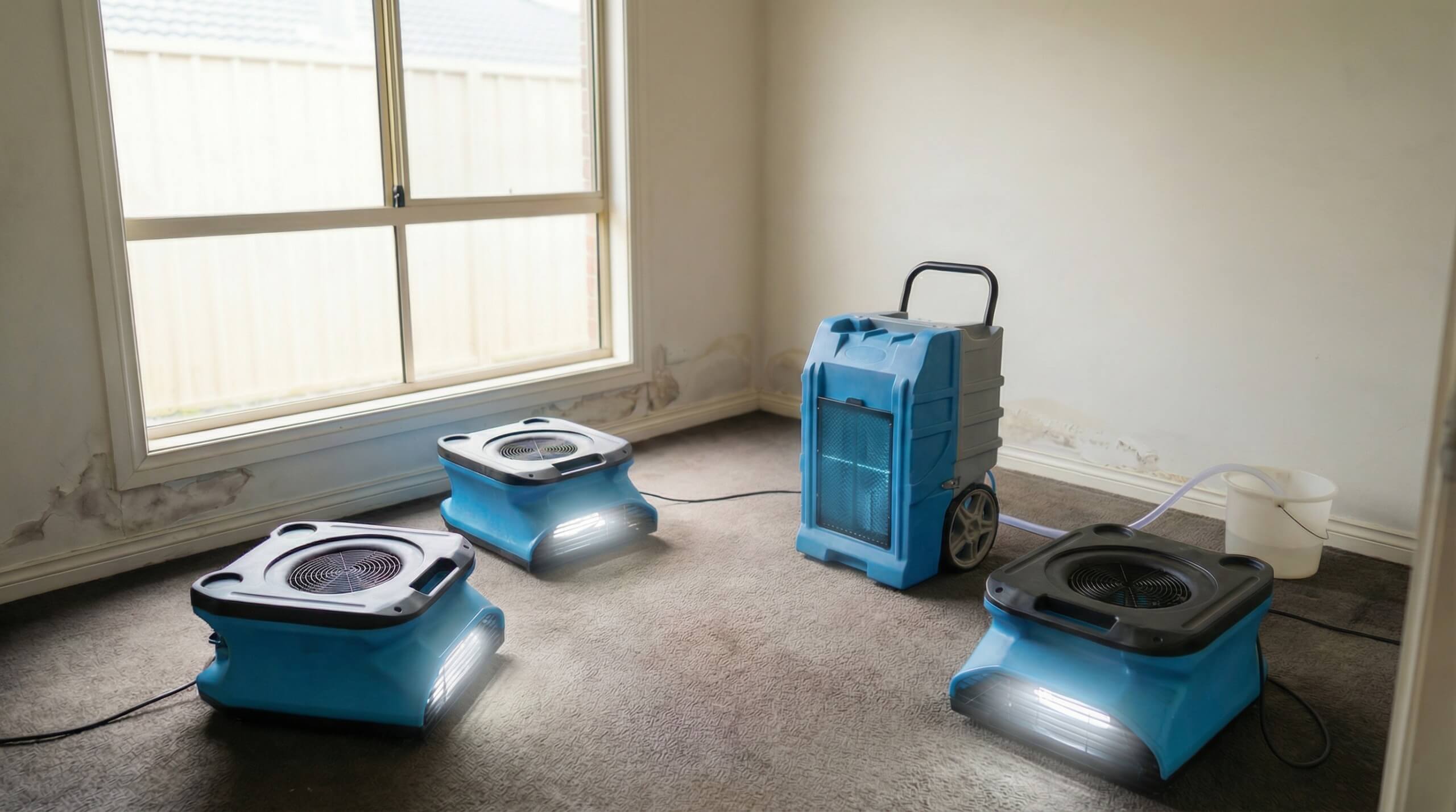
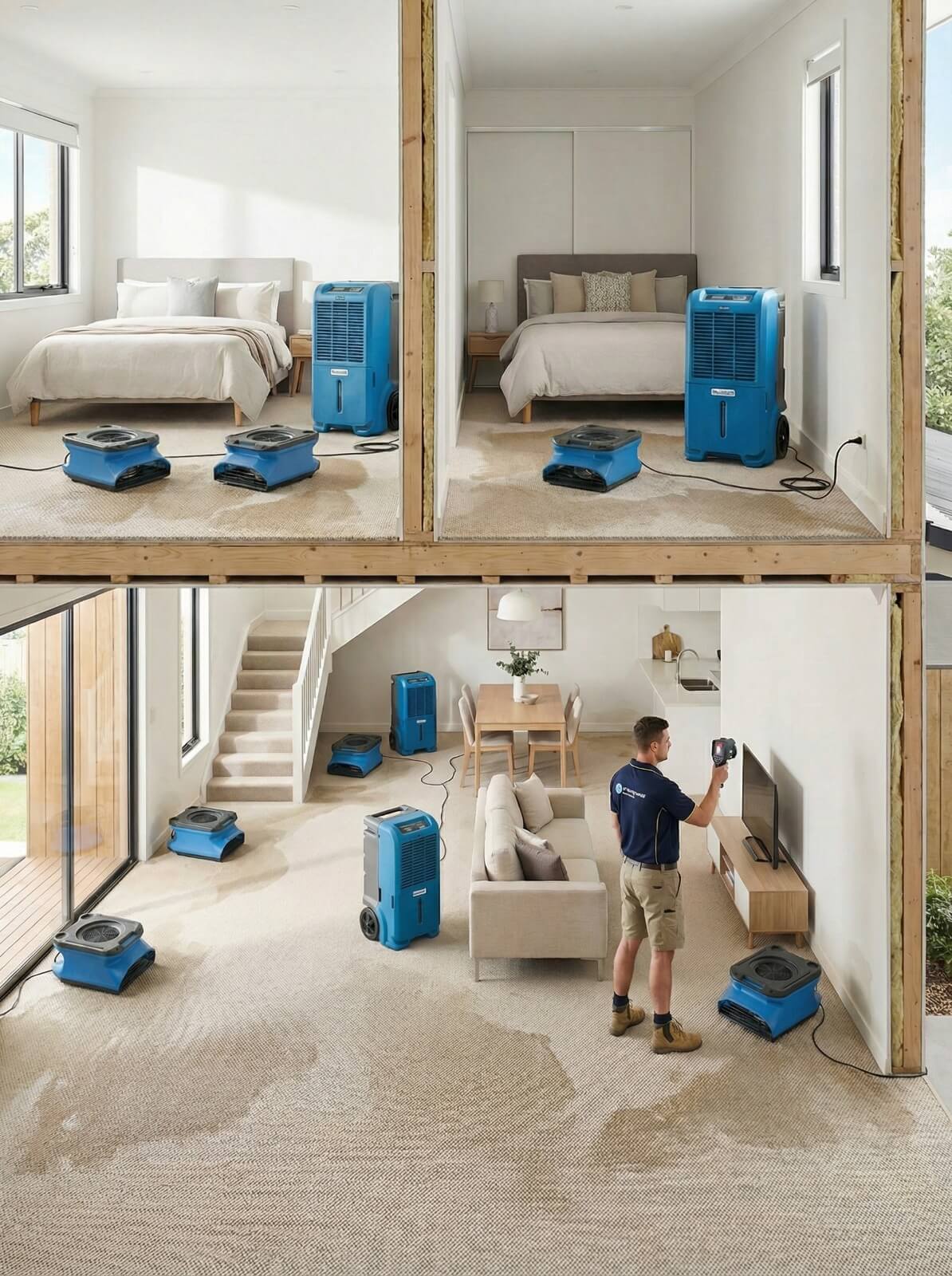
Placement is not negotiable. Put the dehumidifier in the centre of the affected zone. Leave at least 30 centimetres of clearance on all sides. Air needs to enter the intake freely and exit the vent without obstruction.
Close every window and exterior door in the room. If the room is open-plan, close off the affected area with plastic sheeting taped at the edges. A dehumidifier fighting the humidity of an entire house loses.
Position fans at a 45-degree angle to the floor, pointed across the wet carpet surface. The goal is moving the saturated boundary layer of air away from the carpet so evaporation continues. Place fans at opposing ends of the room to create cross-breeze across the entire wet area.
Do not point fans directly at walls. That blows moisture into wall cavities where it condenses and causes secondary damage you will not see for weeks.
How to Properly Use a Dehumidifier: Controls & Settings
Set the humidistat to continuous mode if available, or to the lowest humidity setting, typically 30 per cent. Do not use energy-saver or auto modes. Those settings cycle the compressor off when humidity drops, and you need it running continuously during the first 48 hours.
If the unit has a built-in pump, connect the drain line and route it to a sink, floor waste, or outside. If it relies on a collection tank, check and empty it every few hours. A full tank is a stopped machine. Set reminders. Empty it at 2 am if you have to.
Keep the room temperature between 21 and 32 degrees Celsius. Refrigerant dehumidifiers lose efficiency below 20 degrees. In an unheated Brisbane room during winter, this is rarely a problem, but if you are drying a garage or an unheated space, supplement with a small heater or switch to a desiccant dehumidifier, which works effectively in cooler conditions.
How to Run a Dehumidifier for Maximum Drying
Run it 24 hours a day. Not 12. Not during waking hours. Continuously.
The first 48 hours are critical. Mould spores activate the moment relative humidity exceeds 60 per cent. In Brisbane’s climate, that threshold is crossed within hours of water exposure. Every hour the dehumidifier is off, the room re-humidifies and the clock resets.
A household dehumidifier running 24/7 on a 30 per cent setting should pull the room to a dry state within 2 to 4 days for a moderate clean water incident. Flood-soaked carpet with saturated underlay takes 48 to 72 hours with commercial equipment. These timelines assume the room is properly sealed and fans are running.
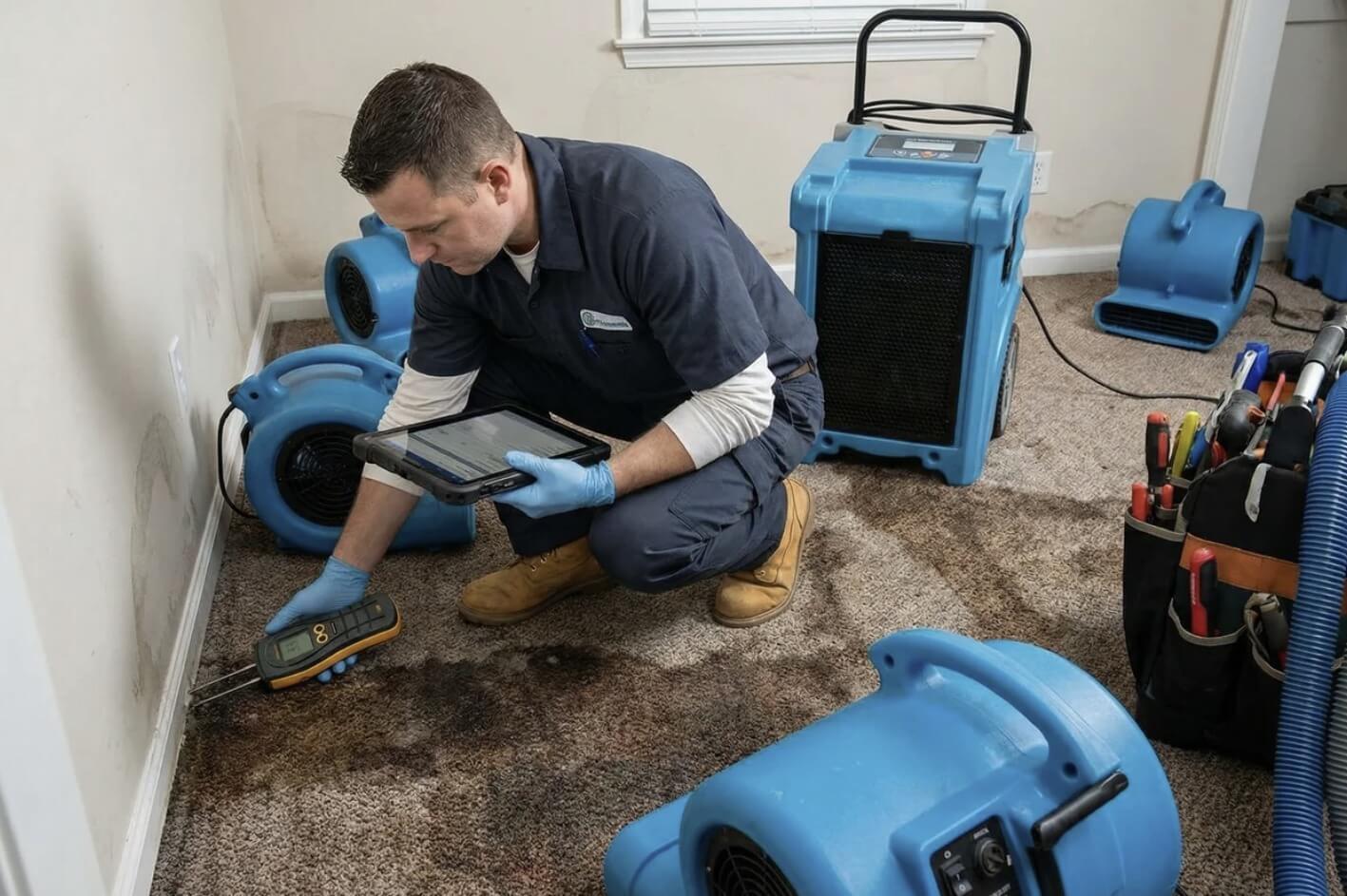
Do not trust the carpet surface. It will feel dry to the touch long before the underlay is safe. Use a moisture meter if you have one. Otherwise, lift a corner, press a dry paper towel firmly against the underlay, and check for any moisture transfer. If you see even a hint of dampness, keep the dehumidifier running.
How to Use a Dehumidifier for Water Damage Restoration
Water damage restoration is a different discipline from drying a spilled drink. The volume is higher, the migration is wider, and the consequences of incomplete drying are structural.
How to Use a Dehumidifier After a Flood
Flood water brings contaminants. Even Category 1 rainwater that has flowed across ground becomes Category 2 the moment it picks up soil, fertiliser, or bacteria. Before you do anything with a dehumidifier, determine what kind of water you are dealing with.
For clean water flooding from a burst pipe or rainwater ingress that has not touched soil:
- Kill power at the switchboard to affected rooms.
- Extract standing water with a pump or wet/dry vacuum.
- Remove furniture and any saturated contents.
- Lift carpet edges and inspect the underlay. If it is sodden, blackened, or smells earthy, it cannot be restored and must be replaced.
- Deploy commercial dehumidifiers and air movers in a sealed room.
- Monitor daily with moisture readings until the subfloor reaches dry standard.
For grey or black water flooding, stop. Do not attempt DIY drying. The AS-IICRC S500:2025 standard requires antimicrobial treatment, containment, and selective demolition for Category 2 and 3 incidents. Call a professional water damage restoration team immediately.
How to Use a Dehumidifier for Damp
Dampness without a specific water event, such as a chronically humid room, condensation on windows, or a musty wardrobe, is a different use case. You do not need the aggressive 30 per cent setting. Set the humidistat to 50 to 55 per cent and run it during daylight hours. The goal is managing ambient humidity, not forcing rapid evaporation from saturated materials. This is maintenance, not restoration.
How to Use a Commercial Dehumidifier
Commercial LGR dehumidifiers are not just bigger versions of household units. They extract 30 to 80 litres per day versus 10 to 20 for a domestic model. They have continuous drainage rather than a collection tank, so they can run unattended for days. They maintain efficiency at lower humidity levels where household units would freeze up and stop.
If you rent a commercial unit from a Brisbane dehumidifier hire provider, it arrives pre-configured and ready to plug in. Connect the drain hose to a floor waste, set the target humidity, and let it run. The hire company handles delivery, setup guidance, and pickup. For a single affected room, one unit with 2 to 3 air movers is typically sufficient. For a full ground floor, you may need 4 to 15 units depending on square metreage and saturation class.
Best Dehumidifier for Wet Carpet: What to Look For
For carpet drying after water damage, you want a refrigerant (compressor) dehumidifier, specifically an LGR model if you can access one. LGR units maintain high water removal rates even as the room dries out, where standard refrigerant units slow down.
Key specs to check:
- Water removal rate: Minimum 20 litres per day for a single room; 50 litres or more for larger areas or saturated underlay
- Continuous drainage: A collection tank that fills every 4 hours is useless for 24/7 drying. Look for a drain port and pump.
- Operating temperature range: Refrigerant units work best above 20 degrees Celsius. If the affected room is unheated or cold, a desiccant dehumidifier is the better choice, though it uses more power.
- Digital humidistat: You need to set and monitor the exact target humidity. Mechanical dials are imprecise.
Household brands like Ionmax, Ausclimate, and Breville sell compressor dehumidifiers with 16 to 25 litre per day capacity. These handle small spills and single-room incidents. For anything involving saturated underlay or multiple rooms, rent a commercial unit.
Rental vs. Purchase: Dehumidifier for Wet Carpet Rental
A household dehumidifier costs $200 to $600 to buy. It will extract 10 to 20 litres per day and struggle with anything beyond a small clean water spill. For a one-off incident, buying one makes sense only if the affected area is small and you caught it early.
Commercial LGR dehumidifier rental costs roughly $80 to $150 per day, depending on capacity and hire duration. These units extract 30 to 80 litres per day and are designed specifically for water damage restoration. They connect to continuous drainage and run 24/7 for days without intervention.
For a moderate clean water incident in one room, a 3 to 5 day rental at $80 to $150 per day costs $240 to $750. This is significantly less than the cost of replacing carpet and underlay, which typically runs $60 to $120 per square metre installed. The maths favours renting proper equipment, using it correctly, and drying the carpet fast.
How Much Does It Cost to Use a Dehumidifier?
A household dehumidifier draws 300 to 500 watts. At the current Australian average electricity rate of roughly 30 to 35 cents per kilowatt-hour (with SE Queensland rates dropping 7.2 per cent from July 2026), running a 400-watt unit 24 hours a day costs approximately $2.90 to $3.40 per day.
A commercial LGR dehumidifier draws 700 to 1,000 watts. Running 24/7, it costs about $5.00 to $8.40 per day in electricity.
Air movers add $0.50 to $1.00 per unit per day. A typical single-room setup with one dehumidifier and three air movers costs $4.50 to $11.00 per day in total electricity. Over a 3 to 5 day drying period, the total power cost is $15 to $55.
Dehumidifiers do not use a lot of electricity compared to air conditioners, clothes dryers, or pool pumps. The cost is modest relative to the alternative: replacing water-damaged carpet, underlay, and potentially subfloor sections.
When to Call a Professional
Call a professional if:
- Water has been sitting for more than 24 hours
- The water source is anything other than clean tap water
- Walls, skirting boards, or wall cavities are wet
- The carpet underlay is saturated or smells musty
- You have lifted the carpet and the subfloor is discoloured, swollen, or damp
- Mould is already visible anywhere in the room
- You are dealing with multiple rooms or a whole floor
- An insurance claim is involved and you need documented moisture readings
Professional water damage restoration follows the AS-IICRC S500:2025 standard. Certified technicians use moisture mapping, thermal imaging, industrial air movers, and commercial dehumidifiers to dry the structure completely. They monitor daily and document every reading. This documentation is critical for insurance claims.
For fast emergency response in Brisbane, a water damage restoration specialist can be on site within 60 minutes, 24/7.
If you are attempting DIY drying, read our step-by-step guide to drying wet carpet quickly for extraction techniques, fan placement, and the full emergency protocol.
Frequently Asked Questions
How long should I run a dehumidifier on wet carpet?
Run it continuously until the carpet, underlay, and subfloor are completely dry. For a moderate clean water incident in a single room, this is typically 2 to 4 days with a domestic unit or 1 to 3 days with a commercial unit. Flood-soaked carpet with saturated underlay takes 48 to 72 hours with commercial equipment. Do not stop when the surface feels dry. Verify with a moisture meter or the paper towel test against the underlay.
Can a dehumidifier dry carpet completely?
Yes, but only if the water is Category 1 (clean), the incident is caught early, the room is properly sealed, and the underlay has not degraded. A dehumidifier cannot restore underlay that has already begun to rot or harbour mould. It cannot sanitise grey or black water contamination. In those cases, the underlay must be removed and replaced after the subfloor is dried.
Should I rent or buy a dehumidifier for water damage?
For a one-off clean water incident in a single room, buying a $200 to $400 household unit may be sufficient. For anything involving multiple rooms, saturated underlay, or flood water, rent a commercial LGR unit. A $400 household dehumidifier cannot match the extraction rate of an $80 to $150 per day commercial unit. The faster you dry, the lower the mould risk and the higher the chance of full carpet restoration.
Where should I place a dehumidifier for wet carpet?
In the centre of the affected room, with at least 30 centimetres of clearance on all sides. Close all windows and doors. Place fans at opposing ends of the room at a 45-degree angle to the floor, pointed across the wet carpet. Do not place the dehumidifier against a wall or in a corner. Do not point fans at walls or skirting boards.
Need help now? Flood Services Brisbane provides 24/7 emergency water damage restoration, commercial dehumidifier hire, and professional carpet drying across Brisbane. Call 07 3185 0987 for immediate assistance.