Mould After a Flood in Brisbane: How to Find, Test, and Remove It
TL;DR
- Mould can begin growing within 24 to 48 hours of a flood in Brisbane’s climate — often sooner in summer.
- Most post-flood mould is hidden — inside wall cavities, under carpet, and in subfloors. Surface appearance means nothing.
- DIY removal is not safe for flood-related mould. Floodwater is Category 3 contamination.
- Professional remediation plus a clearance report is what most insurers require before reinstating.
A flood leaves behind more than mud and waterlogged furniture. In Brisbane’s subtropical climate, it leaves behind the conditions mould needs to thrive. Warm temperatures, high ambient humidity, and saturated building materials create a race against the clock that many homeowners do not know they are in.
The good news: if you act within the right window, mould is preventable. If it has already taken hold, it is treatable. This guide walks you through what to look for, when to test, and how to get your home safe again.
How Fast Does Mould Grow After a Brisbane Flood?
Faster than most people expect.
Mould spores are present in every home, dormant on walls, timber, and dust. They need three things to activate: moisture, an organic surface to feed on, and warmth. Brisbane provides the last two year-round. A flood delivers the first.
Under Queensland Health guidance, mould can begin growing within 24 to 48 hours of a water event. In Brisbane’s summer conditions, with indoor relative humidity regularly sitting above 70% and temperatures rarely dropping below 20°C, that window can be shorter. Materials like plasterboard and carpet underlay absorb moisture rapidly and begin supporting mould growth before they even feel damp to touch.
At 24 hours: spores are germinating but not yet visible.
At 48 hours: colonies are forming on porous surfaces.
At 72 hours and beyond: mould is spreading, structural materials are degrading, and remediation costs are rising fast.
For a detailed breakdown of the mould growth timeline after water damage, see How Long Does Mould Take to Grow After Water Damage.
One important distinction Brisbane homeowners need to understand: surface damp is not the same as active water ingress. Condensation (humid air hitting a cooler surface) causes surface-level moisture that dries when conditions improve. Flood damage is categorically different. Floodwater penetrates deep into wall cavities, subfloor spaces, and structural timber. These two problems require entirely different responses. Treating a flood-affected wall like a condensation patch will not work, and attempting DIY surface cleaning while moisture sits inside the structure is the most common reason mould returns.
Where to Look for Mould After Flooding
Mould rarely stays where you can see it. In the aftermath of a Brisbane flood, the most dangerous growth is the kind hiding inside your walls, under your floors, and in your subfloor.
Before you start: if floodwater reached electrical outlets, ceiling cavities near light fittings, or the switchboard, switch off power at the mains before entering the affected areas.
Inside Walls and Ceiling Cavities
Plasterboard (also called gyprock or drywall) is one of the most flood-vulnerable materials in a home. Once its gypsum core absorbs water, it loses structural integrity quickly. Mould colonies begin forming inside the paper face and behind the board where no amount of surface cleaning will reach them.
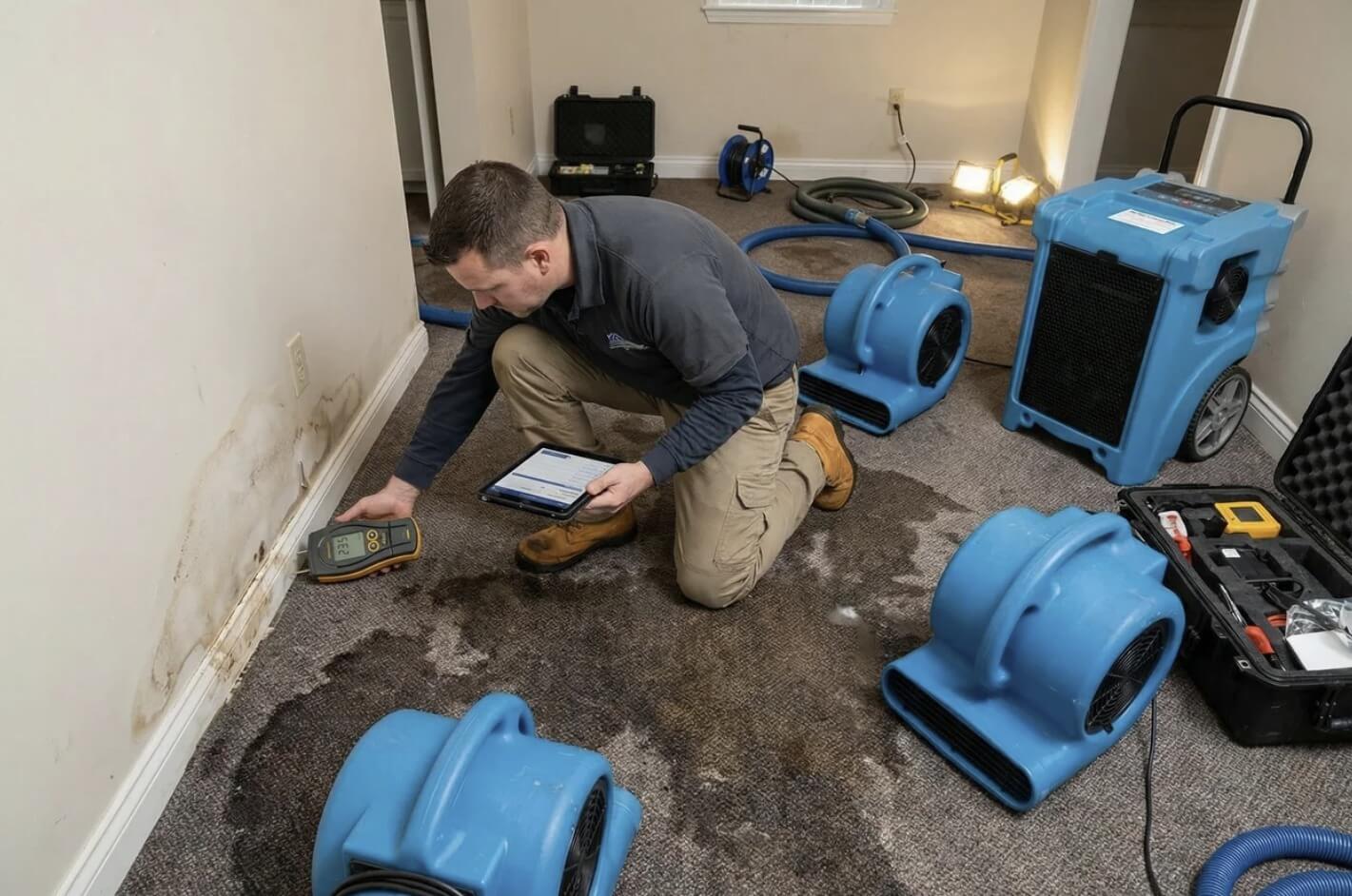
Signs that mould has taken hold inside walls include:
- A persistent musty, earthy smell concentrated near a specific wall
- Paint bubbling or separating from the surface
- Skirting boards darkening along the bottom edge or pulling away from the wall
- Discolouration spreading from a corner or junction
Ceilings tell a similar story. Dark, circular stains that appear after rain or following a flood are reliable indicators of moisture trapped above the plasterboard. Mould on ceilings rarely spreads randomly. It follows the moisture pattern outward from the source.
For a full breakdown of what these signs mean, Signs of Hidden Water Damage covers walls, ceilings, and floors in detail.
Under Carpet and Flooring
Carpet and its underlay act like a sponge. Floodwater saturates both within minutes, and the underlay (a porous foam or felt layer sandwiched between the carpet and the subfloor) stays wet long after the surface appears dry.
Dark mould staining typically appears at the edges of carpet, along skirting boards, and at the base of furniture legs. If you can lift a corner of the carpet and detect a sour or musty smell, growth has likely already started in the underlay.
Timber and laminate flooring present differently. Cupping — where the edges of individual boards rise higher than the centre — indicates moisture is being absorbed from below. Once boards begin cupping, the subfloor beneath them is already wet.
In most cases, flood-affected carpet underlay cannot be saved. It needs to be removed and replaced as part of the water damage restoration process.
Subfloor and Timber Framing
This is where Brisbane’s distinctive housing stock creates a specific vulnerability. Older Queenslander homes, raised-floor properties with tongue-and-groove timber walls and VJ cladding, have subfloor cavities that trap humid air after a flood. Water enters the subfloor space, the timber absorbs it deeply, and the enclosed cavity prevents it from evaporating.
Without targeted structural drying, a Queenslander subfloor can develop active mould growth inside timber framing within days of a flood event. At 72 hours, structural timber begins to degrade. Rot follows. This is not a cosmetic problem. It is a structural one.
Signs of subfloor mould include:
- A musty smell that intensifies at floor level or near subfloor vents
- Soft spots or sponginess when walking across timber floors
- Gaps appearing between floorboards where none existed before
Modern slab homes are not immune. Floodwater can saturate the concrete slab and wick upward into floor coverings and wall bases. Concrete holds moisture far longer than people expect, creating mould-friendly conditions that persist weeks after the flood.
How to Test for Mould After Flooding
If you can see or smell mould following a flood, testing is rarely necessary before beginning professional mould remediation. Visible mould after a water event is already enough to warrant professional response.
Testing becomes valuable in two specific situations:
- When mould is suspected but not visible. A musty smell with no visible growth usually means mould is inside a wall cavity, under flooring, or in the roof space. Professional mould inspection using thermal imaging cameras and calibrated moisture metres can locate the source without opening walls unnecessarily.
- After remediation is complete. Post-remediation clearance testing confirms that mould spore counts have returned to safe ambient levels. Most Australian insurers require a clearance report before authorising reinstatement costs. This is professional air sampling, not a consumer test kit.
A note on DIY test kits: the mould test kits sold at hardware stores are unreliable as a sole diagnostic tool. They detect the presence of spores, but mould spores exist in every home. A positive result tells you spores are present (which is always true), not whether you have an active growth problem or where it is. After a flood, professional moisture mapping is a far more useful first step than a surface swab kit.
WorkSafe Queensland guidance notes that professional assessment is recommended wherever mould is associated with a water damage event, particularly for anything beyond a small, isolated, non-porous surface.
Is DIY Mould Removal Safe After a Flood?
In most post-flood situations, DIY mould removal is not appropriate.
Here is the honest picture:
| Situation |
DIY Appropriate? |
| Surface mould on non-porous material (tiles, glass), under 0.1 sqm |
Possibly, with correct PPE |
| Mould on plasterboard, timber, or carpet (any size) |
No |
| Any mould area larger than 0.1 sqm |
No |
| Mould following flooding or stormwater ingress |
No |
| Mould inside wall cavities or subfloors |
No |
| Occupants experiencing respiratory symptoms |
No. Call immediately. |
The key issue with flood-related mould is water category. Rising floodwater and stormwater are classified as Category 3 contamination, meaning they carry bacteria, pathogens, and chemical contaminants in addition to the mould risk. Attempting DIY cleaning of flood-affected surfaces without proper containment protocols risks spreading spores to unaffected rooms, and puts the person cleaning at genuine health risk.
Queensland Health specifically advises that people with asthma, allergies, compromised immune systems, or chronic lung conditions should not be present during mould removal, regardless of scale. Children under five and the elderly fall into the same category.
If you want to manage a very small, isolated, non-porous surface — a tile grout line, a glass shower screen — use an N95 mask, rubber gloves, disposable coveralls, and an antifungal cleaner. Bag and dispose of all materials used in cleaning. Do not dry brush mould — this releases spores into the air.
For anything on porous materials, anything larger than a dinner plate, or anything following a flood event, professional remediation is the safe and correct path.
The Professional Mould Removal Process After Flooding
Effective mould remediation is a structured, multi-step process. A spray-and-wipe approach does not work on flood-related mould, because the moisture source has already driven growth deep into building materials.
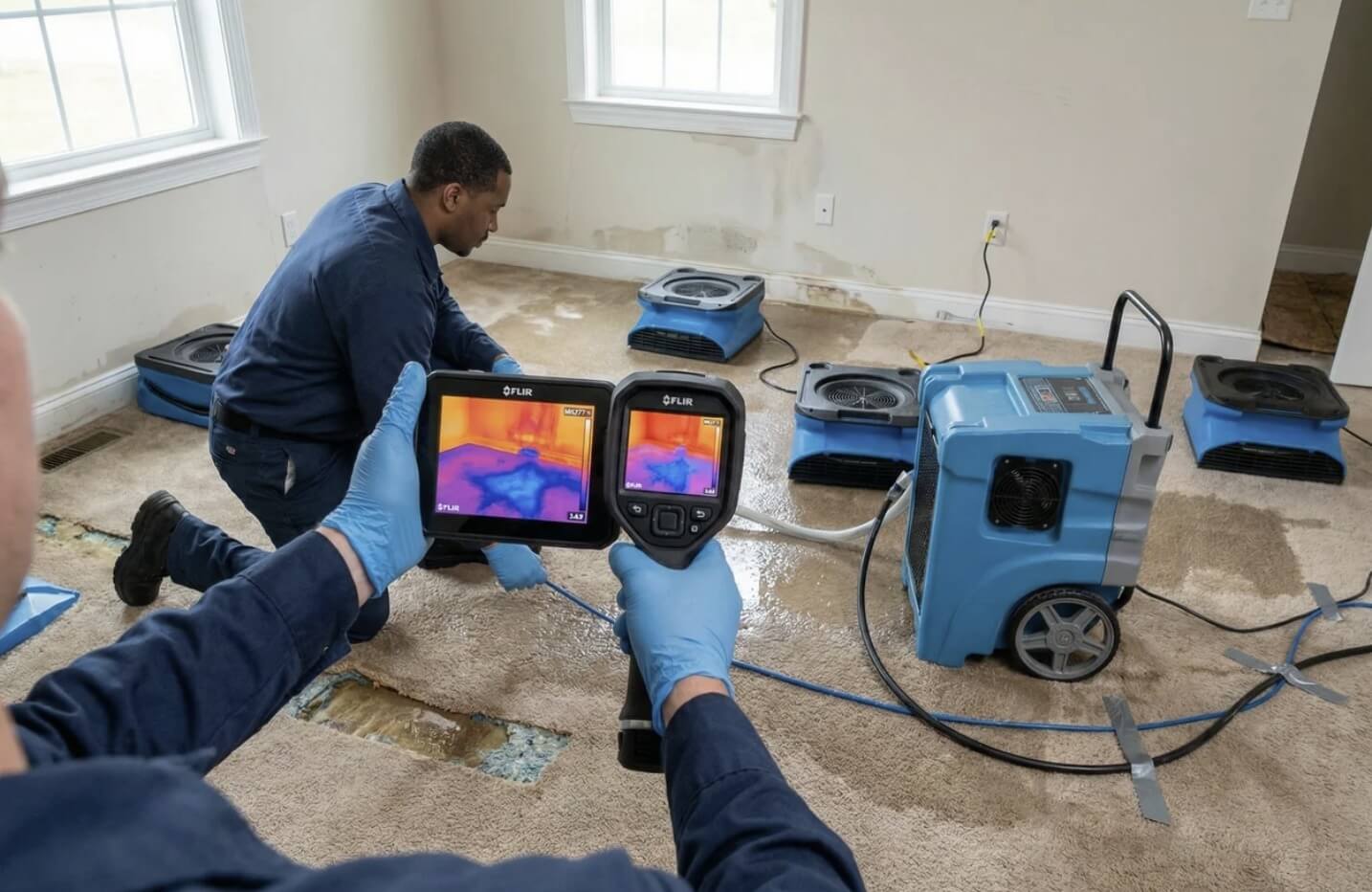
Step 1: Assessment and moisture mapping. Technicians use thermal imaging cameras and calibrated moisture metres to map the full extent of growth and identify the moisture source. Visible mould is typically only a fraction of the affected area.
Step 2: Containment. The affected zone is sealed with heavy-duty plastic sheeting and negative air pressure is established. This prevents spores from spreading to unaffected rooms during removal.
Step 3: HEPA air scrubbing. Industrial HEPA air scrubbers run continuously throughout the job, capturing airborne spores at the 0.3-micron level. Standard household air filters cannot capture spores at this size.
Step 4: Controlled removal. Depending on material type and contamination level, removal methods include HEPA vacuuming, controlled abrasive removal, or the removal and biohazardous disposal of affected porous materials such as plasterboard, insulation, and carpet underlay.
Step 5: Antimicrobial treatment. All affected surfaces are treated with IICRC-approved antimicrobial solutions that eliminate remaining mould at a cellular level and inhibit future colonisation.
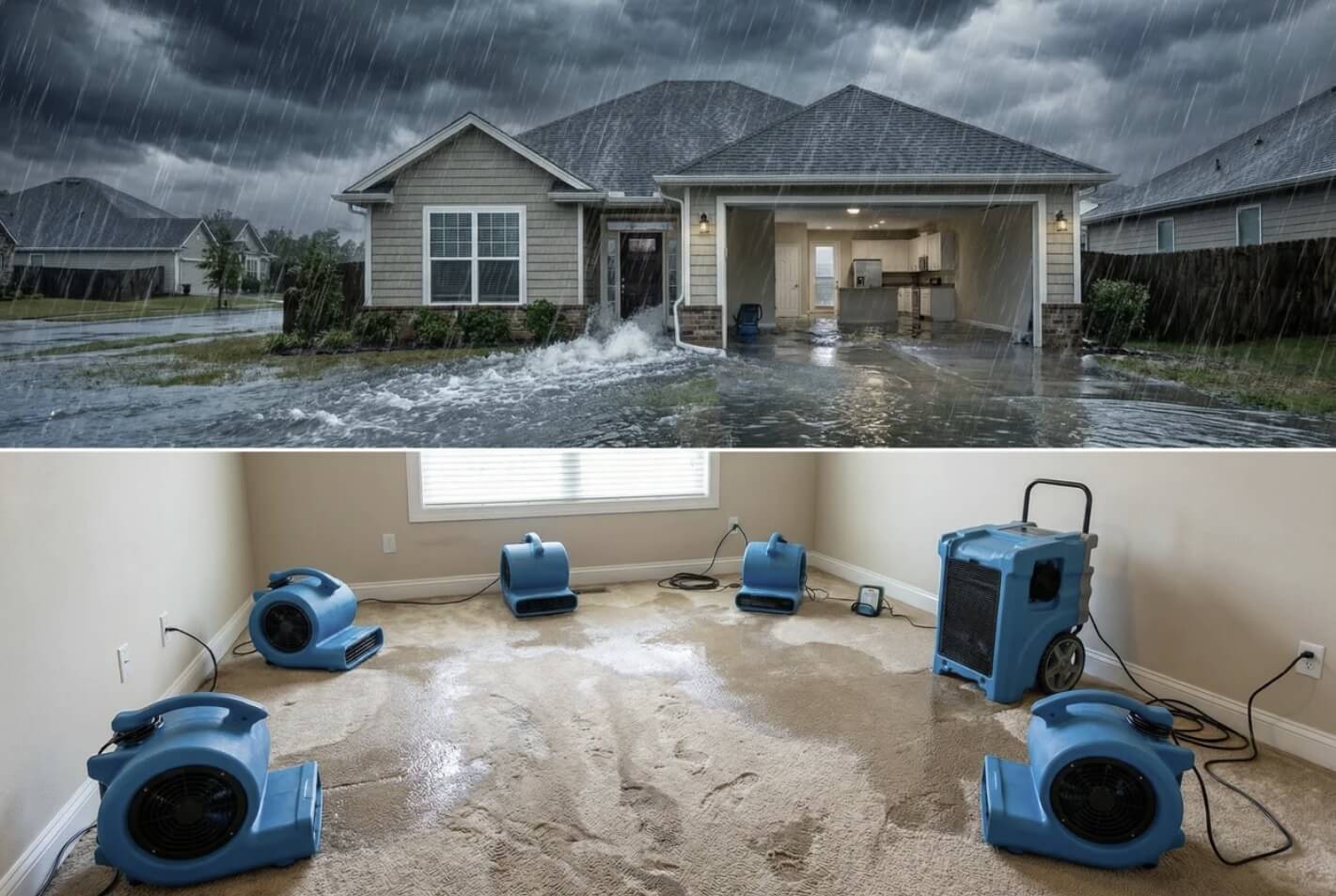
Step 6: Structural drying. Mould returns when moisture returns. All affected structural materials are dried to verified moisture thresholds using LGR dehumidifiers and high-velocity air movers before any reinstatement work begins.
Step 7: Clearance testing and documentation. Post-remediation air testing confirms mould spore counts have returned to safe ambient levels. A full remediation report is issued, a document required by most Australian insurers as part of the claims process.
Does Insurance Cover Flood Mould Removal?
In many cases, yes. But the specifics matter.
Most standard Australian home and building insurance policies cover mould remediation when it results directly from a sudden, accidental, insured water event. A flood, burst pipe, or severe storm event typically qualifies. Mould that develops from long-term neglect, gradual leaks, or rising damp is frequently excluded.
Key points for Brisbane homeowners navigating a flood insurance claim:
- Document everything before any work begins. Photograph all affected areas, including inside wall cavities if accessible. Date-stamp images where possible.
- Do not dispose of any damaged materials until your insurer has assessed or approved the scope of works. Premature removal can affect your claim.
- Obtain a professional moisture assessment report. Insurers require documented evidence of the extent of damage, not just your description of it.
- Request a clearance report after remediation is complete. Most major Australian insurers — including RACQ, NRMA, Suncorp, Allianz, QBE, and GIO, require post-remediation documentation before authorising reinstatement costs.
Flood Services Brisbane assists with insurance documentation and liaises directly with assessors to support your claim. If your insurer disputes a legitimate mould remediation claim, the Australian Financial Complaints Authority (AFCA) provides free dispute resolution for policyholders.
Frequently Asked Questions
How quickly can mould start growing after a Brisbane flood?
In Brisbane’s subtropical climate, mould can begin germinating within 24 hours of water exposure. Visible colonies typically appear within 48 hours. The warm, humid conditions that define Brisbane summers accelerate this process significantly compared to drier climates. Acting within the first 24 hours, with professional water extraction and structural drying, gives the best chance of preventing mould from establishing.
What does black mould look like after flooding?
Black mould (Stachybotrys chartarum) typically appears as dark green to black patches with a slimy texture. It commonly grows in wall cavities, behind plasterboard, and in subfloor spaces where prolonged moisture has been present. It is not always the darkest-coloured mould in a room. Colour alone is not a reliable identifier. Any dark mould following flood damage in a Brisbane home should be professionally assessed rather than cleaned with household products.
Can I stay in my home if mould is present after a flood?
This depends on the extent of the mould and the occupants’ health status. For small, isolated surface mould with no structural involvement and no respiratory symptoms in occupants, staying in the home is generally manageable. For any mould involving wall cavities, subfloors, or HVAC systems, or where occupants have reported coughing, sneezing, or eye irritation, temporary relocation during remediation is strongly recommended. Queensland Health guidance supports this position for vulnerable groups.
What questions should I ask a mould removal specialist?
Before committing to any mould remediation provider, ask:
– Are your technicians IICRC certified?
– Will you use containment and negative air pressure during the job?
– Do you conduct post-remediation clearance testing, and will you provide a written report?
– Do you identify and address the moisture source, or only treat visible mould?
– Can you liaise directly with my insurer?
A reputable specialist will answer yes to all of these.
How do I know if the mould has come back after treatment?
Mould will only return if moisture is reintroduced. After professional remediation, ongoing warning signs include a returning musty smell, new visible spots at wall-floor junctions, or increased respiratory symptoms in occupants. If your property has flooded before, an annual professional moisture inspection is a practical way to identify early-stage growth before it becomes a structural problem.
How much does mould removal cost after a flood in Brisbane?
Costs vary significantly depending on the extent of growth, the materials affected, and how early treatment begins. As a general guide: small isolated jobs under 1 sqm typically range from $500 to $1,500; medium jobs involving structural materials across one room range from $1,500 to $5,000; large multi-room or whole-house remediation can range from $5,000 to $20,000 or more. Acting within 24 hours of the flood event consistently produces the lowest remediation cost.
Flood Services Brisbane provides 24/7 emergency mould inspection and remediation across Greater Brisbane. Call 07 3185 0987 for a same-day assessment.