Water Damage Odour: Why It Keeps Coming Back and How to Remove It
TL;DR
- The smell isn’t the problem — it’s the symptom. It’s produced by mould, bacteria, and damp materials releasing microbial VOCs.
- Air fresheners and surface cleaning don’t work because the source is usually inside a wall cavity, under the floor, or in the subfloor.
- Smell returning after rain or humidity is the clearest sign that concealed moisture was never fully resolved.
- Wet subfloor timber and carpet underlay are the most common hidden culprits in Brisbane’s older housing stock.
- Fixing odour means fixing moisture first. Proper detection, structural drying, and treatment — in that order.
That musty smell after flooding or a leak is one of the most persistent reminders that water damage goes deeper than what you can see. You’ve dried the carpets, aired out the rooms, scrubbed the surfaces. But the smell keeps returning, especially after rain, or when the humidity climbs.
This article explains why that happens, what it means, and how to actually fix it rather than just mask it.
Where Does the Musty Smell After Water Damage Come From?
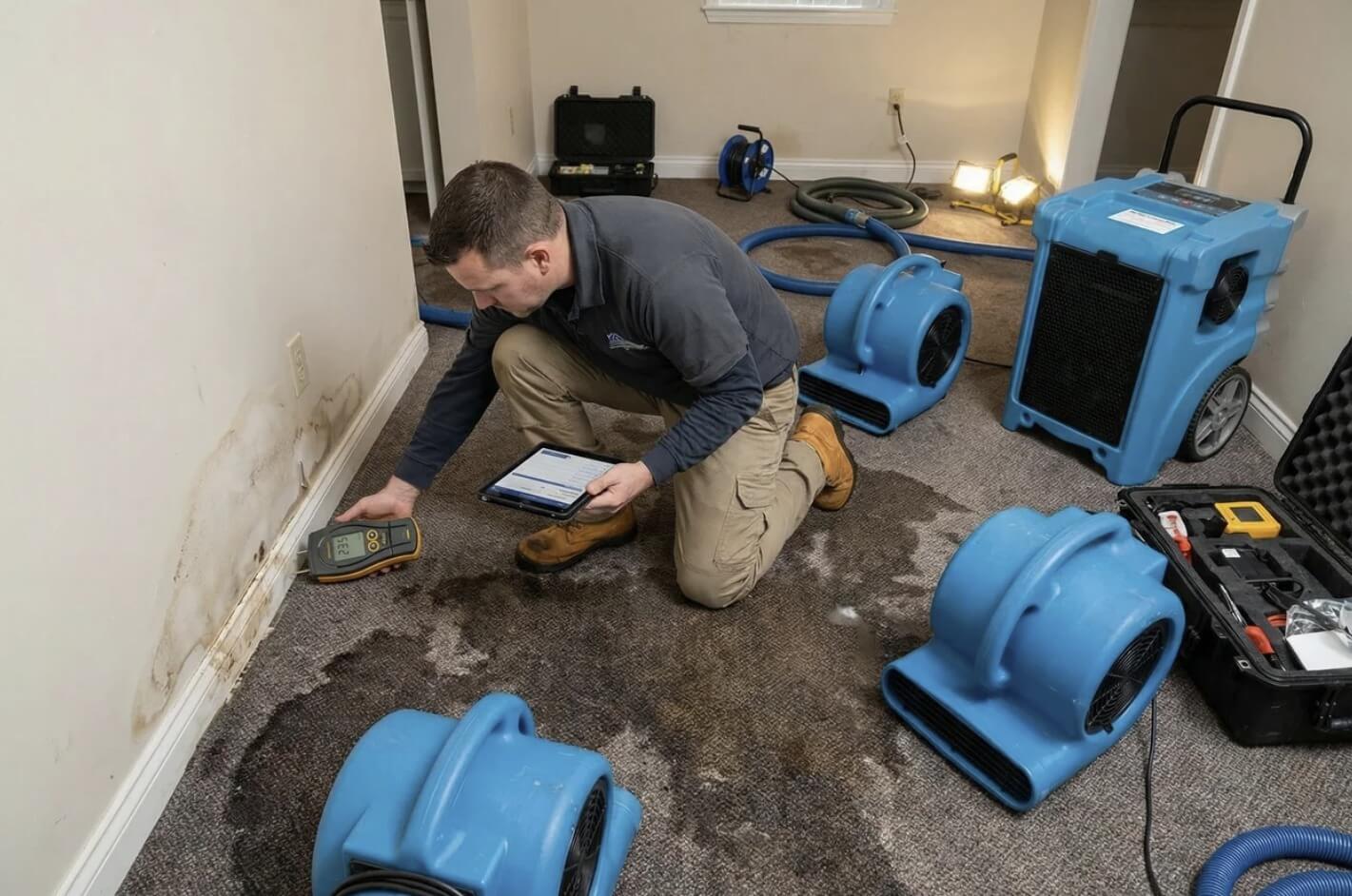
The smell isn’t random. It has a source, and most of the time that source is microbial activity or retained moisture in building materials.
After a flood, a roof leak, a burst pipe, or even a prolonged period of dampness, water works its way into porous materials. Carpet underlay, particleboard, wall cavities, subfloor timbers, plasterboard, and insulation all absorb moisture quickly but release it slowly. Once wet, these materials become hospitable environments for mould, bacteria, and other microorganisms.
That smell is what these organisms produce as they grow.
It’s worth distinguishing between two different situations, because they require very different responses.
Surface damp is moisture on or near the surface. It includes condensation forming on cool walls or windows, humidity accumulating in bathrooms without adequate extraction, or moisture sitting in a room with poor ventilation. Surface damp can cause odour, but it typically responds to ventilation, cleaning, and humidity control.
Active or concealed water ingress is a different problem entirely. This is where water has entered the building structure through a flood, a roof leak, plumbing failure, or stormwater entry, and has saturated materials inside the walls, under the floor, or in the subfloor cavity. The moisture here is hidden. It can’t be aired out with a fan, and it doesn’t dry by itself in Brisbane’s climate.
If your smell returns after treatment, if it gets stronger after rain, or if it seems to come from inside the walls or floor rather than a surface, concealed water ingress is the more likely explanation.
Why DIY Odour Treatments Only Mask the Problem
Air fresheners, fragrance diffusers, odour-absorbing powders, and even most household cleaners work on the air you can smell, not the source producing the smell.
If mould or damp timber inside a wall cavity is generating odour, spraying the room or cleaning the skirting boards doesn’t reach it. You’re neutralising the symptom, not addressing the cause. The smell returns within days, often more noticeably after rain or warm weather because humidity accelerates microbial activity and volatilises odour compounds more readily.
Basic cleaning is entirely appropriate for surface-level issues. Washing hard floors, wiping down walls, cleaning mould off tiles or grout, and running exhaust fans all have their place. But for any odour that has persisted longer than a few days after drying out, or any smell that keeps coming back, surface cleaning is unlikely to be enough.
The most common reason DIY treatment fails is that the moisture source has not been found or resolved. Until that happens, the conditions producing the smell remain in place.
The Science of Water Damage Odour
Mould and Microbial VOCs
When moisture-affected materials remain damp for an extended period, they support microbial growth. This includes mould, bacteria, and other organisms. As these microorganisms metabolise the organic material around them, they release chemical by-products into the air.
These are called microbial volatile organic compounds, or MVOCs. They’re the actual molecules you’re detecting when you smell that characteristic musty odour. MVOCs are produced at low concentrations but are detectable by humans at very small amounts, which is why a contained damp area inside a wall can smell strongly across a room.
It’s important to be accurate here: a musty smell does indicate microbial activity or retained moisture, but smell alone is not a reliable way to identify specific mould species, contamination levels, or health risk. Persistent odour is a signal that something requires investigation, not a definitive diagnosis of what’s there.
Queensland Health guidance on mould following flooding acknowledges that mould growth after water events is common and that properties should be thoroughly dried and cleaned. It also notes that mould can affect health, particularly for people with respiratory conditions, asthma, or weakened immune systems.
Wet Timber and Subfloor Materials
Timber is one of the most significant contributors to persistent water damage odour, particularly in Brisbane’s older housing stock. Queenslander homes, post-war fibro houses, and many brick-and-tile properties from the 1970s and 1980s all have subfloor cavities with timber framing that sits close to or on the ground.
When water enters a subfloor, the timber absorbs it deeply. In Brisbane’s subtropical climate, where ambient humidity rarely drops low enough to allow significant natural drying, subfloor timber can remain wet for weeks or months. That sustained dampness encourages both microbial growth and the natural decomposition of organic material in the timber itself.
Both produce odour. And both can continue producing it long after the original water event, because the material itself is the problem, not just the event that caused the damage.
Carpet underlay is equally problematic. It holds moisture far longer than the carpet pile above it, and because it’s hidden, it’s often left in place after the surface carpet has been dried or replaced. Wet underlay is a reliable source of persistent musty smell.
How Professionals Eliminate Water Damage Odour for Good
Effective odour removal after water damage isn’t a single treatment. It’s a structured process that begins with finding the actual source.
1. Identifying the likely source
The first step is understanding what type of water event occurred, where the water entered, and which areas are most likely to have been affected. This guides where inspection and testing focus.
2. Locating concealed moisture
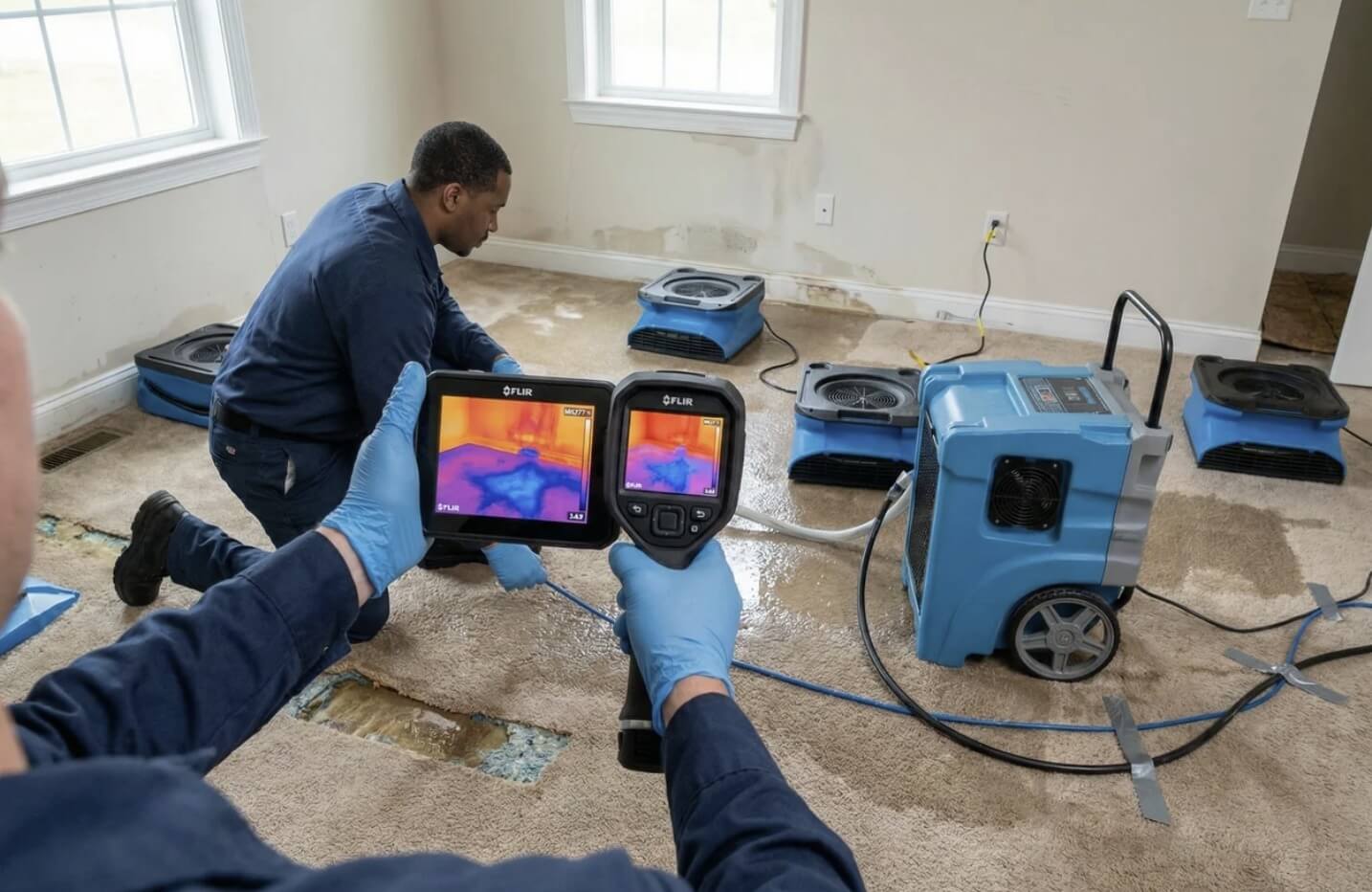
Thermal imaging cameras and calibrated moisture metres identify wet areas inside walls, under floors, and in subfloor spaces that are not visible to the naked eye. This is often where the primary odour source is found. You can read more about what these findings can indicate on the signs of hidden water damage page.
3. Assessing affected materials
Not all materials respond the same way to water. Plasterboard, particleboard, carpet underlay, and subfloor timbers are all porous and can retain moisture and microbial contamination that surface inspection misses. The assessment determines what can be dried in place and what needs to be removed.
4. Removing or addressing the moisture source
If there is an active leak, plumbing failure, or ongoing water entry point, this must be resolved before any odour treatment begins. Treating odour without fixing the source is temporary by definition.
5. Drying affected areas
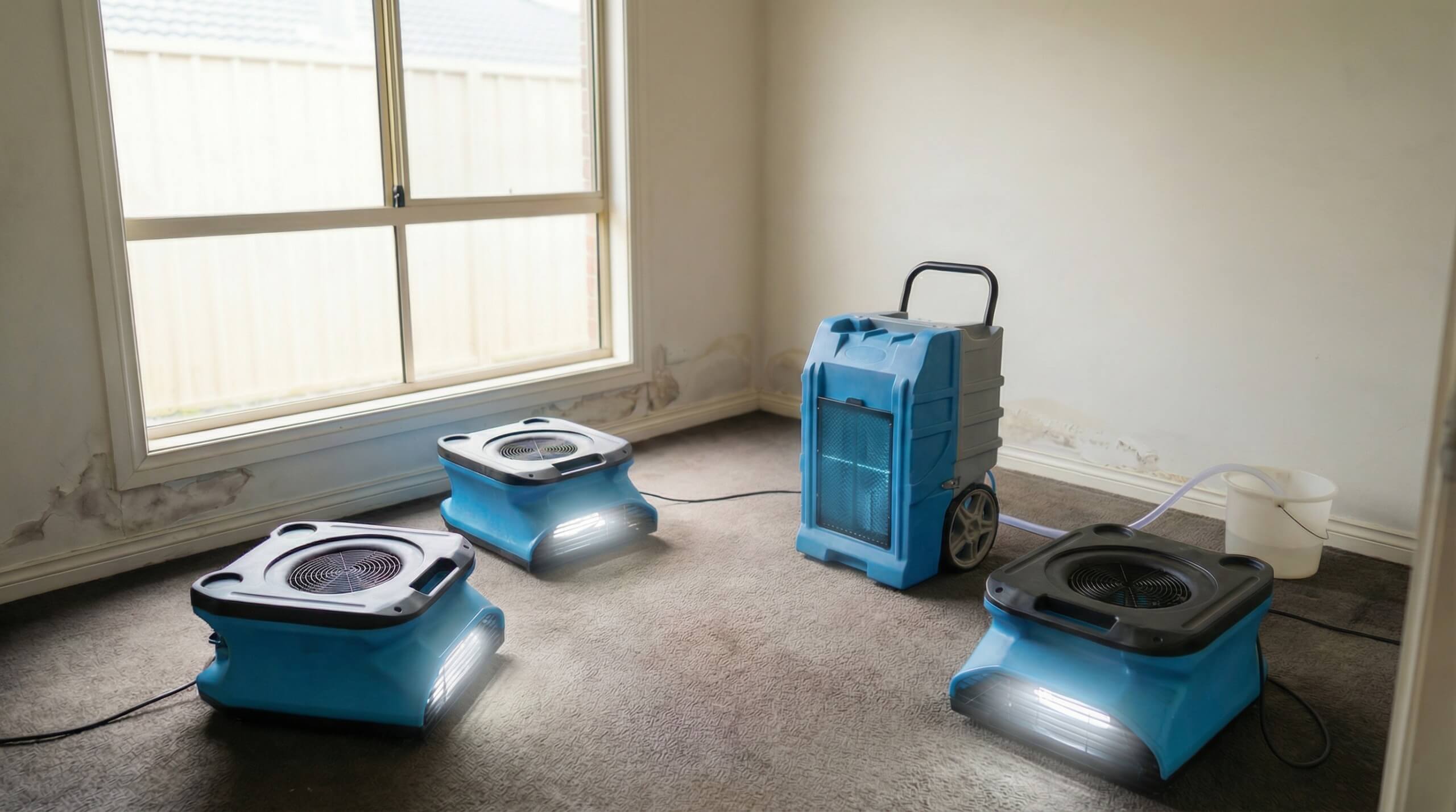
Structural drying uses commercial-grade LGR (Low Grain Refrigerant) dehumidifiers and high-velocity air movers to remove moisture from building materials to verified thresholds. This is the foundational step. Learn more about how structural drying addresses moisture inside walls, subfloors, and frames.
Household fans and domestic dehumidifiers don’t reach the moisture levels required to dry saturated structural materials in Brisbane’s climate. This is why professional equipment matters.
6. Cleaning or treating suitable materials
Surfaces that can be salvaged are cleaned with appropriate antimicrobial treatments. Porous materials that are too saturated or contaminated to be effectively cleaned in place are removed and disposed of properly.
7. Applying appropriate odour-control treatments
Once the moisture source is resolved and materials are dry, targeted odour control treatment addresses any residual odour compounds in the air and on surfaces. These treatments work at a molecular level and are effective precisely because the underlying moisture problem has already been addressed.
8. Verifying the result
Post-treatment moisture readings confirm that structural materials have reached safe dryness thresholds. This is documented in a certified drying log, which is also required by most Australian insurers as part of a claims submission.
How Long Does Odour Last After Water Damage?
There is no single honest answer, because the duration depends on several factors specific to each property and event.
Relevant factors include:
- How long materials were wet before drying began
- The volume of water involved
- Whether the water was clean, grey, or contaminated
- The materials affected and how porous they are
- Brisbane’s ambient temperature and humidity at the time
- Whether the property was well-ventilated during drying
- Whether any moisture remained concealed and untreated
- Whether mould or microbial growth had established before drying began
Properties where drying began quickly, where moisture was fully extracted, and where there was no ongoing ingress typically see odour resolve within days to a few weeks of professional treatment.
Properties where drying was delayed, where moisture remained trapped inside wall cavities or subfloor spaces, or where there was ongoing ingress can carry odour for months. In some cases, the smell persists indefinitely because the underlying moisture has never been properly addressed.
The smell itself is the most reliable indicator. If it hasn’t resolved, or if it keeps returning, something is still wet or still growing somewhere in the building.
When the Smell Returns: What It Means
A smell that initially improves but then returns is a clear signal that the source wasn’t fully resolved.
The most common reasons include:
- Remaining structural moisture inside walls, under floors, or in the subfloor that was not fully dried
- Wet subfloor or floor framing continuing to support microbial activity
- Wall cavity moisture that wasn’t identified during initial assessment
- A recurring leak that keeps reintroducing water to the same materials
- Brisbane’s humidity and rainfall reactivating residual mould or microbial activity in materials that weren’t fully treated
This last point is particularly relevant here. In a subtropical climate, even materials that seem dry during a run of fine weather can absorb enough moisture from the air during humid periods or after rain to reactivate dormant microbial activity. If a material was never properly dried to safe thresholds, it will behave this way repeatedly.
A smell that gets noticeably worse after rain, during humid weather, or when the air conditioning is turned off warrants professional moisture assessment. The recurrence is the building telling you that moisture remains somewhere inside it.
Frequently Asked Questions
Can a musty smell mean mould even if I can’t see any?
Yes. Mould grows readily inside wall cavities, beneath flooring, in subfloor spaces, and inside ceiling spaces where it isn’t visible from a room. A persistent musty smell with no visible mould is often a sign of concealed growth. Professional moisture testing and thermal imaging can locate it.
Is the musty smell after a flood harmful to my health?
Prolonged exposure to mould and high concentrations of MVOCs can affect health, particularly for people with asthma, respiratory conditions, or compromised immune systems. Queensland Health guidance after flooding recommends thorough drying and cleaning to limit mould growth and protect household health. If occupants are experiencing new respiratory symptoms, it warrants prompt investigation.
My house smells musty after rain but we haven’t had a flood. What’s causing it?
Rain can reactivate existing moisture problems in a building. Common causes include a roof leak introducing small amounts of water each time it rains, moisture already in the subfloor that rises with high humidity, or previously wet materials that were never fully dried after an earlier event. The pattern of smell worsening after rain consistently points to an active or unresolved moisture source.
Will replacing the carpet fix the odour?
Replacing carpet without replacing the underlay and investigating what’s underneath often doesn’t resolve persistent odour. If the subfloor or structural materials below the underlay are wet or affected by mould, the new carpet will sit over the same odour source. It’s worth having the subfloor assessed before any replacement is done.
How is professional odour treatment different from using an ozone machine?
Professional odour treatment follows moisture identification and removal. Ozone generators can neutralise airborne odour compounds temporarily, but they don’t address moisture inside materials or active microbial growth. Used without resolving the underlying moisture, ozone treatment produces temporary results at best.
How do I know if my odour problem requires professional help?
If the smell has persisted for more than a week after you’ve dried and cleaned the area, if it keeps returning, if it gets worse after rain or humidity, or if you had a significant water event such as flooding or a burst pipe, professional assessment is warranted. A moisture inspection can confirm whether the problem is surface-level or structural, and that’s the only reliable way to know which approach is appropriate.