House Flooded What to Do: Step-by-Step Emergency Guide
Water creeping across your floors, seeping into walls, swallowing your belongings. A house was flooded moment hits hard and fast. It’s a gut-punch that leaves even the most level-headed homeowner standing paralysed in ankle-deep water, not knowing where to begin.
You’re not alone. Approximately 7% of Australian addresses carry some level of flood risk, and when the water comes, it doesn’t send a courtesy notice.
This guide gives you the exact steps to take when there’s a flood inside the house. No fluff. No theory. Just the emergency sequence that protects your family, salvages your property, and starts the recovery clock properly.
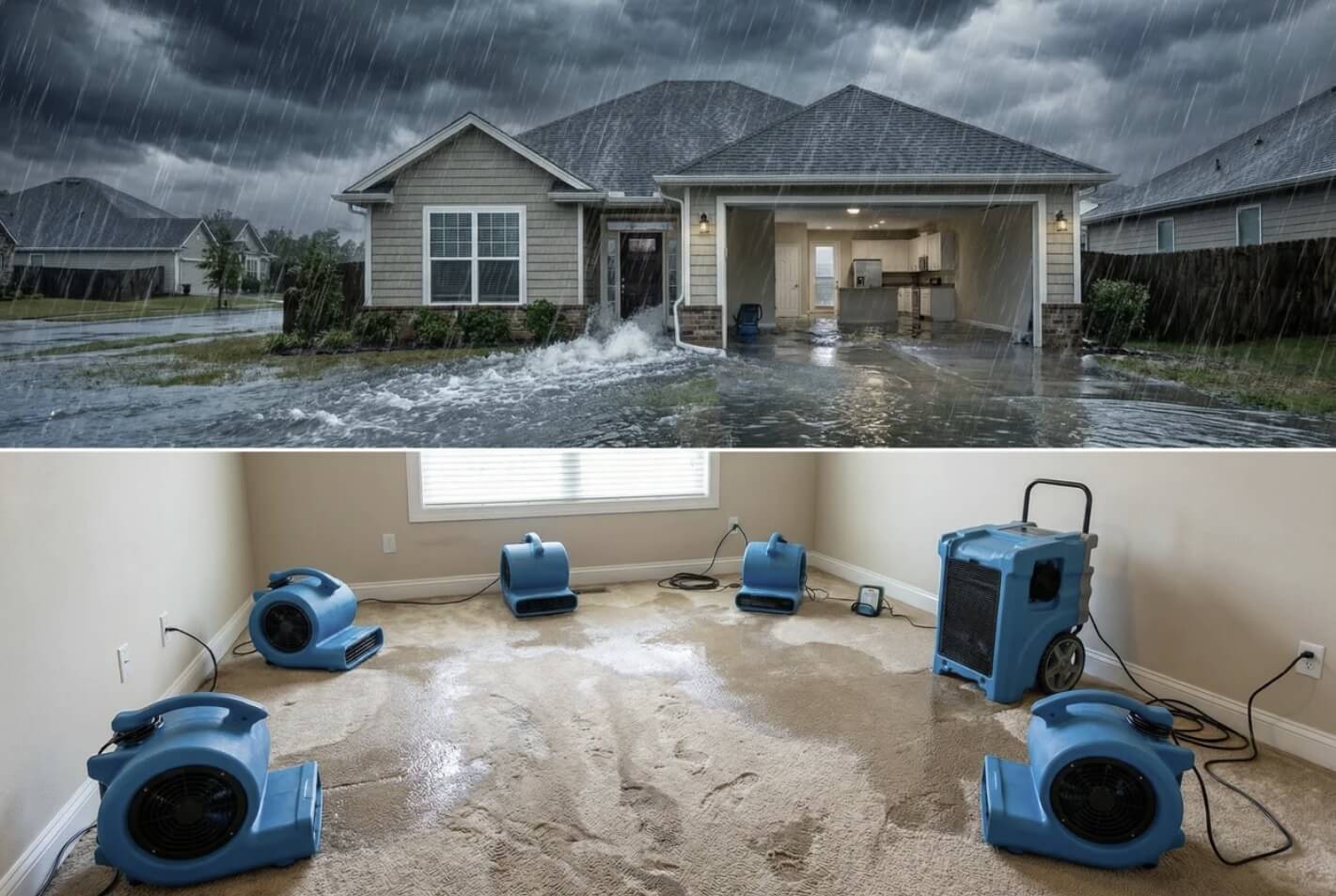
What to Do Immediately When Your House Is Flooded
The first 60 minutes shape everything that follows. When a flood emergency hits, your brain will scream fifty instructions at once. Pause. Breathe. Follow this sequence.
Step one: Secure the people. Move everyone to the highest dry point in the home. If water is rising rapidly, exit entirely and head for higher ground. Possessions are replaceable. People aren’t.
Step two: Kill the power, but not recklessly. If your switchboard is dry and safely accessible, turn off the main switch, all circuit breakers, and individual fuses. If the switchboard is wet, or you’d need to stand in water to reach it, do not touch it. Call your electricity provider immediately and wait for a licensed electrician.
Step three: Shut off gas at the meter or bottle. Floodwater can shift appliances and rupture gas lines. A fast move here prevents a compounding disaster.
Step four: Stop the water source. If the flood inside the house comes from a burst pipe or failed appliance, locate the individual isolation valve or turn off water at the mains. Street shutoff valves often require a specialised key. It’s worth buying one now and keeping it accessible.
Once these four critical tasks are done, you’ve arrested the emergency. Your emergency flood response just bought you breathing room.
Flood Safety Tips: Electricity, Gas, and Structural Risks
Floodwater is deceptive. It hides hazards that kill more people than the water itself. Here’s what isn’t obvious when you’re standing in a flooded house:
- Electrical shock risk persists even during localised flooding. Water conducts through wet carpet, timber, and wall cavities. Assume every outlet, appliance, and light switch below the waterline is live until proven otherwise.
- Gas leaks smell different in flood conditions. The familiar rotten-egg odour can be masked by mud, sewage, and standing water. If you detect even a faint gas smell, evacuate immediately and call emergency services from outside.
- Structural collapse isn’t always visible. Fast-moving water scours foundations, erodes soil beneath slabs, and weakens load-bearing walls. Look for new cracks wider than 5mm, doors suddenly jammed in their frames, and floors that feel spongy underfoot. These are not cosmetic; they’re structural red flags.
- Floodwater chemistry is aggressive. It’s not rainwater pooling in your lounge room. It’s a cocktail of sewage, agricultural runoff, industrial chemicals, and sharp debris. Gumboots and heavy-duty gloves are non-negotiable. Cuts sustained in floodwater can lead to serious infections within hours.
- Never walk or drive through moving floodwater. Fifteen centimetres of fast-flowing water will knock an adult off their feet. A car floats in sixty centimetres. Floodwater is the leading cause of flood-related death in Australia, not drowning from rising water, but from people entering it deliberately.
Stop the Water Source If Possible
When water flooding house comes from inside your plumbing rather than external inundation, swift source shutdown changes the damage equation dramatically.
For burst flexi-hoses (the number one culprit in Australian homes), shut the nearest isolation valve by turning it clockwise. For hot water system failures or appliance hose ruptures, isolate at the individual fixture stopcock. For anything beyond your immediate control, the mains shutoff at the water meter is your emergency brake.
One exception: if floodwater outside the home is the source and it’s still rising, you cannot stop it. Focus entirely on the four safety priorities above and evacuate if advised.
Document the Damage for Insurance
Before you move a single piece of furniture or wipe down a skirting board, document everything. Insurers process claims based on evidence, not narrative. Here’s the unglamorous reality of flood claims success:
- Photograph every affected room from four corners, capturing floor, walls, and ceiling in frame.
- Video walk through the entire property, narrating what you see: water depth, materials affected, items damaged.
- Photograph serial numbers, model numbers, and brand labels on appliances and electronics. Generic descriptions like “TV damaged” get generic payouts. “Samsung 65 inch QLED 2024 model” gets proper valuation.
- Before discarding anything, photograph it against a plain background with a ruler or common object for scale.
- If carpet, underlay, or wall linings must be removed for safety, retain a 30cm by 30cm sample of each material for the assessor.
How to Remove Water and Start Drying Your Flooded House
Once authorities or emergency services confirm safe re-entry, the race against damaged by water becomes a sprint. Every hour water sits in your home, it migrates further: wicking up plasterboard, penetrating timber, saturating insulation.
Water Extraction Methods for Different Water Levels
For shallow standing water (less than 15mm), a wet-dry shop vacuum with its filter removed handles the job efficiently. Mop and bucket method works but exhausts you quickly. For larger volumes of water flooding house interiors (15mm and deeper), submersible pumps are essential. They move water fast and connect to standard garden hoses for discharge well away from the foundation. For major flooding, a specialist pump might be necessary to remove water efficiently.
The hierarchy is simple: pump for volume, wet-dry vac for residual, towels and mops for final surface moisture. Don’t use standard household vacuums. Water and electricity don’t belong in the same appliance unless it’s specifically rated.
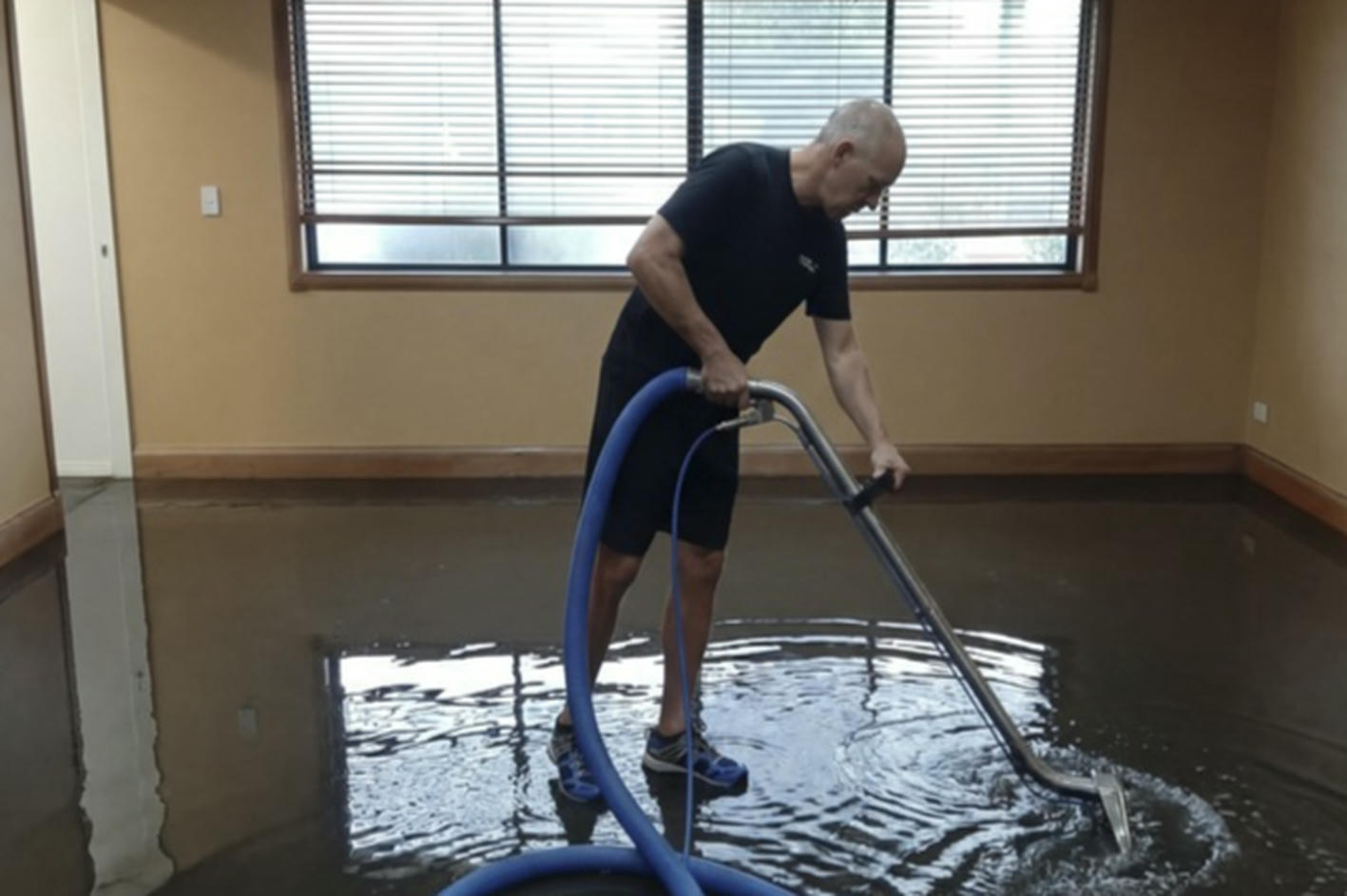
Pay special attention to water trapped in wall cavities, under cabinetry kickboards, and inside floor registers. These hidden reservoirs drive ongoing humidity and mould growth. Drill weep holes at the base of plasterboard walls if water has wicked up beyond the skirting board height. This allows drainage from within the cavity.
Ventilation and Dehumidification: Drying Out Your Home
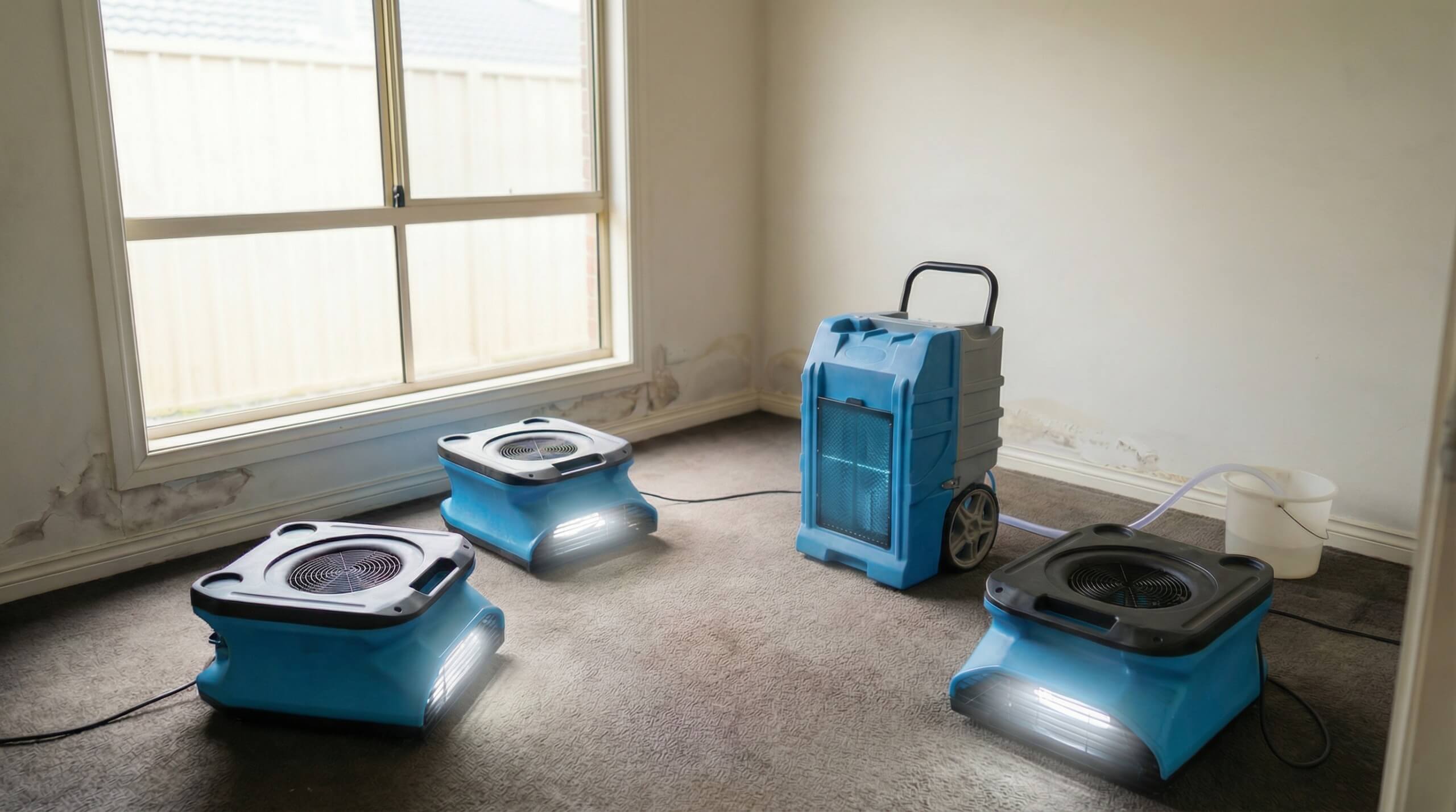
Drying a flooded house requires aggressive air movement and moisture extraction working in tandem. Opening windows works only when outside humidity is lower than inside. In Brisbane’s subtropical climate, this often isn’t the case. You need mechanical assistance.
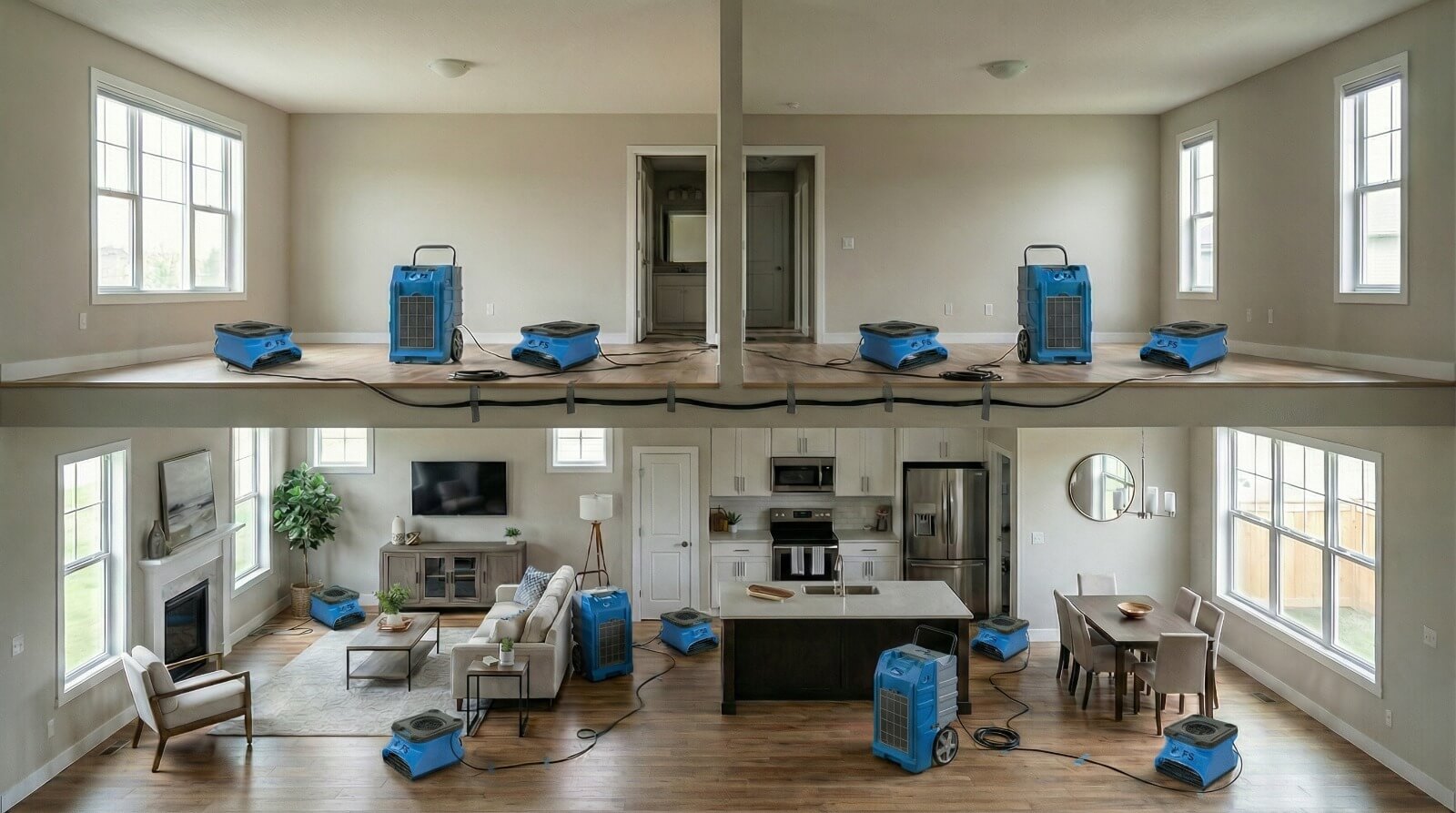
Start with industrial air movers positioned to create cross-flow turbulence across all wet surfaces. Aim them at 45-degree angles to walls and floors. Add commercial dehumidifiers: the refrigerant-type for warmer conditions, desiccant-type if you’re dealing with cooler or humid weather. Together, they create a vacuum effect that draws moisture from building materials into the air, then strips it from the air into collection tanks.
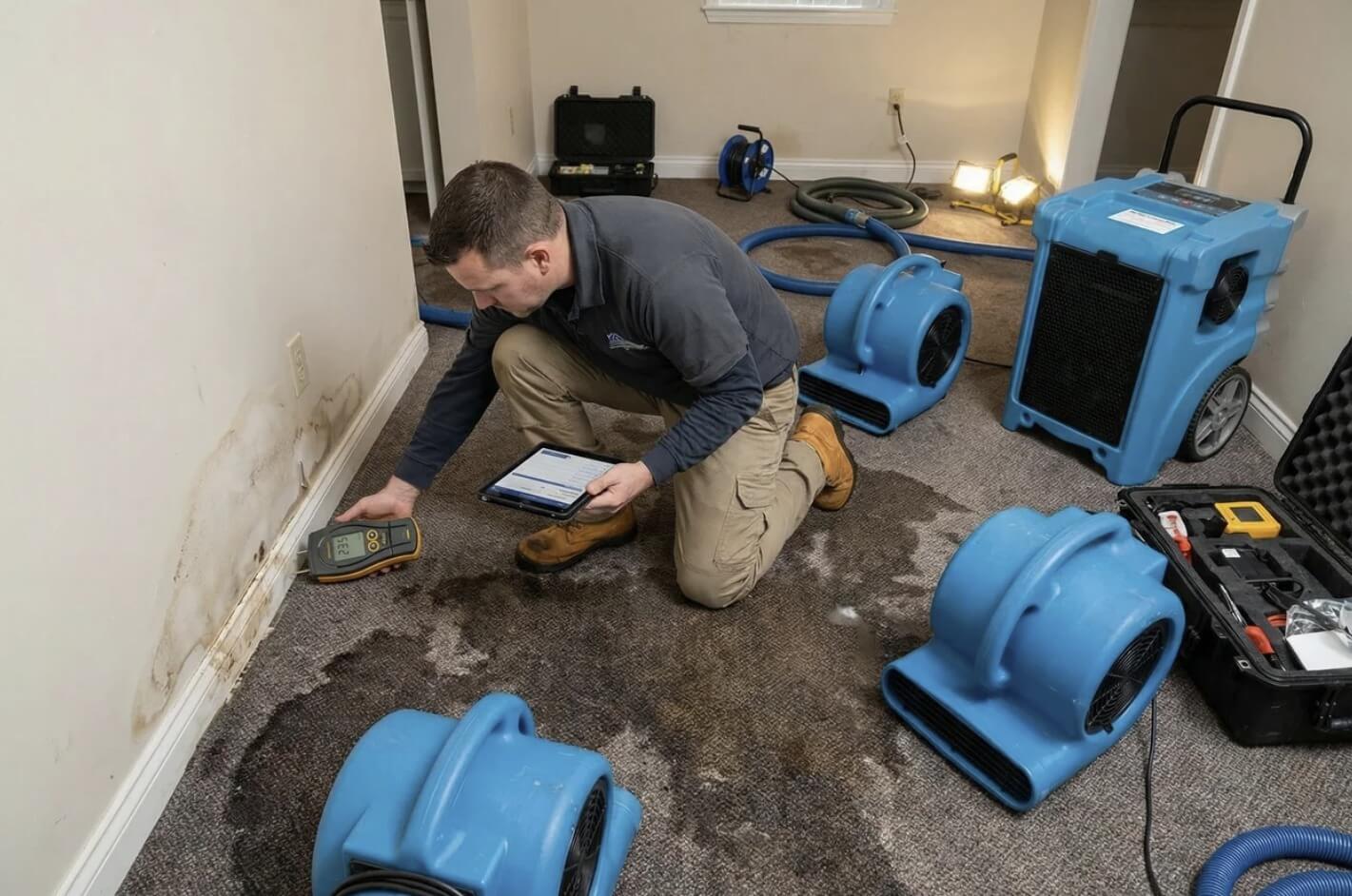
Monitor progress with a moisture meter, not your instincts. Plasterboard feels dry long before the internal gypsum reaches safe moisture levels. Timber framing that reads above 16% moisture content is still breeding ground for rot and mould.
Items You Can Salvage vs. What to Discard
Floodwater contamination makes the salvage-or-discard calculus brutal. Be honest with yourself.
Generally salvageable:
- Solid timber furniture (if cleaned and dried immediately)
- Metal appliances (after professional electrical testing)
- Ceramic and glass items
- Sealed vinyl flooring
- Some solid core doors
Almost always discard:
- Mattresses and pillows
- Particleboard flat-pack furniture
- Insulation batts or blown-in material
- MDF cabinetry and architraves
- Cardboard-stored items
- Upholstered furniture saturated longer than 48 hours
- Carpet underlay (always; it acts like a sponge and cannot be economically dried)
- Any soft furnishings exposed to sewage-affected water
Professional sewage clean-up is essential when black water contamination is present. The 48-hour rule is real. Mould establishes colonies within 24 to 48 hours on organic materials. After that window, remediation moves from cleaning to demolition.
Assessing Flood Damage to Your House
Visible water is only half the problem. Flood damage house assessment must go deeper, literally into walls, under floors, and into the building’s skeleton.
Signs of Water Damage to Walls, Flooring, and Subfloors
Water leaves a forensic trail. Knowing what to look for prevents you from sealing moisture inside your building envelope. The signs of water damage to hunt for include:
- Skirting boards that swell, cup, or separate from the wall. This indicates water has wicked behind them into the wall cavity.
- Paint that bubbles, blisters, or peels in sheets rather than flakes. This signals moisture pushing outward from inside the substrate.
- Plasterboard that feels cool to the touch days after the flood. A sign of retained moisture within the gypsum core. Press gently; water-damaged plasterboard yields and crumbles.
- Timber flooring that cups (edges higher than centre), crowns (centre higher than edges), or develops black staining along joins. These indicate absorbed moisture changing the cellular structure of the timber.
- Subfloor spaces that smell earthy or appear to have standing water. A subfloor inspection is non-negotiable for Queensland-style raised homes. Damp subfloors pump moisture upward into living spaces for months.
- Grout that darkens and remains dark. A sign of ongoing moisture wicking from behind tiles.
Structural Damage: What’s Cosmetic vs. What’s Dangerous
Not all flood damage threatens your home’s structural integrity. Distinguishing between surface-level issues and genuine danger saves thousands in unnecessary repairs, or prevents catastrophic failure.
Cosmetic damage looks alarming but poses no structural risk:
- Minor plasterboard cracking under 2mm wide
- Paint staining at the floodwater line
- Skirting board separation that doesn’t exceed 5mm
- Surface rust on steel lintels
- Slight door sticking that corrects itself as the home dries
Dangerous structural damage requires immediate professional assessment:
- Horizontal cracks in masonry or brick veneer walls (especially at the damp-proof course level)
- Floors that deflect or bounce when walked on
- Ceiling sagging exceeding 10mm
- Any cracking that runs at 45-degree angles from door or window corners
- Piers or stumps that have shifted, tilted, or sunk
The difference between cosmetic and dangerous isn’t always obvious. When in doubt, a structural engineer’s inspection costs less than a structural failure.
When Carpet and Underlay Need Replacement
The question of carpet survival comes down to two factors: water source and saturation duration.
Clean water (from a burst supply pipe) on carpet for less than 24 hours can often be extracted, dried, cleaned, and reinstated. Grey water (from washing machines or dishwashers without sewage contamination) might be salvageable with hot-water extraction and antimicrobial treatment within 12 hours.
Black water (any floodwater containing sewage, river overflow, or stormwater runoff) means immediate disposal. No exceptions. The pathogen load makes sanitisation impossible in a residential setting.
Carpet underlay is universally unsalvageable after any flood. Its open-cell foam or felt structure acts as a sponge, holding water against the subfloor indefinitely. It’s inexpensive to replace and ruinously expensive to leave in place. We’ve extracted underlay that still dripped three weeks after the visible carpet surface felt dry.
For detailed carpet drying techniques, see our guide: How to Dry Wet Carpet Quickly
What to Do After a Flood: Recovery and Next Steps
The water’s gone. The fans are running. Now the real work begins. The flood recovery process extends weeks beyond the visible water event, and the decisions made in this phase determine whether your home truly recovers or harbours long-term problems beneath freshly painted surfaces.
Dealing with Insurance Claims: A Step-by-Step Overview
Insurance claims processes vary by provider, but a methodical approach improves outcomes across the board:
- Notify immediately. Most policies require prompt notification. Even if you can’t find your policy documents, insurers maintain electronic records; your name and address suffice to open a claim.
- Request an advance payment if needed. If you’re in urgent financial need, insurers can fast-track partial payment within five business days. Speak up. This isn’t automatically offered.
- Get written approval before authorising repairs. Emergency repairs to prevent further damage (tarping a roof, boarding broken windows) are generally covered. But structural or cosmetic repairs undertaken without insurer authorisation may be rejected entirely. Written approval protects you.
- Don’t sign off too quickly. If your claim is finalised within one month of the disaster, Australian insurers must give you six months from finalisation to request a review. Use this if you discover damage the initial assessment missed.
- Keep a claim diary. Record every phone call: time, date, who you spoke to, what was agreed. Insurance processes get complex fast. Your notes become evidence if disputes arise.
Preventing Mold and Mildew After a Flood
Mould is not a cosmetic nuisance. It’s a health hazard that can render a home uninhabitable. After a flood, mould prevention means moisture elimination. There’s no shortcut.
Maintain relative humidity below 60% using dehumidifiers and air conditioning. Remove any materials that show visible mould growth within 24 to 48 hours. Treat wall cavities with antimicrobial sprays where water has penetrated but full sheet removal isn’t planned. Leave cupboard doors, wardrobes, and any enclosed spaces open to airflow. Replace rather than attempt to clean fibrous insulation materials. Use professional mould remediation services if mould appears widespread.
Long-Term Restoration Planning
Recovery happens in phases. The emergency phase lasts 1 to 7 days and focuses on water extraction, drying, and making the property safe. The assessment phase runs 7 to 30 days, involving insurance assessments, structural inspections, and detailed scoping of repair work. The restoration phase extends 30 to 90 days or more, covering strip-out, drying confirmation, reconstruction, and refinishing.
Expect the unexpected. A wall that dried beautifully in week one can still develop mould in week four if humidity wasn’t properly controlled. Rushing to reinstall flooring before subfloor moisture readings stabilise virtually guarantees cupping, buckling, or rot within 12 months.
When to Call Professional Flood Damage Restoration
DIY has limits. Flood damage restoration professionals bring equipment, expertise, and the ability to see what homeowners miss. The threshold where professional help becomes essential is lower than most people assume.
What Professional Flood Restoration Involves
Professional restoration isn’t just pumping water and setting up fans. It’s a systematic process starting with moisture mapping: using thermal imaging and penetrating moisture meters to map the full extent of water migration, including inside wall cavities and under floor coverings. It continues with targeted extraction using truck-mounted or high-volume portable extraction units that remove water ten times faster than consumer equipment.
Industrial drying follows, with commercial air movers, dehumidifiers, and specialist drying systems for wall cavities and underfloor spaces. Antimicrobial application ensures sanitisation rather than just surface cleaning, and restoration includes controlled demolition of unsalvageable materials, reconstruction, and final finishing.
The key difference is speed and thoroughness. Professionals dry a home in 3 to 5 days; DIY efforts often take weeks and still leave moisture behind.
For professional assistance, see our Storm & Flood Restoration service page.
Cost Expectations for Flood Restoration Services
Costs vary dramatically based on water source, affected area, and contamination level. Clean water extraction from a single room sits at the lower end of the scale.
Grey water or black water (Category 2 to 3) flooding across multiple rooms costs significantly more due to decontamination requirements, controlled demolition of affected materials, full structural drying, and waste disposal. Full reconstruction costs sit on top and depend entirely on finish level and material choices.
Insurance typically covers professional restoration. If your policy includes flood cover, engaging experts ensures the work meets the standard your insurer expects, and you avoid the risk of out-of-pocket rectification later.
Questions to Ask Before Hiring a Restoration Company
Not all restoration companies operate to the same standard. Ask direct questions:
- Are your technicians IICRC-certified in water damage restoration? (This is the industry standard qualification.)
- What moisture measurement equipment do you use, and will I receive a moisture map and drying log?
- Do you handle insurance claims directly, and can you work with my specific insurer?
- What is your guarantee regarding mould prevention and complete drying?
- Will you handle the full process including controlled demolition and reconstruction, or will I need separate trades?
A professional restoration company answers these questions clearly and without hesitation. Evasive answers are a red flag.
Frequently Asked Questions
What is the first thing to do when your house floods?
Ensure everyone’s immediate safety, then if possible without risk, turn off electricity, gas, and water at their mains or isolation points. Document everything with photos and video before moving anything. Then contact your insurer and begin water extraction.
How long does it take to dry out a flooded house?
With professional equipment, 3 to 7 days for full structural drying under normal conditions. Without professional equipment, drying can take 2 to 4 weeks and may still leave hidden moisture that causes future problems. Drying time is affected by humidity, temperature, air movement, and the materials affected.
Can a flooded house be saved?
In almost all cases, yes, though “saved” means different things depending on water depth, duration, and contamination level. A flood destroys soft furnishings and finishes, but the structure itself is almost always restorable with proper professional intervention. Houses that appear destroyed are often fully recoverable.
Does home insurance cover house flooding?
It depends entirely on your policy wording. Flood cover is not automatic in Australia. Many policies offer it as an optional extra or exclude it altogether. Check your Product Disclosure Statement or call your insurer directly to confirm. “Storm damage” and “flood damage” are legally distinct categories in insurance policies.
How do I know if my house has hidden water damage?
Signs include persistent musty or earthy odours, skirting boards or architraves that remain damp to touch, peeling or bubbling paint appearing weeks after the event, floor coverings lifting or shifting, and visible mould in corners or behind furniture. A professional moisture inspection using penetrating meters and thermal imaging reveals what the naked eye misses.
Helpful Resources for Flood Recovery in Brisbane and Queensland
- SES Queensland: ses.qld.gov.au — For emergency flood rescue and community support
- Queensland Government Flood Information: qld.gov.au/disasterhelp — Up-to-date flood alerts, safety advice, and recovery programs
A flood emergency tests every homeowner. The difference between a home that recovers completely and one that harbours ongoing problems comes down to the speed and thoroughness of the initial response. Safety first, water out fast, dry aggressively, document everything, and know when to call in those who do this work every day.
Recovery takes time, but with methodical action from the first hour onward, your home will be restored, your claim processed, and your life rebuilt. One step at a time.