Water Damage Under Floorboards: What to Do Before It Gets Worse
Water Damage Under Floorboards: What to Do Before It Gets Worse
TL;DR: Water under your floorboards does more damage than it looks. The subfloor can stay saturated long after the surface feels dry, and mould can start growing within 24 to 48 hours. Hardwood can be saved if you act within 24 to 48 hours; laminate almost certainly cannot. Natural drying in Brisbane’s humidity takes months and leaves your structure at risk the whole time. If you can smell mould, see cupping, or the water has been there more than 24 hours, call a professional.
In This Article
- Why Water Under Floorboards Is So Dangerous
- How to Tell If You Have Water Damage Under Your Floorboards
- How Drying Works for Different Floor Types
- Mould Under Floorboards: What You Are Actually Dealing With
- The Structural Drying Process: What Professionals Actually Do
- What Happens If You Wait: A Timeline
- When to Call a Professional: Non-Negotiable Situations
- How Flood Services Brisbane Can Help
Water under your floorboards is one of the most deceptive types of property damage you can face. The surface might feel firm and dry underfoot, but deep in the subfloor, the timber framing, joists, and boards can be saturated. By the time visible signs appear, the damage is often well underway.
This guide walks Brisbane homeowners through the warning signs, what the drying process looks like for different floor types, and the point at which you need to call a professional before things get significantly worse.
Why Water Under Floorboards Is So Dangerous
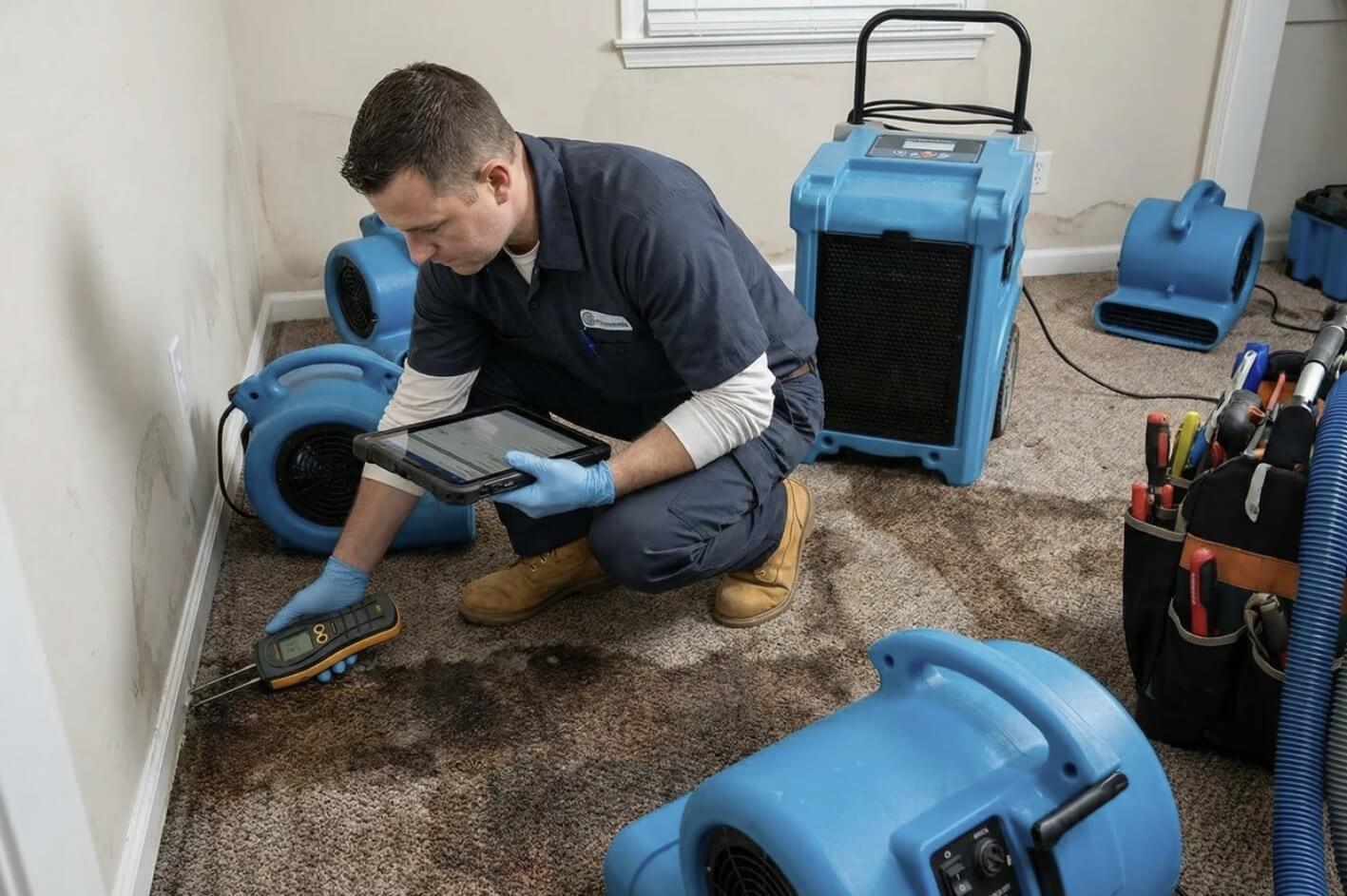
The main problem with water damage under floorboards is that it is invisible for a long time. Moisture works its way into the subfloor structure quietly, and the surface above can feel perfectly normal while the materials underneath are actively breaking down.
In Brisbane’s subtropical climate, where ambient humidity regularly exceeds 70%, conditions under a wet subfloor deteriorate faster than in most other Australian cities. Mould can begin growing within 24 to 48 hours of a water event. Timber rot can follow within days of prolonged exposure. And once rot or mould takes hold in the subfloor framing, you are no longer looking at a drying job. You are looking at structural repairs.
The other risk specific to Brisbane is termites. Damp timber is a primary attractant. An untreated wet subfloor in a Queensland home, particularly a raised Queenslander, significantly elevates termite risk at exactly the point when the structure is already vulnerable.
Acting within the first 24 hours gives you the best chance of saving your floors and keeping costs manageable. Waiting 48 to 72 hours changes the conversation entirely.
How to Tell If You Have Water Damage Under Your Floorboards
The floor surface is not a reliable indicator. Here are the signs that point to moisture beneath the boards, even when the surface appears dry.
Cupping and Crowning
These are the two most common deformations in timber flooring after water exposure.
Cupping happens when the edges of a board sit higher than the centre. This occurs when moisture from the subfloor causes the underside of the board to expand more than the top. It is the most common deformation after flooding because water enters from below.
Crowning is the opposite: the centre of the board rises higher than the edges. This is what happens when the surface dries faster than the underside, which is a common result of DIY drying that only addresses the top layer.
Both deformations can be reversed with professional drying if treated before the distortion sets permanently.
Soft or Spongy Spots
If you notice areas that flex underfoot or feel noticeably softer than surrounding boards, this points to subfloor saturation. In particleboard or plywood subfloors, absorbed moisture causes swelling and loss of structural strength. The board may look intact from above while the internal structure has already broken down.
Musty or Earthy Smell
A persistent musty smell is one of the earliest signs that mould has started growing beneath the floor. If you can smell it but cannot see it, the growth is almost certainly underneath the boards or inside the subfloor cavity. At that stage, cleaning the visible surface does nothing, because the source is hidden.
Discolouration and Dark Staining
Dark spots or grey-black staining along board joints or across the floor surface indicate that moisture has been present long enough to cause discolouration. In timber flooring, this is particularly common where moisture wicks up through the subfloor from a saturated concrete slab below.
Squeaking and Loose Boards
Boards that have absorbed water and then partially dried will contract and expand unevenly, which causes squeaking. Boards that feel loose or have developed movement that was not there before are a sign that the subfloor connection has been compromised by moisture.
How Drying Works for Different Floor Types
Not all floors respond to water damage the same way, and the drying approach needs to match the material. Here is what you need to know about the most common floor types in Brisbane homes.
How to Dry Hardwood Floors
Solid hardwood, including species like spotted gum, blackbutt, tallowwood, and brushbox common in older Brisbane and Queenslander homes, absorbs water slowly but deeply. This means it can survive a water event if drying begins quickly, but it needs time and controlled conditions to recover properly.
The key principle for how to dry hardwood floors correctly is that moisture must be drawn out evenly from both the surface and the subfloor simultaneously. Drying only from above creates an uneven moisture gradient, which causes crowning and can permanently distort the boards. Professional drying uses high-velocity air movers, LGR (Low Grain Refrigerant) dehumidifiers, and subfloor drying systems working in combination to control the drying rate from both directions.
Hardwood floor drying typically takes 5 to 14 days depending on the species, board thickness, subfloor conditions, and ambient humidity. Once dry, boards that have cupped or experienced minor distortion can be sanded and re-coated. Boards that have been wet for extended periods or have developed black mould staining may require replacement.
Hardwood floors treated within 24 to 48 hours of a water event have the best recovery outcomes. Hardwood left wet for 72 hours or more is at serious risk of permanent structural distortion.
Engineered Timber
Engineered timber has a plywood core with a hardwood veneer on top. The plywood core is more dimensionally stable than solid hardwood when exposed to moisture, which means it absorbs less and dries faster.
However, prolonged or severe water exposure can cause the layered structure to delaminate, where the core separates from the veneer. Once delamination occurs, the board cannot be restored. Engineered timber treated quickly, within the first 24 to 48 hours, can be saved in most cases. Engineered timber that has been wet for several days is far more likely to require replacement.
Drying time for engineered timber is typically 3 to 7 days with professional equipment.
Laminate Over Subfloor
Laminate flooring has a high-density fibreboard (HDF) core. This core swells rapidly when it absorbs water and cannot be de-swelled once fully saturated. For this reason, full-flooding of laminate is almost always an irreversible situation for the boards themselves.
This does not mean nothing can be done. The laminate boards will need to be removed, but the subfloor beneath them still requires professional drying before replacement can happen. Laying new flooring over a saturated subfloor will result in the same damage recurring and drives up costs significantly.
Laminate perimeter damage from minor moisture ingress can sometimes be addressed without full replacement, but this depends on how far the moisture has tracked and whether the subfloor has been affected.
Vinyl Plank and Tile
Vinyl plank (LVP/SPC) and ceramic or porcelain tile are waterproof at the surface level, but neither prevents water from reaching the subfloor. Water penetrates through joints and grout lines and saturates the subfloor beneath. The boards or tiles themselves may be unaffected, but if the subfloor is not dried properly, the result is subfloor rot, adhesive failure, and mould growth that eventually forces its way through.
Mould Under Floorboards: What You Are Actually Dealing With
Mould under floorboards is not just a cosmetic or odour issue. It is a health risk and a structural one.
In Brisbane’s climate, mould can begin developing in a damp subfloor within 24 to 48 hours of water exposure. The dark, enclosed subfloor cavity is an ideal environment for mould to colonise on the underside of boards and the timber framing. From there, it spreads upward through floor gaps and into the living space above.
According to Queensland Health’s guidance on mould after flooding, health effects from mould exposure include respiratory irritation, allergic reactions, sneezing, coughing, and in more serious cases, hypersensitivity pneumonitis. People with asthma, allergies, or compromised immune systems are at higher risk.
Small surface areas of low-risk mould species on non-porous surfaces can be cleaned by a homeowner. Anything inside a subfloor cavity, on timber framing, or covering more than one square metre requires professional remediation. DIY cleaning of surface mould does nothing for growth that has penetrated the material or is present in an enclosed cavity beneath the floor.
If you can smell mould but cannot see it, the source is almost certainly underneath the floor. That is a professional call, not a household cleaning job.
The Structural Drying Process: What Professionals Actually Do
Structural drying after a flood is different from surface drying. It targets the moisture that has been absorbed into the building’s structure, including the subfloor, floor framing, timber joists, concrete slab, and wall frames below floor level.
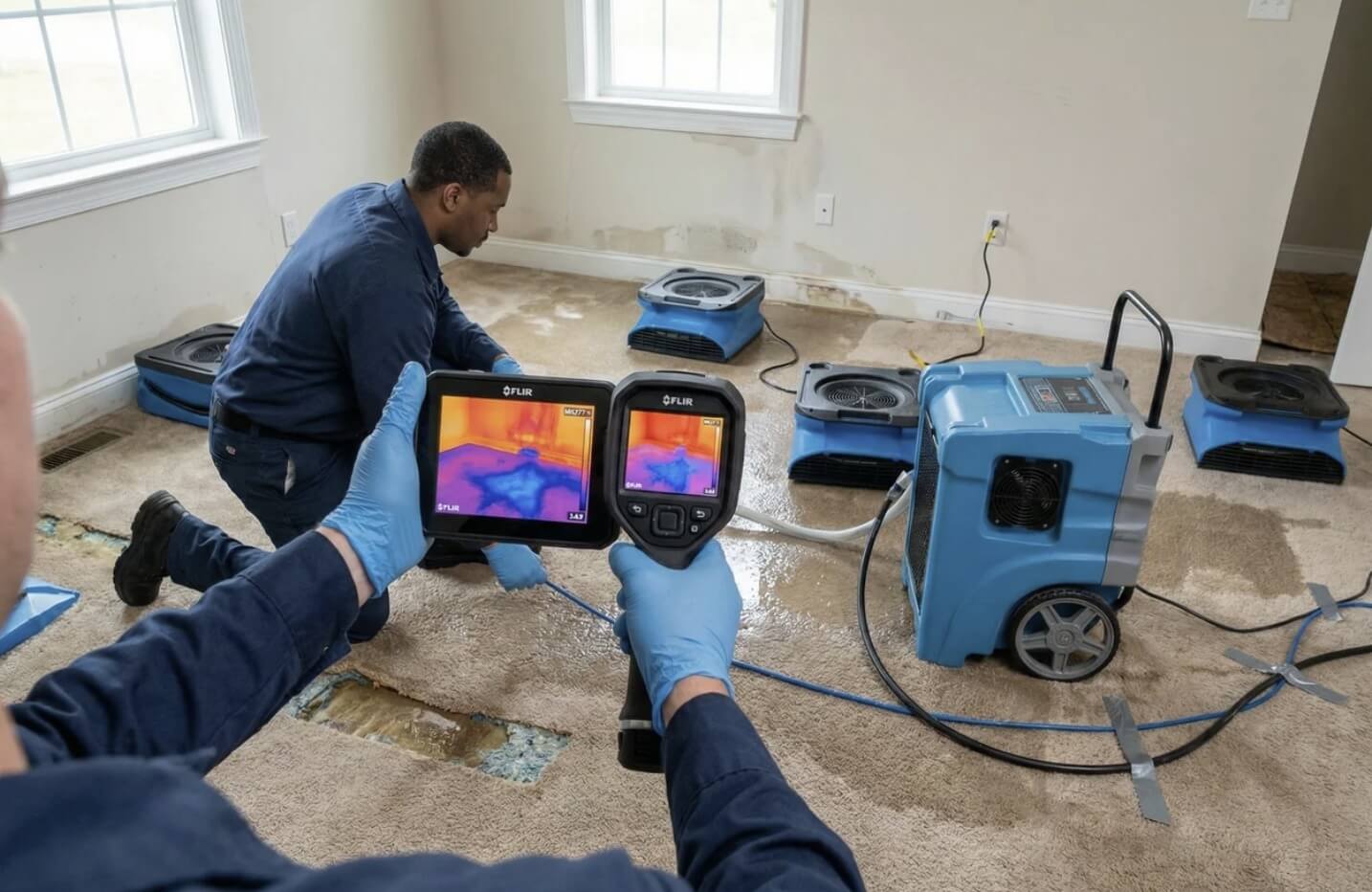
Our sub-floor and wood hard floor drying service uses a combination of specialist equipment deployed in a monitored process:
- Moisture mapping: thermal imaging cameras identify moisture pockets beneath the floor and in framing that are invisible to the naked eye.
- Subfloor access and drying: dry, heated air is injected into the subfloor cavity through small access points. For Queenslander homes with open subfloor spaces, the cavity is sealed and systematically dried using subfloor drying mats and desiccant dehumidifiers.
- High-velocity air movers: industrial fans replace saturated air with dry air at the surface level, accelerating evaporation.
- LGR dehumidifiers: Low Grain Refrigerant dehumidifiers draw moisture from the air at low humidity levels where standard household dehumidifiers stop functioning effectively.
- Data logging: continuous temperature and humidity sensors placed in the drying zone create a documented drying curve used for insurance reporting.
- Calibrated moisture metres: pin and pinless metres verify moisture content in all structural materials. Drying is signed off only when readings reach equilibrium moisture content (EMC), which is a verified dryness standard, not a visual estimate.
A raised timber Queenslander subfloor typically takes 5 to 10 days to dry with commercial subfloor drying equipment. Concrete slabs and enclosed subfloors can take 2 to 4 weeks. Natural drying in Brisbane’s humidity without professional equipment can take months, and leaves materials at ongoing risk of mould and structural damage throughout that time.
Our structural drying service covers all materials and provides certified drying reports accepted by all major Australian insurers.
What Happens If You Wait: A Timeline
Every hour a wet subfloor sits without treatment, the damage compounds.
| Time After Event |
What Is Happening Below Your Floor |
| 0 to 6 hours |
Water penetrates the surface. Timber begins absorbing. Subfloor moisture starts building. Most floors fully salvageable. |
| 6 to 24 hours |
Cupping begins in hardwood. Subfloor moisture deepens. Adhesive under glued floors softens. Costs increase 40 to 70%. |
| 24 to 48 hours |
Mould activates in the subfloor cavity. Laminate is beyond saving. Partial floor replacement likely alongside drying. |
| 48 to 72 hours |
Visible mould in subfloor framing. Structural timber rot begins. Hardwood likely facing permanent distortion. Costs triple compared to an early call. |
When to Call a Professional: Non-Negotiable Situations
There are situations where a professional call is not optional. These include:
- You can smell mould but cannot see it, which means it is inside the structure.
- The floor is cupping, crowning, or has developed soft spots.
- Water has been present under the floor for more than 24 hours.
- The water source was floodwater, sewage, or stormwater runoff (all of which are contaminated and require professional decontamination, not just drying).
- You have a Queenslander or raised timber home, where the subfloor cavity is enclosed and inaccessible without specialist equipment.
- Moisture readings taken with a pin metre are not dropping after several days of your own drying efforts.
- There is any visible staining, discolouration, or structural movement in the floor framing.
Attempting to complete repairs or lay new flooring before the subfloor has reached verified dryness thresholds virtually guarantees the damage will recur. Rushing the final step is the most common and most expensive mistake homeowners make.
How Flood Services Brisbane Can Help
At Flood Services Brisbane, we handle water damage under floorboards every day across greater Brisbane, from inner-city apartments to heritage Queenslanders in the western and southern suburbs.
When you call us, we arrive on-site within 60 minutes, 24 hours a day, 7 days a week. Our first step is always a full assessment using thermal imaging cameras and calibrated moisture metres. You get an honest report of what is happening below the surface before any work begins, and a clear recommendation for the best path forward, whether that is drying, remediation, or replacement.
Our sub-floor and wood hard floor drying service uses specialist subfloor drying systems to extract moisture from beneath your floors without invasive removal in most cases. We work with hardwood, engineered timber, vinyl plank, and tile over subfloor, and we have extensive experience with Brisbane’s Queenslander homes and the specific drying challenges they present.
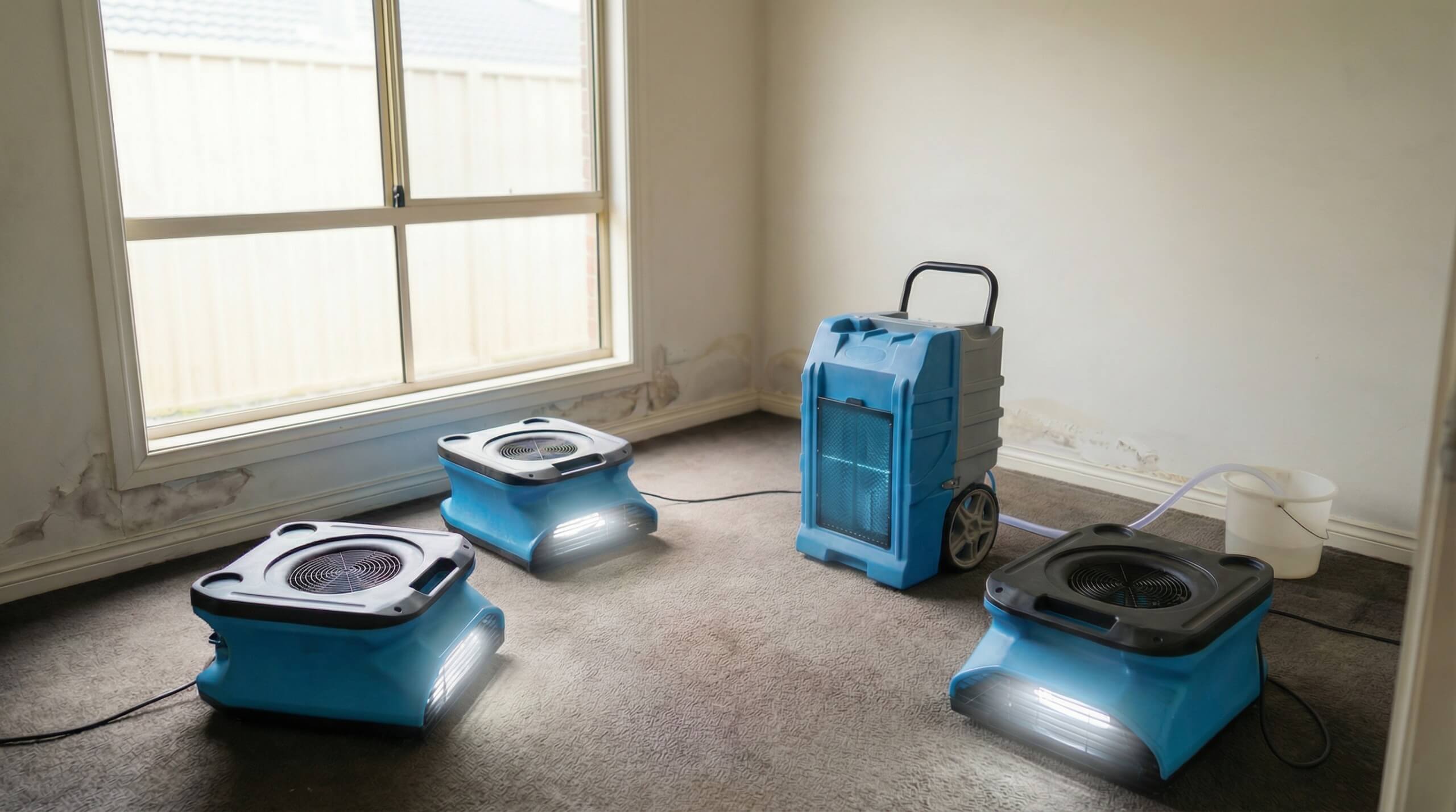
Where floors have been wet long enough to require structural drying, we deploy LGR dehumidifiers, high-velocity air movers, data loggers, and continuous moisture monitoring until every affected material reaches verified safe dryness. Our reports are accepted by RACQ, NRMA, Suncorp, Allianz, QBE, and GIO.
We sign off only when moisture readings confirm the job is done. Not when it looks dry. Not when it smells dry. When the numbers say so.
Call us on 07 3185 0987 the moment you discover water under your floors. The sooner we start, the more of your home we can save.