What Is a Commercial Dehumidifier and When Do You Need One
TL;DR: A domestic dehumidifier from Bunnings is built for background dampness, not flood recovery. After a serious water event, you need a commercial-grade unit with the extraction capacity, continuous drainage, and LGR technology to actually dry your structure. Sizing matters: units range from 45L/day for a single room up to 120L/day for large commercial spaces. For most Brisbane property owners, commercial dehumidifier rental is the smarter and far cheaper option than buying. If the flooding involved stormwater, sewage, or has been sitting for more than 24 hours, call a professional restoration team rather than going DIY.
In This Article
- What Is a Dehumidifier and How Does It Work?
- Dehumidifier vs Air Purifier: They’re Not the Same Thing
- The Real Difference Between Residential and Commercial Dehumidifiers
- How to Choose the Right Dehumidifier Size for Your Space
- Why Hire Industrial Equipment Instead of Buying It?
- When to Call a Professional Instead of Going DIY
- Quick Checklist for Brisbane Property Owners
- How We Can Help
If your property has been hit by a flood, a burst pipe, or a serious stormwater event, one of the first things you’ll want to do is get a dehumidifier running. So you head to Bunnings, grab a unit off the shelf, and assume you’re sorted.
Here’s the problem: you’re probably not.
The domestic dehumidifier you just bought is built for general household dampness. It’s not built for a serious water damage event. Running it after a flood is a bit like using a kitchen sponge to mop up a broken swimming pool. Understanding the difference between residential and commercial-grade equipment could save your floor, your walls, your structural timber, and a significant amount of money.
This guide breaks it all down clearly, so you know exactly what you’re dealing with, what to look for, and when hiring industrial equipment is the smarter choice.
What Is a Dehumidifier and How Does It Work?
Before we get into the commercial vs residential debate, it helps to understand how does a dehumidifier work in the first place.
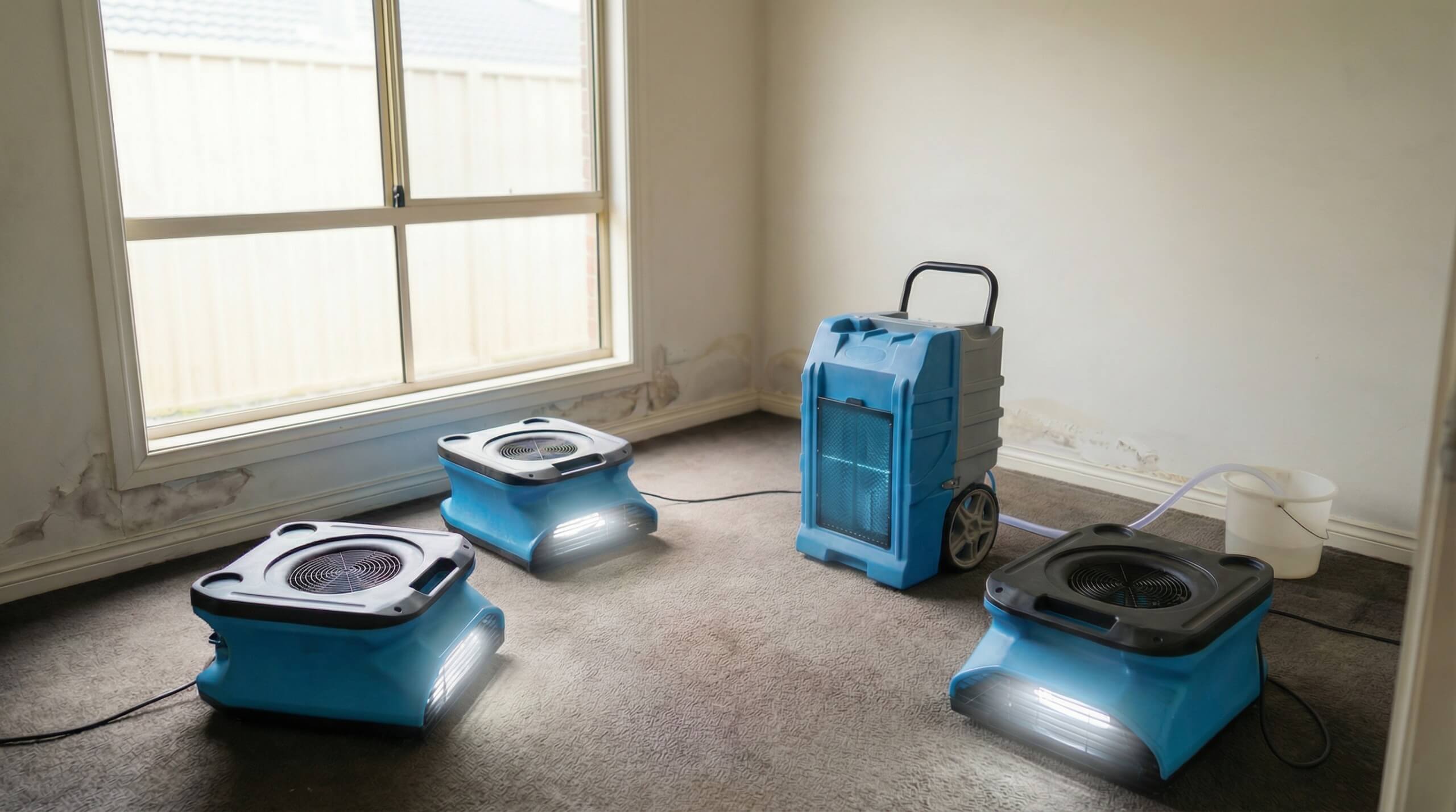
A dehumidifier pulls moisture out of the air. It does this by drawing in humid air, passing it over a set of cold coils that cause moisture to condense into water droplets, and then returning drier air back into the room. That collected water either drips into a tank (which you empty) or drains continuously through a hose.
In Brisbane and greater South East Queensland, refrigerant (also called compressor) dehumidifiers are the most practical option for water damage restoration. Brisbane’s subtropical climate, with warm temperatures and high seasonal humidity, is exactly the environment where refrigerant units perform at their best. They’re efficient in warm, humid conditions, which is precisely what you’re dealing with after a flood in Queensland.
Desiccant dehumidifiers, which use a rotating moisture-absorbing wheel rather than cold coils, are better suited to cold climates or situations requiring very low humidity levels. For Brisbane flood restoration, refrigerant units are the standard choice.
Why This Matters After a Flood
After a water event, humidity inside your property can spike to 80, 90, even close to 100 percent relative humidity (RH). Every saturated surface, from your carpets to your wall cavities to your timber subfloor, is releasing moisture into the air. If that moisture stays in the air, it gets reabsorbed right back into your building materials. A dehumidifier breaks this cycle by continuously pulling the moisture out.
Without one running, your property doesn’t dry. It just sits wet.
Dehumidifier vs Air Purifier: They’re Not the Same Thing
This is a common point of confusion, so let’s clear it up quickly.
A dehumidifier removes moisture from the air. That’s its job. It reduces relative humidity to stop mould growth, structural deterioration, and secondary water damage.
An air purifier filters airborne particles, such as dust, pollen, pet dander, mould spores, and smoke. It cleans what’s in the air, but it does not remove moisture.
After a flood, you need a dehumidifier, not an air purifier. An air purifier does nothing to lower humidity or dry out your structure. While an air purifier can complement a dehumidifier once the moisture source is under control (particularly useful for capturing airborne mould spores after a flood), it is not a substitute and should never be used instead of one.
If someone tells you to run an air purifier after water damage, get a second opinion.
The Real Difference Between Residential and Commercial Dehumidifiers
This is where most property owners get it wrong, and it’s an expensive mistake.
Residential Units (What’s on the Shelf at Bunnings)
A domestic dehumidifier from a hardware or appliance store is designed for background moisture control. Think a musty laundry room, condensation on windows, or a slightly damp bathroom. These units typically extract between 10 and 30 litres per day under normal household conditions.
Here’s the critical limitation: residential units are rated under controlled test conditions, not real-world flood conditions. When ambient humidity is extremely high, as it always is after a flood, their extraction rates drop significantly. Many residential units will also slow down or stop efficiently extracting once humidity drops below around 50 to 60 percent RH. After a flood, you need equipment that keeps working well below that threshold.
They also collect water in a small tank, which needs to be emptied every few hours. When a unit is extracting heavily, that tank fills fast. If you’re asleep or away from the property, the tank fills, the unit shuts off, and your walls keep absorbing moisture.
Commercial and Industrial Grade Units
A commercial dehumidifier is built for sustained, heavy-duty moisture removal under demanding conditions. The key differences are:
Extraction capacity. Commercial units extract significantly more moisture per day. Our hire fleet at Flood Services Brisbane ranges from 45 litres per day for smaller residential jobs right up to 120 litres per day for major commercial water damage events. That’s not a small difference, that’s the difference between drying your property in three to five days versus watching mould grow over a week and a half.
Continuous drainage. Commercial units have built-in condensate pumps or drain hose connections, which means they run continuously without someone manually emptying a tank. You set them up and they do the job unattended, 24 hours a day.
LGR technology. The gold standard for flood restoration is an LGR (Low Grain Refrigerant) dehumidifier. Standard commercial units slow down as the air gets drier. An LGR unit keeps extracting moisture efficiently even when relative humidity drops below 40 percent, all the way through to the final stages of structural drying. This matters enormously because the last 10 to 15 percent of moisture trapped inside timber framing and plasterboard is the hardest to remove, and it’s where mould takes hold if you stop too soon.
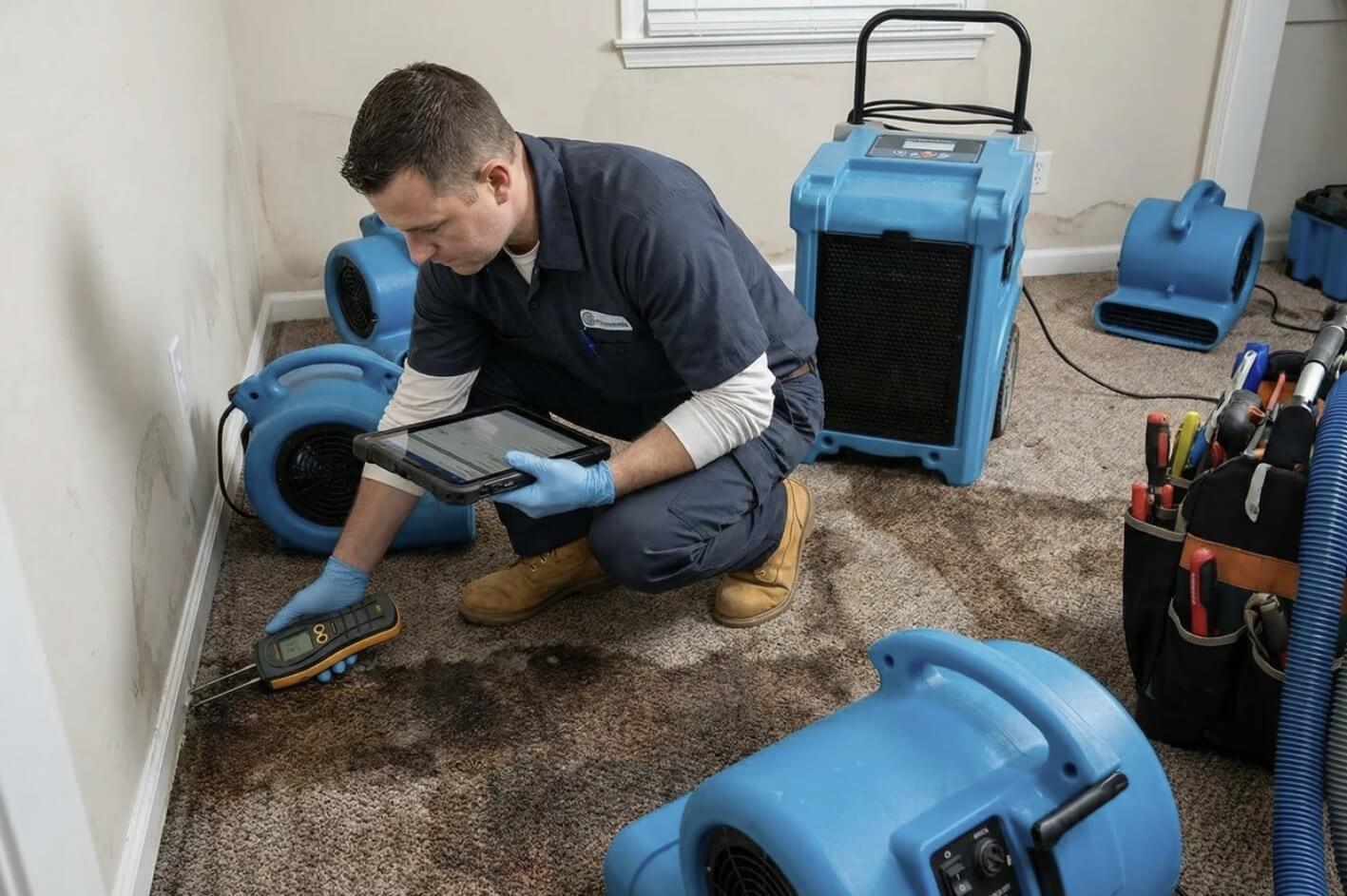
Insurance compliance. If you’re making an insurance claim, this is critical. Standard residential units and even some basic commercial units do not produce the certified drying documentation that Australian insurers require. Our LGR fleet meets IICRC (Institute of Inspection, Cleaning and Restoration Certification) standards, which means the drying logs produced during your job are accepted by all major Australian insurers. A residential Bunnings unit will never produce that paperwork.
How to Choose the Right Dehumidifier Size for Your Space
Getting the dehumidifier size for room right is not guesswork. Too small and the job takes far too long. Too long means mould.
The sizing principle we use in restoration work is based on the affected area, the severity of the water event, and the building materials involved.
As a general guide:
- Single room (up to 30sqm), minor water damage: A 45L/day unit is the starting point.
- Apartment or retail space (30 to 80sqm): A 70L/day mid-range commercial unit is appropriate.
- Large residential floor or significant water damage (80 to 150sqm): An industrial LGR unit at 100L/day.
- Major flooding, large commercial spaces (150 to 200sqm and above): 120L/day units, and usually multiple of them running simultaneously.
These are starting guides only. The actual number depends on how much water entered the property, what category of water it is (clean, grey, or black), which materials were affected, and the ambient humidity conditions at the time.
For reference: a single room with severe flooding requires between one and two commercial dehumidifiers paired with four to five air movers working together. A whole house with moderate flooding across 150 square metres needs eight to ten commercial dehumidifiers and 25 to 30 air movers running in combination.
Why Air Movers Matter Too
A dehumidifier works by pulling moisture out of the air. But the moisture in your carpet, your walls, and your subfloor first needs to evaporate into the air before the dehumidifier can remove it. That’s what high-velocity air movers do. They create airflow across wet surfaces that dramatically accelerates evaporation.
Air movers and commercial dehumidifiers work together as a system. Using one without the other is like trying to bail out a boat with a bucket while leaving the plug out. You need both.
Why Hire Industrial Equipment Instead of Buying It?
For a property owner dealing with a one-off flood event, buying commercial dehumidification equipment makes no financial sense whatsoever.
A commercial LGR dehumidifier costs several thousand dollars to purchase. After your property is dry, you have no ongoing use for it. It sits in your garage.
Commercial dehumidifier rental is the practical answer. You get access to the right equipment, sized correctly for your job, for the days or weeks you actually need it, and then it gets collected when the work is done.
There are other practical reasons to hire rather than buy:
Correct sizing without guesswork. When you hire from an experienced flood restoration team, we help you determine exactly what you need. You’re not guessing at capacity or positioning.
Paired equipment. Our drying equipment hire packages include matched combinations of commercial dehumidifiers, high-velocity air movers, carpet and floor dryers, and moisture meters. You get the full system, not just one piece of it.
Continuous drainage. Our commercial units have automatic condensate pumps, so they run unattended while you sleep or go to work.
IICRC-compliant drying logs. If you’re claiming on insurance, you need certified moisture readings and drying documentation. Equipment hire alone doesn’t produce this. For jobs requiring insurance documentation, our team provides certified monitoring visits alongside the hire equipment.
Availability when you need it. After a major storm event in Brisbane, commercial drying equipment gets hired out quickly. Having a relationship with a local restoration team means you’re not scrambling.
When to Call a Professional Instead of Going DIY
Equipment hire works well in the right situations. Here’s an honest breakdown.
DIY equipment hire is appropriate for:
- Small spills or condensation in a single room with clean water and no structural involvement
- Minor water events where you can confirm the subfloor is not affected
You need professional restoration for:
- Any flooding from stormwater or an overflowing drain (grey water contamination risk)
- Any flooding involving sewage backup or black water
- Flooding that has been sitting for more than 12 to 24 hours
- Any situation where you can see or smell mould
- Any job requiring insurance claim documentation and certified drying logs
- Flooding that has reached inside walls, subfloors, or ceiling cavities
If you’re not sure which category you’re in, call before committing to a DIY approach. We will tell you honestly whether hire equipment alone is sufficient or whether you need our full restoration team on site. If DIY is the right call for your situation, we’ll say so.
Dehumidifier for Water Damage: A Quick Checklist for Brisbane Property Owners
Here are the key things to check and act on quickly after a water event:
- Extract standing water first. A dehumidifier cannot pump out standing water. Get the bulk of it removed before running drying equipment.
- Close windows and doors. You’re trying to dry a contained space. Letting in humid Brisbane air works against you.
- Start drying within 24 to 48 hours. Mould can begin to develop on wet building materials within 24 to 48 hours in warm Queensland conditions. Speed matters.
- Use the right capacity. Don’t underestimate the job. A unit that’s too small just slows the process and extends your risk window.
- Run equipment continuously. Commercial dehumidifiers and air movers need to run 24 hours a day, not just during the day. Moisture doesn’t take breaks.
- Monitor with a moisture meter. Don’t stop drying based on how things look or feel. Stop when moisture meter readings in walls and floors return to safe levels.
- Document everything. Photograph damage before, during, and after. Keep records for your insurer.
How We Can Help
At Flood Services Brisbane, we’ve been handling flood and water damage restoration across Brisbane and greater South East Queensland for years. We know how Brisbane properties are built, how Queensland’s subtropical humidity behaves after a water event, and exactly what equipment it takes to dry a structure properly.
Our team offers both full flood restoration services and commercial dehumidifier hire in Brisbane, so you can choose the level of support that fits your situation.
For hire, our fleet includes LGR commercial dehumidifiers from 45L/day through to 120L/day, high-velocity air movers, carpet and floor dryers, and moisture meters. We offer same-day delivery across all Brisbane suburbs when you order before 2pm, and 24/7 emergency delivery for urgent situations.
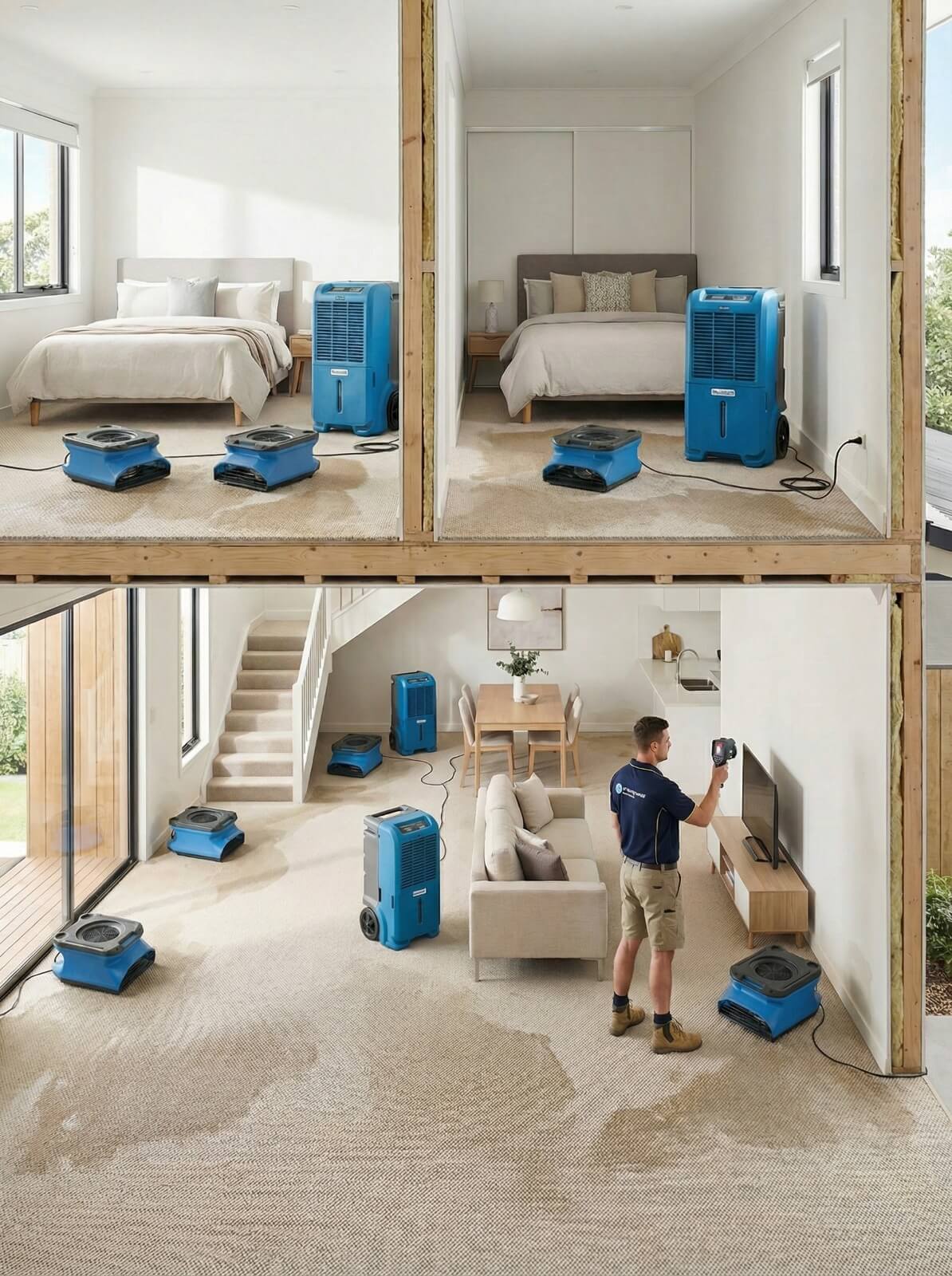
If you want the full restoration team, we’re available 24 hours a day, seven days a week, with on-site response within 60 minutes. We handle everything from the initial damage assessment and water extraction through to structural drying, mould remediation, and insurance documentation.
Call us on 07 3185 0987 or submit an enquiry online. Whether you need one dehumidifier for tomorrow or an emergency team tonight, we’re ready.
Flood Services Brisbane. Available 24/7. On-site within 60 minutes. Fully certified and insured.